


Autotransfusion Devices Market Growth, Share, Trend and Forecast Analysis By Fact.MR
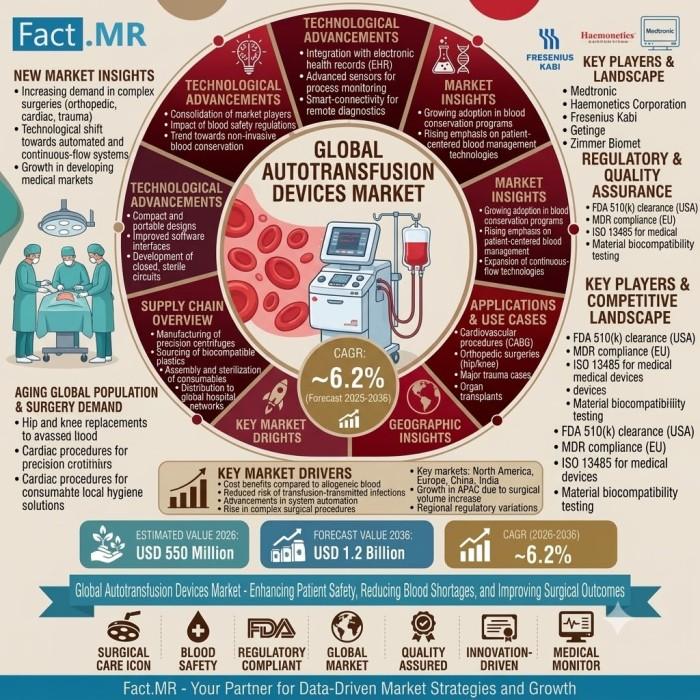
Rockville, Maryland – October 14, 2026 — The global autotransfusion devices market is projected to grow from USD 584.1 million in 2026 to USD 1.066 billion by 2036, registering a compound annual growth rate (CAGR) of 6.2% over the forecast period. According to the latest market report published by Fact.MR, demand is supported by increasing cardiovascular and orthopedic surgery volumes, wider adoption of patient blood management protocols, and growing attention to transfusion safety. India is expected to record the fastest growth among the countries analyzed, with a projected CAGR of 7.2% through 2036.
Get detailed market forecasts, competitive benchmarking, and pricing trends:
KEY MARKET TAKEAWAYS
- Market Valuation: USD 584.1 million in 2026, projected to reach USD 1.066 billion by 2036.
- Growth Rate: Expanding at a CAGR of 6.2% from 2026 to 2036.
- Leading Product Segment: Intraoperative autotransfusion systems are projected to account for 48.0% of product-segment revenue in 2026.
- Leading Application: Cardiovascular surgery is expected to represent 46.0% of application demand in 2026.
- Leading End Use: Hospitals are projected to account for 62.0% of end-use demand in 2026.
- Fastest-Growing Country: India is forecast to register a CAGR of 7.2% through 2036.
- Core Growth Driver: Growing surgical volumes and institutional adoption of blood conservation and patient blood management protocols.
INDUSTRY SHIFTS & MARKET DYNAMICS
Autotransfusion devices recover and process a patient's own blood for reinfusion during or after surgery. These systems are used in procedures where significant blood loss may occur, including cardiovascular operations, orthopedic surgery, trauma care, and organ transplantation. As hospitals strengthen patient blood management practices, autotransfusion technology is gaining attention as a way to support blood conservation and reduce reliance on donor blood in appropriate clinical settings. Growing surgical capacity and the need for effective blood management are creating opportunities for manufacturers of intraoperative and postoperative systems.
Intraoperative autotransfusion systems are expected to remain the leading product category, accounting for 48.0% of the product segment in 2026. Cardiovascular surgery is projected to represent 46.0% of application demand, reflecting the role of blood recovery in procedures that can involve substantial blood loss. Hospitals are expected to account for 62.0% of end-use demand, as major surgical procedures and specialized operating facilities are concentrated in hospital settings. Automated processing, blood washing capabilities, and integration with surgical workflows are important considerations for institutions evaluating equipment procurement.
However, high capital costs can restrict adoption among smaller hospitals and ambulatory surgical centers. Operating these systems also requires appropriate clinical training and procedural expertise, which may limit utilization at facilities without dedicated perfusion or blood management support. Autotransfusion is not suitable for every surgical procedure, particularly those with limited anticipated blood loss. Manufacturers therefore have opportunities to develop compact systems, improve automation, and simplify workflows for eligible procedures while meeting clinical and regulatory requirements.
REGIONAL MARKET SUMMARY
Fact.MR projects the following country-level growth rates for the 2026–2036 forecast period.
|
Country |
Forecast CAGR |
Market Outlook |
|
India |
7.2% |
Expanding surgical capacity and hospital infrastructure |
|
China |
7.1% |
Rising surgical volumes and hospital equipment modernization |
|
United Arab Emirates |
6.3% |
Healthcare infrastructure development |
|
Brazil |
6.0% |
Growing surgical capacity and blood conservation awareness |
|
United States |
5.8% |
Established blood management programs and hospital procurement |
India is expected to lead country-level growth, supported by expanding cardiovascular and orthopedic surgical capacity and increasing adoption of blood conservation protocols. China follows closely, with growth supported by rising procedure volumes and hospital equipment modernization. The United Arab Emirates and Brazil offer additional opportunities as healthcare facilities expand their capabilities, while the United States benefits from established blood management programs and institutional procurement practices.
ANALYST INSIGHTS
“The autotransfusion devices market is a niche but structurally important segment of surgical blood management. Growth is linked to surgical volume expansion in cardiovascular and orthopedic specialties, blood conservation program adoption, and transfusion safety awareness,” stated Shambhu Nath Jha, Principal Consultant at Fact.MR. “The competitive advantage lies in device automation, processing efficiency, and integration with hospital blood management workflows. Emerging markets are providing the strongest growth as new hospital facilities adopt blood salvage capability alongside operating theater expansion.”
The market outlook emphasizes the importance of equipment reliability, processing efficiency, and clinical workflow compatibility. Manufacturers can pursue growth by strengthening relationships with hospitals, improving system usability, and developing solutions suited to different surgical settings. Procurement teams are likely to continue assessing equipment costs, clinical requirements, training needs, and service support when evaluating autotransfusion technologies.
Unlock 360° insights for strategic decision making and investment planning:
FREQUENTLY ASKED QUESTIONS
Q: What is the projected size of the autotransfusion devices market by 2036?
A: The global market is estimated at USD 584.1 million in 2026 and is projected to reach USD 1,065.9 million by 2036, growing at a CAGR of 6.2%.
Q: Which product segment holds the leading market share?
A: Intraoperative autotransfusion systems are projected to account for 48.0% of the product segment in 2026.
Q: Which application segment leads the market?
A: Cardiovascular surgery is expected to represent 46.0% of application demand in 2026.
Q: Which country is expected to exhibit the highest growth rate?
A: India is projected to record the highest growth among the countries listed, with a CAGR of 7.2% from 2026 to 2036.
Q: What factors are driving demand for autotransfusion devices?
A: Increasing surgical volumes, blood conservation initiatives, patient blood management protocols, and attention to transfusion safety are key demand drivers.
Q: What challenges could constrain market growth?
A: High equipment costs, training requirements, procedural complexity, and limited applicability in surgeries involving low expected blood loss may restrict adoption.
Q: Which end-use segment dominates the market?
A: Hospitals are projected to account for 62.0% of end-use demand in 2026, reflecting their concentration of major surgical procedures and specialized facilities.
Explore More Related Studies Published by Fact.MR Research
Familial Hypercholesterolemia Treatment Market
About Fact.MR
Fact.MR is a market research and consulting firm providing syndicated research, customized research, investment research, and market intelligence across a broad range of industries. Its research coverage includes food and beverage, healthcare, pharmaceuticals, biotechnology, consumer products, chemicals and materials, technology, industrial goods, and packaging.
Fact.MR provides market intelligence designed to help organizations understand market dynamics, emerging opportunities, competitive developments, and changing industry requirements.
Media Contact
Fact.MR
Email: sales@factmr.com
Phone: +1 (628) 251-1583
Website: www.factmr.com

 English
 Arabic
 French
 Spanish
 Portuguese
 Deutsch
 Dutch
Dutch
 Italiano
 Russian
 Romaian
 Portuguese (Brazil)
 Greek
Greek
