


Pemphigus Vulgaris Treatment Market Growth, Share, Trend and Forecast Analysis By Fact.MR
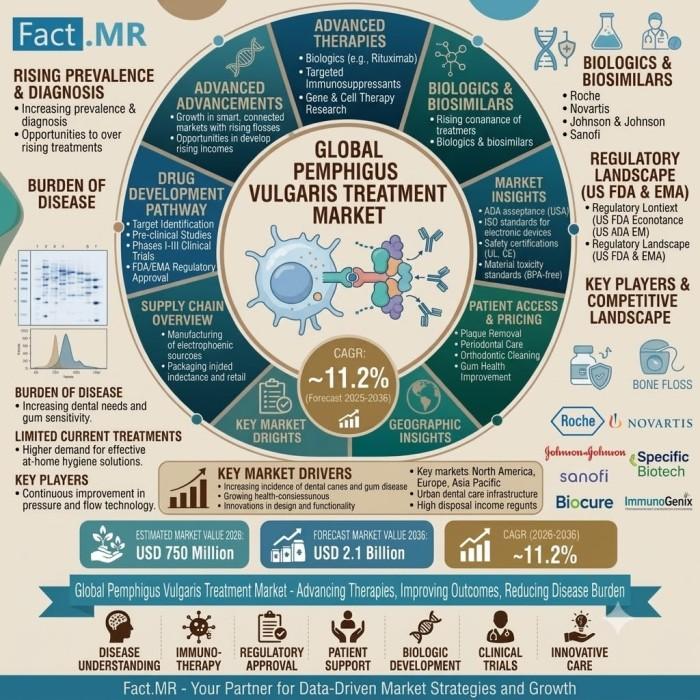
Rockville, Maryland – October 14, 2026 — The global pemphigus vulgaris treatment market is projected to grow from USD 563.2 million in 2026 to USD 1.25 billion by 2036, registering a compound annual growth rate (CAGR) of 8.3% over the forecast period. According to Fact.MR, demand is being supported by improved diagnostic awareness, wider access to targeted biologic therapies, and changes in clinical treatment approaches for this rare autoimmune blistering disease.
The market was valued at approximately USD 520.0 million in 2025. Fact.MR estimates that the market will create an absolute dollar opportunity of USD 686.9 million between 2026 and 2036 as healthcare providers adopt treatment strategies that combine disease control with efforts to reduce long-term corticosteroid exposure.
Get detailed market forecasts, competitive benchmarking, and pricing trends:
KEY MARKET TAKEAWAYS
- Market Valuation: USD 563.2 million in 2026, projected to reach USD 1.25 billion by 2036.
- Growth Rate: Expanding at an 8.3% CAGR from 2026 to 2036.
- Leading Product Segment: Corticosteroids, accounting for 48% of the product segment in 2026.
- Leading Application: Mucocutaneous pemphigus, representing 52% of the application segment in 2026.
- Leading End-User Segment: Hospitals, accounting for 60% of end-use demand in 2026.
- Fastest-Growing Country: India, with a projected CAGR of 9.5% through 2036.
- Core Growth Driver: Increasing disease recognition and broader use of targeted biologic therapies, including rituximab.
INDUSTRY SHIFTS & MARKET DYNAMICS
Pemphigus vulgaris causes painful blisters and erosions affecting the skin and mucous membranes, often requiring prolonged treatment and specialist supervision. Greater diagnostic awareness among dermatologists and improved testing for disease-associated antibodies are helping identify patients who need treatment. Corticosteroids remain an important treatment option for controlling active disease, while immunosuppressive medicines such as azathioprine and mycophenolate mofetil can help manage disease activity and reduce reliance on long-term steroid treatment. Fact.MR estimates that corticosteroids will account for 48% of the product segment in 2026.
Biologic therapies are reshaping treatment strategies, particularly for patients with moderate-to-severe disease. Rituximab, which targets B cells involved in antibody production, has become an important option in treatment protocols. Its expanding clinical use is shifting part of the market toward targeted therapies with higher per-patient treatment costs. Intravenous immunoglobulin therapy also serves selected patients, including those with difficult-to-control disease. The emergence of biosimilar products may improve affordability and broaden access in markets where treatment costs remain a barrier.
Despite these developments, the market faces challenges related to the high cost of advanced therapies, differences in healthcare access, and regulatory timelines for new treatments. Diagnosis and treatment can be delayed when symptoms are initially mistaken for other skin or oral conditions. Access to specialist dermatology services and biologic medicines also varies between countries. Pharmaceutical companies that support clinical education, evidence-based prescribing, and affordable access strategies may be better positioned to serve this specialized market.
REGIONAL MARKET SUMMARY
Fact.MR projects the following country-level growth rates for the 2026–2036 period:
|
Country |
CAGR (2026–2036) |
Market Outlook |
|
India |
9.5% |
Expanding treatment access and diagnostic awareness |
|
China |
9.2% |
Improving diagnostic capacity and biologic access |
|
Japan |
8.8% |
Continued demand for specialist autoimmune care |
|
United States |
7.9% |
Established treatment infrastructure and biologic adoption |
|
Germany |
7.4% |
Specialist care and structured treatment pathways |
India is projected to record the fastest growth among the highlighted markets, at a CAGR of 9.5%, followed by China at 9.2%. Japan is expected to expand at 8.8%, while the United States and Germany are forecast to register CAGRs of 7.9% and 7.4%, respectively. These forecasts reflect differences in treatment access, healthcare infrastructure, diagnostic capabilities, and adoption of newer therapies.
ANALYST INSIGHTS
“The pemphigus vulgaris treatment market is being transformed by the shift from corticosteroid-dependent management to rituximab-based therapy. Clinical evidence establishing rituximab as first-line treatment for moderate-to-severe disease is changing prescribing patterns from steroid-centric suppression toward targeted B-cell depletion that achieves deeper and more durable remissions. Companies with established anti-CD20 biologic platforms and dermatology specialist relationships are capturing a growing share of the treatment value. The development of neonatal Fc receptor inhibitors and other targeted biologics is expected to further expand the treatment option portfolio,” stated Shambhu Nath Jha, Principal Consultant at Fact.MR.
Unlock 360° insights for strategic decision making and investment planning:
FREQUENTLY ASKED QUESTIONS
Q: What is the projected size of the pemphigus vulgaris treatment market by 2036?
A: The market is projected to reach USD 1.25 billion by 2036, up from USD 563.2 million in 2026, representing an 8.3% CAGR.
Q: Which product segment holds the largest market share?
A: Corticosteroids lead the product segment, accounting for 48% of the market in 2026.
Q: Which application segment accounts for the largest share?
A: Mucocutaneous pemphigus is projected to account for 52% of the application segment in 2026.
Q: Which country is expected to record the highest growth rate?
A: India is forecast to lead the highlighted country markets with a 9.5% CAGR between 2026 and 2036.
Q: What factors are driving market growth?
A: Improved diagnostic awareness, increasing use of rituximab and other biologic therapies, evolving clinical guidelines, and broader treatment access are key growth drivers.
Q: What challenges affect the pemphigus vulgaris treatment market?
A: High treatment costs, unequal access to specialist care, and regulatory delays for new therapies can restrict market expansion.
Q: Which companies operate in this market?
A: Key companies identified by Fact.MR include Genentech, Inc., Pfizer Inc., Amgen Inc., Celltrion Inc., Zenyaku Kogyo Co., Ltd., and Scinai Immunotherapeutics Ltd.
Explore More Related Studies Published by Fact.MR Research
Familial Hypercholesterolemia Treatment Market
About Fact.MR
Fact.MR is a market research and consulting firm providing syndicated research, customized research, investment research, and market intelligence across a broad range of industries. Its research coverage includes food and beverage, healthcare, pharmaceuticals, biotechnology, consumer products, chemicals and materials, technology, industrial goods, and packaging.
Fact.MR provides market intelligence designed to help organizations understand market dynamics, emerging opportunities, competitive developments, and changing industry requirements.
Media Contact
Fact.MR
Email: sales@factmr.com
Phone: +1 (628) 251-1583
Website: www.factmr.com

 English
 Arabic
 French
 Spanish
 Portuguese
 Deutsch
 Turkish
 Dutch
Dutch
 Italiano
 Russian
 Romaian
 Greek
Greek
