


What role does air quality play in Modular Ophthalmic Operation Theatre?
INTRODUCTION
Air quality plays a critical role in a Modular Ophthalmic Operation Theatre, helping support infection prevention, a controlled surgical environment, and reliable operating conditions. Ophthalmic procedures require precision, and airborne particles, microorganisms, and contaminants must be managed through appropriate ventilation, filtration, pressure control, and environmental monitoring. A well-designed modular operation theatre combines cleanable construction materials with a properly engineered heating, ventilation, and air-conditioning (HVAC) system to maintain suitable conditions for eye surgery.
Air quality is not determined by filtration alone. It also depends on airflow distribution, air changes, room pressure, equipment placement, door-opening frequency, maintenance, and staff practices. When these elements are planned together, a Modular Ophthalmic Operation Theatre can support a cleaner and more controlled environment for patients, surgeons, and clinical teams.
Understanding Air Quality in an Ophthalmic Operation Theatre
Air quality refers to the condition of the air within a room, including the presence of airborne particles, microorganisms, gases, and other contaminants. In an operating theatre, ventilation systems are designed to dilute or remove airborne contaminants, provide filtered air, maintain appropriate pressure relationships, and support thermal comfort.
Air quality management commonly involves:
-
Filtration of incoming and recirculated air
-
Controlled airflow distribution
-
Appropriate ventilation rates
-
Pressure relationships between connected spaces
-
Temperature and humidity regulation
-
Routine monitoring and maintenance
-
Procedures that minimize unnecessary contamination
The exact design parameters should be selected according to the intended clinical use, applicable regulations, and relevant healthcare engineering guidance. The US Centers for Disease Control and Prevention (CDC), for example, recommends positive-pressure ventilation for operating rooms relative to corridors and adjacent areas, along with appropriate ventilation and filtration measures. These recommendations should be interpreted alongside the requirements applicable to the facility’s location. <Cite refs={["turn794941search0","turn794941search1"]} />
1. Supporting Infection Prevention
One of the primary roles of air quality management is to help reduce airborne contamination in the surgical environment.
People continuously shed skin particles, and these particles can carry microorganisms. Movement, clothing, equipment, and door openings can also contribute to airborne particle levels. Appropriate ventilation and filtration help manage these contaminants, although they cannot eliminate every source of infection.
In a Modular Ophthalmic Operation Theatre, infection-prevention planning should include:
-
Suitable air filtration
-
Correct airflow direction
-
Appropriate room pressure
-
Hygienic wall, ceiling, and floor finishes
-
Effective cleaning procedures
-
Controlled movement of staff and equipment
-
Routine maintenance of ventilation components
The Indian National Guidelines for Infection Prevention and Control in Healthcare Facilities describe filtered air, pressure gradients, ventilation, and appropriate room finishes as important considerations in operating theatre design. <Cite refs={["turn794941search16","turn794941search17"]} />
Air quality should therefore be treated as one part of a wider infection-prevention strategy that also includes hand hygiene, sterilization, environmental cleaning, surgical protocols, and staff training.
2. The Importance of HEPA Filtration
High-Efficiency Particulate Air (HEPA) filters are used in many healthcare and cleanroom ventilation systems to remove airborne particles. When correctly selected, installed, and tested, they can help reduce the concentration of particles entering the operating environment.
A Modular Ophthalmic Operation Theatre may incorporate HEPA filtration within terminal filter units or other parts of its HVAC system, depending on the design.
Important considerations include:
-
Filter efficiency and suitability for the application
-
Correct filter housing and sealing
-
Prevention of air bypass around the filter
-
Adequate fan capacity to overcome filter resistance
-
Access for inspection and replacement
-
Filter integrity testing
-
Monitoring of pressure drop across filters
A filter’s performance depends on its installation and condition as well as its specified efficiency. Damaged seals, incorrect installation, or poor maintenance can compromise the intended filtration performance.
HEPA filtration also does not replace room ventilation, cleaning, pressure control, or other infection-prevention measures. The complete system must be designed and verified as a whole.
3. Maintaining Appropriate Airflow Patterns
Airflow distribution influences how clean, conditioned air moves through the operating theatre. Depending on the system design, air may be supplied through ceiling-mounted outlets or a dedicated unidirectional airflow arrangement.
A properly engineered system should consider:
-
Supply-air terminal locations
-
Return and exhaust air positions
-
Air velocity and distribution
-
Surgical lights and ceiling-mounted equipment
-
Operating tables and workstations
-
Potential obstructions to airflow
-
The relationship between clean and less-clean zones
Poorly positioned equipment can obstruct airflow or create areas where air movement differs from the intended pattern. Design teams should coordinate the ventilation layout with the surgical equipment plan before installation.
Laminar or unidirectional airflow may be appropriate for selected applications, but it should not automatically be assumed to be necessary or superior for every ophthalmic procedure. The system should be chosen based on clinical requirements, engineering design, and applicable guidance.
The World Health Organization’s guidance on operating theatre ventilation emphasizes that ventilation has several purposes, including controlling airborne particles, supporting thermal comfort, and maintaining appropriate pressure relationships. <Cite refs={["turn794941search15","turn794941search7"]} />
4. Controlling Room Pressure
Pressure control helps manage the movement of air between the operating theatre and adjacent spaces.
Operating rooms are commonly designed to maintain positive pressure relative to adjoining areas so that air tends to flow outward when doors or other openings allow movement. This can help limit the entry of less-filtered air from surrounding spaces.
A Modular Ophthalmic Operation Theatre may require coordinated pressure relationships between:
-
The operating room
-
Scrub and preparation areas
-
Clean corridors
-
Equipment or support rooms
-
Other connected clinical spaces
Pressure control depends on supply and exhaust airflow, room sealing, door conditions, and the operation of the HVAC system.
Differential pressure monitors can help staff and facility engineers identify deviations. Alarm limits and response procedures should be established according to the approved design.
Positive pressure alone does not guarantee a contaminant-free environment. Its effectiveness depends on appropriate filtration, ventilation, maintenance, and the way the space is operated.
5. Managing Temperature and Humidity
Temperature and humidity affect the comfort of patients and surgical teams, as well as the operating conditions of equipment and materials. Excessive humidity can contribute to condensation and may create conditions that encourage microbial growth on some surfaces. Very low humidity can cause discomfort and may increase static-related concerns in certain environments.
HVAC systems help maintain the specified temperature and humidity by regulating heating, cooling, ventilation, and moisture removal.
Key design considerations include:
-
Cooling and heating capacity
-
Humidity-control capability
-
Heat generated by surgical equipment
-
Outdoor climate and fresh-air requirements
-
Room occupancy
-
Sensor placement and calibration
-
Environmental monitoring and alarms
The appropriate temperature and humidity range should be determined from applicable standards, clinical requirements, and facility policies rather than adopting a universal setting for every operating theatre.
6. Reducing Airborne Particles During Surgery
Airborne particles can originate from people, clothing, equipment, packaging, and movement within the room. Ventilation and filtration help control airborne particle levels, while operational practices reduce the amount of contamination introduced.
A Modular Ophthalmic Operation Theatre should support practices such as:
-
Keeping doors closed except when necessary
-
Limiting unnecessary movement
-
Restricting entry to essential personnel
-
Using appropriate surgical clothing
-
Following cleaning and disinfection protocols
-
Avoiding unnecessary storage in the operating room
-
Keeping supply and return air pathways unobstructed
Frequent door opening can affect pressure relationships and airflow patterns. Staff workflow and equipment movement should therefore be considered during both design and daily operation.
The CDC recommends keeping operating-room doors closed except for the passage of patients, personnel, and equipment, and limiting entry to essential personnel. <Cite refs={["turn794941search0","turn794941search5"]} />
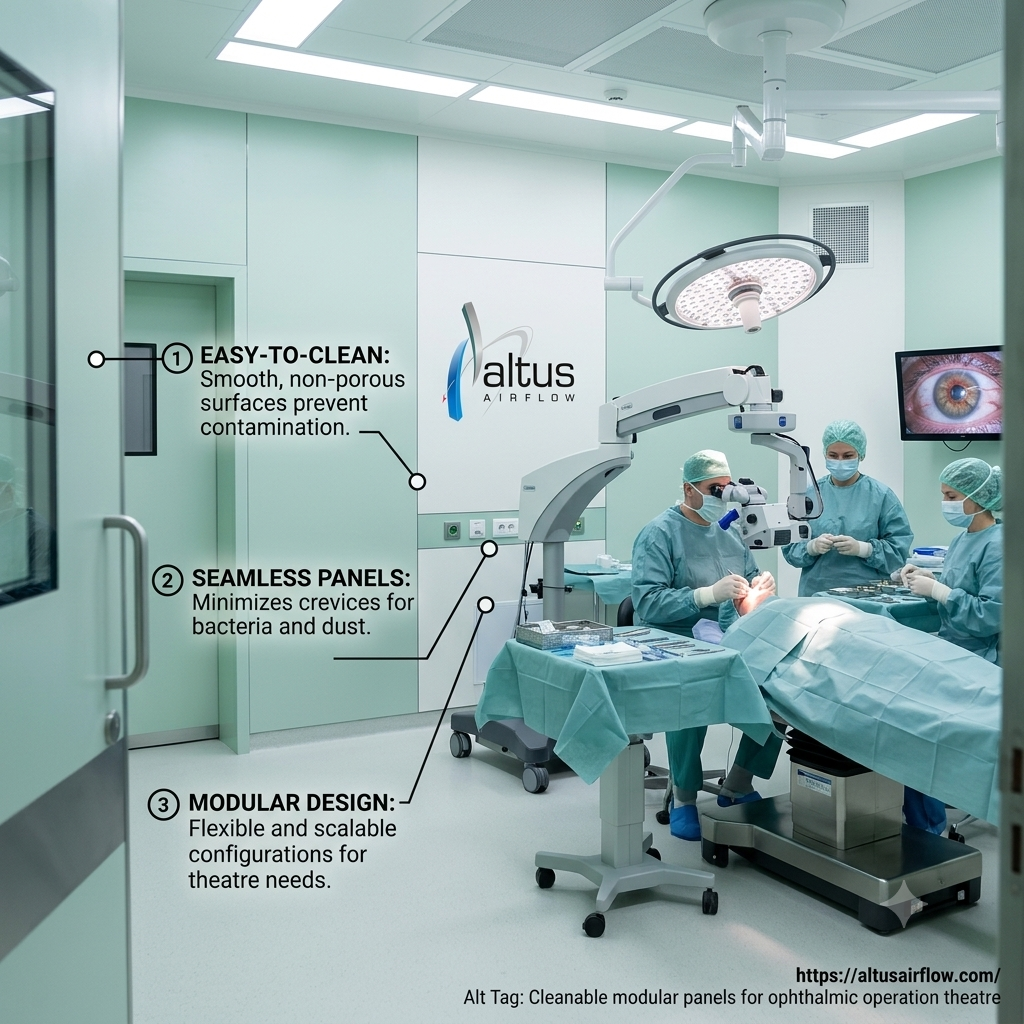
7. Cleanable Modular Construction Materials
Air quality is influenced not only by ventilation equipment but also by the materials used inside the operating theatre.
Smooth, non-porous, durable surfaces can support routine cleaning and help prevent the accumulation of dust and contaminants. Modular wall and ceiling systems should be designed with attention to joints, penetrations, service openings, and other details where dust or moisture could accumulate.
Material selection should consider:
-
Cleanability and resistance to approved disinfectants
-
Low particle-shedding characteristics
-
Suitable sealing of joints
-
Durability under routine cleaning
-
Resistance to moisture where required
-
Compatibility with the facility’s maintenance procedures
The design should also allow access to service components without unnecessary disturbance to clean areas. Construction work and commissioning activities must be planned carefully so that dust and debris are removed before clinical use.
8. Environmental Monitoring and Air-Quality Testing
Monitoring helps confirm whether the ventilation system is operating within its specified parameters. It can also identify changes that may require investigation or maintenance.
Depending on the design and risk assessment, testing and monitoring may include:
-
Airflow velocity and distribution measurements
-
Air changes per hour verification
-
Differential pressure checks
-
Temperature and humidity measurements
-
HEPA filter integrity testing
-
Airborne particle counting
-
HVAC functional testing
-
Review of alarms and monitoring records
The testing plan should specify the methods, acceptance criteria, locations, and responsible personnel. Testing should be carried out after installation and repeated when required by the maintenance plan, applicable requirements, or significant system changes.
Air sampling methods should be selected carefully. Particle testing and filter integrity testing measure different aspects of performance, and neither should be treated as a complete substitute for the other.
Documented commissioning provides evidence that the installed system meets the agreed engineering specifications. It also creates a baseline for future maintenance and performance comparisons.
9. Preventive Maintenance of Air-Quality Systems
Even a well-designed system can lose performance if it is not maintained. Filters can become loaded, sensors can drift, fans can deteriorate, and controls can develop faults.
A preventive maintenance programme for a Modular Ophthalmic Operation Theatre may include:
-
Inspection and replacement of filters
-
Checking fan and motor performance
-
Reviewing filter pressure-drop readings
-
Calibrating sensors
-
Verifying pressure-monitoring systems
-
Inspecting air outlets and return grilles
-
Checking HVAC control sequences
-
Reviewing environmental trends
-
Maintaining records of servicing and repairs
Maintenance intervals should follow equipment manufacturers’ instructions, the facility’s risk assessment, and applicable requirements.
Staff should also know what to do if environmental conditions fall outside approved limits. Clear escalation procedures can help the facility respond promptly and determine whether clinical activity should be paused.
10. How Air Quality Supports Surgical Workflow
A well-planned air-quality system can support a more predictable operating environment. When temperature, humidity, filtration, and pressure are properly controlled, the surgical team can work within the environmental conditions specified for the facility.
Good planning can also reduce operational problems caused by poorly placed equipment, difficult-to-access filters, inadequate monitoring, or ventilation components that are challenging to maintain.
Air-quality engineering should therefore be coordinated with:
-
Surgical equipment layout
-
Lighting and ceiling services
-
Staff and patient movement
-
Cleaning procedures
-
Storage and supply locations
-
Maintenance access
-
Emergency and backup arrangements
The best results come from combining engineering controls with consistent clinical procedures and trained personnel.
11. Choosing the Right Modular OT Provider
When selecting a provider, hospitals should assess its ability to design, install, test, and maintain the complete environmental-control system.
Consider the following criteria:
Healthcare experience: Review experience with operating theatres and other controlled healthcare environments.
HVAC expertise: Confirm the provider can explain ventilation calculations, filtration, pressure control, temperature, and humidity requirements.
Design coordination: Ensure the airflow layout is coordinated with surgical lights, microscopes, equipment, and ceiling services.
Testing and commissioning: Request a clear list of tests, acceptance criteria, and documentation.
Material quality: Check cleanability, durability, and suitability of modular panels and finishes.
Maintenance support: Confirm filter replacement, servicing, calibration, and troubleshooting arrangements.
Documentation: Request equipment specifications, operating manuals, commissioning reports, and maintenance schedules.
A detailed technical proposal makes it easier to compare providers based on performance and long-term reliability rather than initial price alone.
Conclusion
Air quality is a fundamental part of a Modular Ophthalmic Operation Theatre, supporting airborne-contamination control, appropriate ventilation, pressure management, and suitable environmental conditions. HEPA filtration, well-designed airflow, cleanable materials, monitoring, commissioning, and preventive maintenance all contribute to the performance of the operating environment. These measures must work together with clinical infection-prevention practices; no single filtration or airflow system can guarantee the elimination of infection risk. For hospitals planning modular surgical infrastructure, Altus Airflow can be considered for modular OT and cleanroom engineering solutions tailored to healthcare requirements.
Frequently Asked Questions
1. Why is air quality important in a Modular Ophthalmic Operation Theatre?
Air quality in a Modular Ophthalmic Operation Theatre helps manage airborne particles and contaminants, supports appropriate ventilation and pressure control, and contributes to a controlled environment for ophthalmic procedures.
2. How does HEPA filtration improve a Modular Ophthalmic Operation Theatre?
HEPA filtration in a Modular Ophthalmic Operation Theatre helps remove airborne particles when filters are correctly selected, installed, tested, and maintained. It works alongside ventilation, cleaning, and other infection-prevention measures.
3. Does a Modular Ophthalmic Operation Theatre require laminar airflow?
A Modular Ophthalmic Operation Theatre may use unidirectional or laminar airflow where the clinical and engineering requirements justify it. The airflow system should be selected according to the intended procedures, applicable guidance, and validated design.
4. How is air quality tested in a Modular Ophthalmic Operation Theatre?
Air quality in a Modular Ophthalmic Operation Theatre may be evaluated through airflow measurements, pressure checks, HEPA filter integrity testing, temperature and humidity measurements, and particle-count testing, depending on the approved testing plan.
5. How does maintenance affect air quality in a Modular Ophthalmic Operation Theatre?
Regular maintenance helps a Modular Ophthalmic Operation Theatre maintain ventilation and filtration performance through filter replacement, fan inspections, sensor calibration, pressure checks, and HVAC servicing.
Read Our Previous Blog------>How does Laminar Airflow System Manufacturers help maintain stable temperature and humidity levels?

 English
 Arabic
 French
 Spanish
 Portuguese
 Turkish
 Dutch
Dutch
 Italiano
 Russian
 Romaian
 Portuguese (Brazil)
 Greek
Greek
