


Floor Finish and Polish Systems Market Set to Reach USD 3.8 Billion by 2036, China Leads at 5.2% CAGR
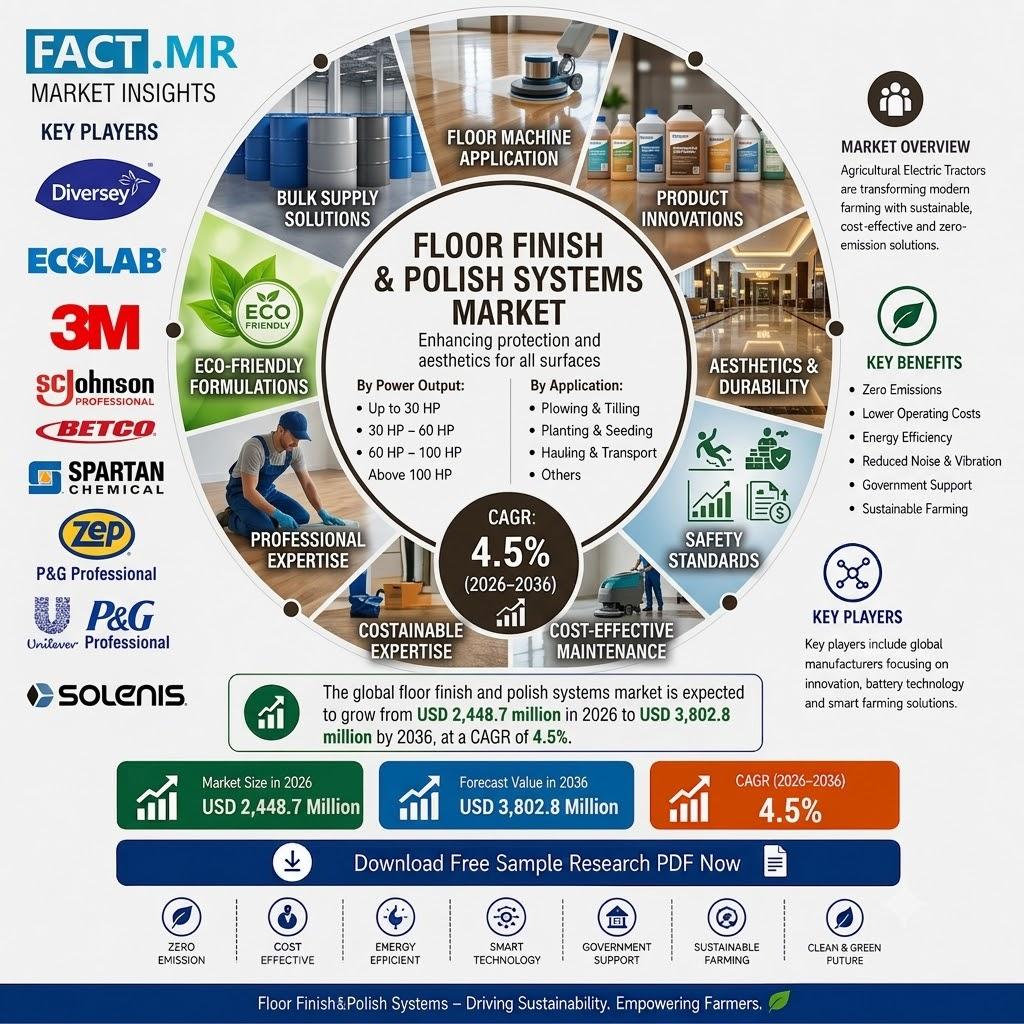
The global floor finish and polish systems market is projected to increase from USD 2.45 billion in 2026 to USD 3.80 billion by 2036, expanding at a compound annual growth rate (CAGR) of 4.5%, according to Fact.MR. Demand is being shaped by commercial facility maintenance requirements, the need for longer-lasting floor protection, and growing interest in formulations that reduce environmental impact. The market is expected to add approximately USD 1.35 billion in value over the forecast period.
Floor finish and polish systems protect flooring surfaces while helping facilities maintain appearance, durability, and cleaning efficiency. These products serve commercial buildings, educational institutions, healthcare facilities, and industrial environments. As facility operators look to reduce maintenance frequency and labor requirements, purchasing decisions increasingly consider coating durability, reapplication intervals, and compatibility with floor-cleaning equipment.
Get detailed market forecasts, competitive benchmarking, and pricing trends: https://www.factmr.com/connectus/sample?flag=S&rep_id=14088
High-Gloss Finishes Maintain a Leading Position
High-gloss finishes are projected to account for 38.0% of the market in 2026, making them the leading finish type, according to Fact.MR. These finishes are used in retail stores, airports, hospitals, and corporate buildings where floor appearance and light reflectivity influence facility presentation.
High-gloss surfaces can help create a brighter appearance in large indoor spaces. They also make visible wear and soiling easier to identify during routine inspections. For facility managers, these characteristics support planned maintenance schedules and consistent presentation in high-traffic environments.
High-durability and high-solids finishes offer another option for facilities seeking extended wear and fewer recoating cycles. Matte and satin finishes serve environments where lower reflectivity or a different visual appearance is preferred. Product selection depends on floor substrate, traffic levels, cleaning practices, and the performance requirements of each site.
Finish and Polish Coatings Drive System Component Demand
Finish and polish coatings are forecast to represent 52.0% of system component demand in 2026. These coatings form the primary protective layer on treated floors and influence gloss retention, resistance to abrasion, and overall service life.
Commercial and institutional facilities frequently reapply coatings to restore appearance and protect underlying flooring. This recurring requirement supports product demand beyond new construction and initial floor installation. Sealers and primers prepare surfaces for subsequent treatments, while maintenance sprays and burnishing aids help preserve the finish between applications.
Suppliers that can demonstrate consistent performance and compatibility with different floor substrates may be better positioned to serve large facility-management contracts. Ease of application and the ability to reduce downtime also matter in buildings that cannot readily interrupt daily operations.
Lower-Emission Formulations and Automated Cleaning Influence Product Development
Environmental considerations are influencing product development across the floor care sector. Facility operators are evaluating formulations with reduced volatile organic compound (VOC) emissions and alternatives to certain fluorinated chemicals. These requirements are encouraging suppliers to review raw materials, formulation performance, and product compatibility with existing maintenance procedures.
The adoption of automated floor-cleaning equipment is another consideration. Facilities using autonomous scrubbers need surfaces that can withstand repeated cleaning cycles while maintaining suitable performance. Floor finish suppliers must account for wear resistance, cleaning-agent compatibility, and maintenance requirements when developing products for these settings.
Longer recoating intervals can reduce labor demands and the amount of product used over time. However, performance depends on the floor substrate, application conditions, traffic intensity, and cleaning regime. Facility managers therefore need to assess total maintenance costs rather than compare products solely by initial purchase price.
China and Brazil Lead Country Growth Forecasts
China is projected to record the fastest growth among the highlighted country markets, with a 5.2% CAGR through 2036. Expansion in commercial real estate, retail, hospitality, and public infrastructure supports demand for floor finishes that maintain appearance under frequent use. Domestic suppliers are also responding to demand for products with improved wear performance.
Brazil follows with a projected 5.0% CAGR, supported by commercial construction, urbanization, and refurbishment activity across retail and hospitality facilities. Durable finishes that reduce maintenance frequency can appeal to building operators managing high-traffic spaces.
The United States is forecast to expand at a 4.4% CAGR, reflecting demand from commercial, institutional, and retail facilities. The United Kingdom is projected to grow at 4.0% CAGR, while Germany is expected to record 3.8% CAGR. In both European markets, maintenance standards, product performance, and environmental considerations influence procurement decisions.
Competitive Landscape
The floor finish and polish systems market includes established cleaning, specialty chemical, and professional facility-care suppliers. Key companies identified by Fact.MR include Diversey, Ecolab, 3M, SC Johnson Professional, Betco, Spartan Chemical, Zep, P&G Professional, Unilever Professional, and Solenis.
Competition centers on finish durability, gloss retention, application efficiency, formulation characteristics, and technical support. Suppliers also compete to meet the requirements of institutional buyers that manage multiple buildings and need consistent maintenance procedures across sites.
Product development is increasingly focused on reducing the frequency of stripping and recoating, improving performance under repeated cleaning, and meeting changing environmental expectations. Companies that can demonstrate measurable maintenance benefits and reliable product performance may strengthen their position with commercial and institutional customers.
Analyst Perspective
Fact.MR identifies the transition toward more durable, lower-emission floor care systems as an important market development. Demand is no longer driven only by visual appearance; facility operators also consider the cost of labor, cleaning chemicals, floor downtime, and replacement over the life of a surface.
This shift creates opportunities for suppliers offering high-performance coatings, compatible maintenance products, and technical guidance tailored to different floor substrates. At the same time, premium formulations may face cost barriers, particularly among smaller businesses with limited maintenance budgets. Demonstrating the long-term value of a floor care system will remain important for broader adoption.
Market Snapshot
According to Fact.MR, the floor finish and polish systems market is valued at USD 2,448.7 million in 2026 and is projected to reach USD 3,802.8 million by 2036, at a 4.5% CAGR. High-gloss finishes account for 38.0% of the finish-type segment, while finish and polish coatings represent 52.0% of system component demand. China leads the highlighted country forecasts at 5.2% CAGR, followed by Brazil at 5.0%.
To View Related Reports
https://afgbfh.blogspot.com/2026/10/steering-wheel-multifunction-switch-and.html
https://sportgalax.com/read-blog/25095
About Fact.MR
Fact.MR is a market research and consulting company providing market intelligence, competitive analysis, and forecasting across global industries. Its research covers emerging technologies, evolving consumer trends, industrial developments, and changing business environments. Fact.MR delivers data-driven insights designed to support strategic planning, investment decisions, and market-entry initiatives.

 English
 Arabic
 French
 Spanish
 Portuguese
 Deutsch
 Turkish
 Dutch
Dutch
 Italiano
 Russian
 Portuguese (Brazil)
 Greek
Greek
