


FMCG Logistics Market to Hit USD 190.5 Billion by 2036, India Leads at 9.1% CAGR
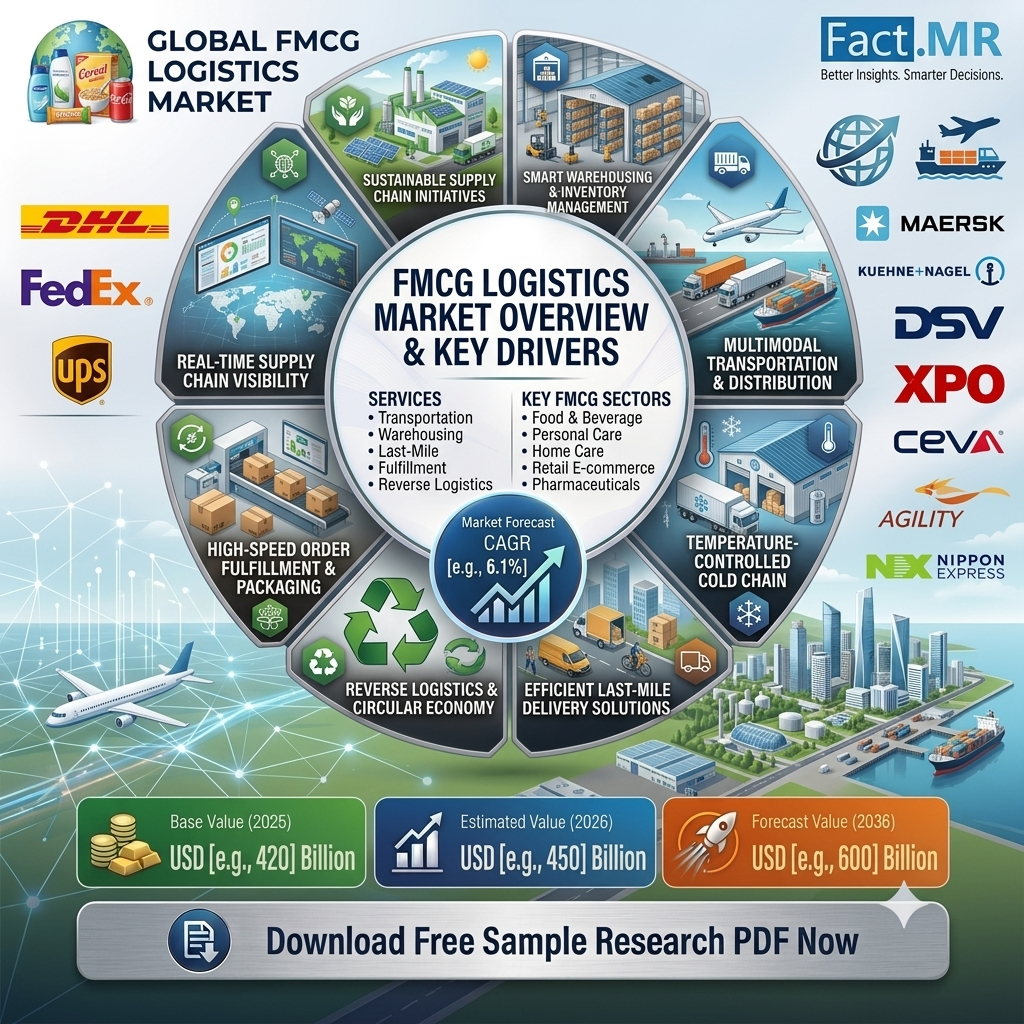
The FMCG logistics market is forecast to expand from USD 129.2 billion in 2026 to USD 190.5 billion by 2036, registering a 4.1% CAGR over the forecast period. According to Fact.MR, demand is being supported by the expansion of organized retail, e-commerce grocery deliveries, quick commerce platforms, and temperature-controlled distribution. Manufacturers and retailers increasingly require logistics networks that can manage frequent replenishment, inventory visibility, and timely delivery of food, beverages, personal care products, and household essentials.
The shift toward faster delivery models is changing how fast-moving consumer goods move from manufacturers to end customers. Quick commerce platforms require smaller, more frequent shipments and inventory positioned close to consumption centers. At the same time, investments in freight corridors, warehousing, cold chain facilities, and digital logistics platforms are supporting the development of more organized distribution networks.
Get detailed market forecasts, competitive benchmarking, and pricing trends:
https://www.factmr.com/connectus/sample?flag=S&rep_id=14328
Railways Retain Leading Position in Transportation
By mode of transportation, railways are expected to account for 43.1% of the FMCG logistics market in 2026. Their cost efficiency and ability to transport large volumes over long distances support their use across major markets, including India, China, and the United States. Dedicated freight corridors and intermodal services are also helping logistics operators manage bulk movements and maintain replenishment schedules.
Roadways and other transportation modes continue to serve different distribution requirements, particularly where shipments need to reach retail outlets, warehouses, and urban fulfillment centers. As delivery cycles become shorter, logistics providers must balance transportation costs with service reliability and shipment frequency.
By product type, food and beverages are projected to hold 44.7% of the market in 2026. Frequent replenishment requirements and the need to maintain product quality support demand for specialized transportation, inventory management, and cold chain services. Personal care and household care products also contribute to logistics demand through retail distribution and expanding e-commerce sales.
India, China, and Germany Show Growth Potential
India is projected to record the fastest growth among the countries assessed, with FMCG logistics demand rising at a 9.1% CAGR from 2026 to 2036. The expansion of modern retail and quick commerce is increasing the need for organized distribution networks. The government's Pradhan Mantri Gati Shakti National Master Plan and investments in freight infrastructure are supporting multimodal connectivity, helping logistics providers improve transportation efficiency and expand their service coverage.
China is expected to register a 6.4% CAGR through 2036. Rising FMCG demand in lower-tier cities and the continued expansion of fulfillment networks are supporting market development. Growth in cross-border e-commerce is also creating additional logistics requirements, while warehouse expansion and digital inventory systems are helping operators serve a broader range of consumers.
Germany is projected to advance at a 5.2% CAGR during the forecast period, making it a key European growth market. Its position as a major distribution center supports demand for integrated freight, warehousing, and inventory management services. Sustainability requirements and road freight decarbonization policies are encouraging logistics providers to evaluate rail and intermodal transportation for suitable medium- and long-distance routes.
The United States is forecast to grow at a 4.5% CAGR through 2036. E-commerce grocery purchases, personal care deliveries, and last-mile fulfillment are contributing to demand. However, labor availability and urban delivery regulations continue to influence operating costs and logistics capacity.
Brazil is expected to record a 5.3% CAGR over the same period. Expansion of organized retail and e-commerce beyond traditional urban centers is supporting demand for structured distribution networks. Improvements in transportation connectivity and last-mile delivery capabilities are also relevant to the development of FMCG logistics services.
Competitive Landscape
Competition in the FMCG logistics market includes international transportation companies, contract logistics providers, and specialized distribution operators. Key companies profiled by Fact.MR include United Parcel Service, Inc., FedEx Corp., Deutsche Post AG, C.H. Robinson Worldwide Inc., Kuehne+Nagel International AG, A.P. Moller–Maersk, Schenker AG, DSV Solutions, Nippon Express Holdings, Inc., and Landstar System Holdings, Inc.
Procurement decisions are influenced by network coverage, service reliability, technology integration, cold chain capabilities, and total logistics costs. FMCG manufacturers increasingly need partners that can coordinate transportation, warehousing, and distribution across multiple channels. Providers with integrated freight management systems and fulfillment infrastructure are positioned to address these requirements.
Technology and Sustainability Trends Shape the Market
Digital freight platforms, warehouse automation, and real-time inventory monitoring are becoming important tools for logistics operators. Integration with retailer inventory systems can improve replenishment planning, reduce unnecessary stock buffers, and help providers respond to changing consumer demand. Cold chain monitoring is also relevant for maintaining product quality and supporting food safety requirements during transportation and storage.
Sustainability policies are influencing transportation decisions, particularly in Europe. Road freight emission standards and urban low-emission zones are encouraging operators to evaluate alternative fuels, electric delivery vehicles, and intermodal transport. In India and China, infrastructure expansion and quick commerce growth are creating different priorities around network capacity, fulfillment locations, and delivery speed.
As FMCG distribution becomes more closely linked to e-commerce, rapid replenishment, and digitally managed inventory, logistics providers are expected to continue adapting their transportation and warehousing networks. Fact.MR's report provides further analysis of market forecasts, transportation modes, product categories, regional opportunities, and competitive developments through 2036.
Top Reports:
https://adamaamresearch.blogspot.com/2026/10/active-electronic-components-market.html
https://zeuspage.org/blogs/69784/Active-Electronic-Components-Market-to-Reach-USD-780-Billion-by
https://kaamkaaziclub.com/read-blog/68620
https://net-pals.com/blogs/48049/Active-Electronic-Components-Market-to-Grow-at-9-1-CAGR
About Fact.MR
Fact.MR is a market research and consulting company providing market intelligence, competitive analysis, and forecasting across global industries. Its research supports businesses with data-driven insights into emerging markets, technology trends, competitive dynamics, regional opportunities, and changing demand patterns.

 English
 Arabic
 French
 Spanish
 Portuguese
 Deutsch
 Turkish
 Dutch
Dutch
 Italiano
 Russian
 Romaian
 Portuguese (Brazil)
