


When Should Motorcycle Racing Boots Be Replaced After a Crash or Hard Impact?
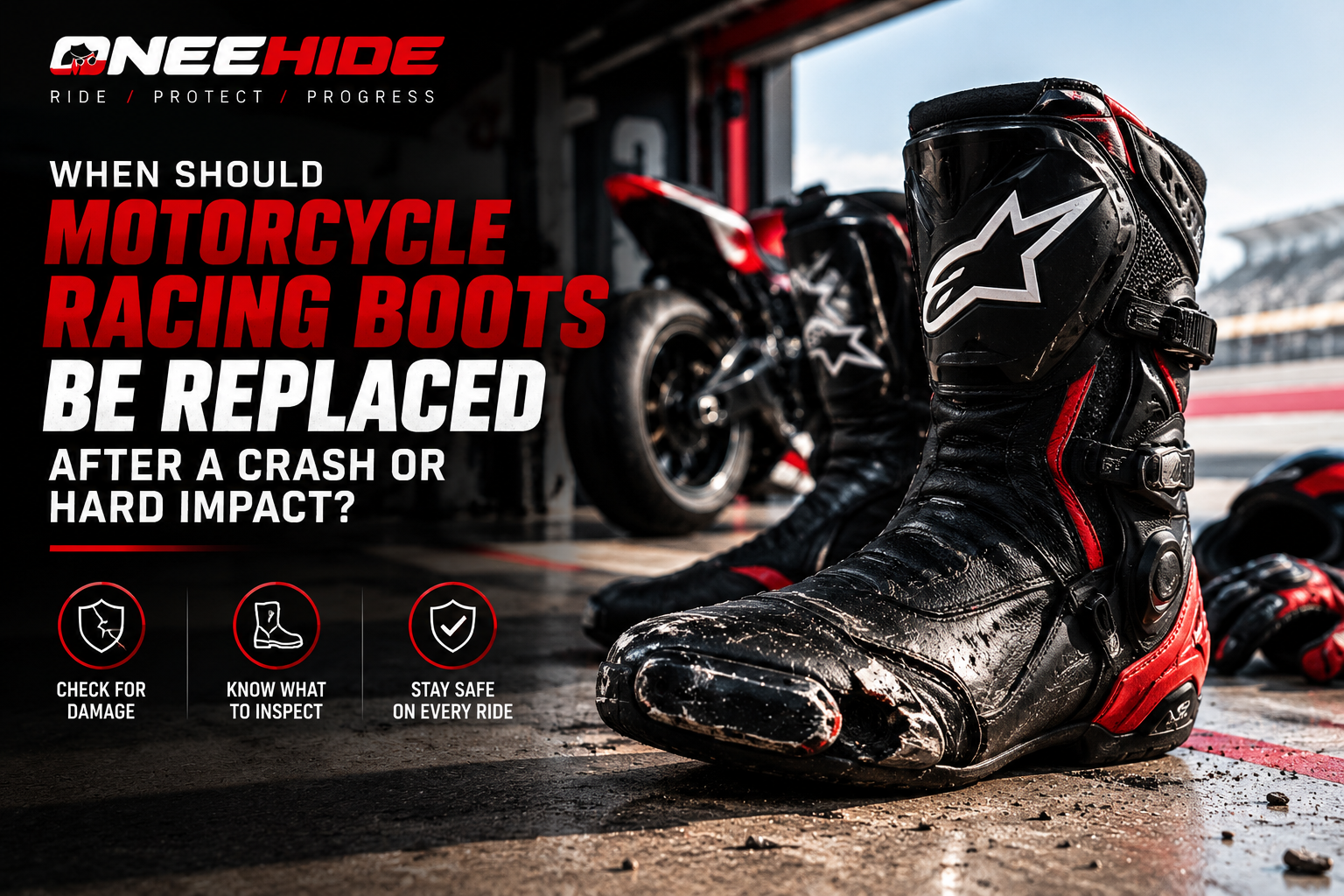
Motorcycle racing boots should be replaced after a crash when their protective structure may have been compromised, even if the damage looks minor from the outside. A torn outer layer, cracked heel cup, damaged ankle support, or closure that no longer holds securely can affect how the boot protects the foot during another impact. The difficult part is that some damage remains hidden beneath the lining or inside the boot's reinforced structure.
The decision isn't based on mileage alone, and there is no universal rule requiring every rider to discard boots after every fall. A low-speed tip-over may leave a boot usable, while a high-energy impact or a foot trapped beneath a motorcycle can justify replacement even when visible marks are limited. The type of crash, the area that absorbed the force, the boot's construction, and the manufacturer's inspection guidance all matter.
Knowing what to inspect, which warning signs demand immediate retirement, and when a professional assessment is worthwhile can help riders avoid relying on footwear that no longer provides its intended protection.
Why a Crash Can Damage Racing Boots Without Leaving Obvious Marks
Racing boots are designed to manage several hazards, including abrasion against the road, direct impacts, twisting forces, and compression when a foot becomes trapped. Their protective performance depends on the interaction between the outer materials, reinforced impact zones, sole, closures, and internal support components.
A crash can affect one or several of these parts at once. For example, a boot may slide across the asphalt without suffering a major structural impact, or it may take a concentrated blow against a footpeg, kerb, or another part of the motorcycle. These events create different damage patterns.
Three types of loading deserve particular attention:
-
Abrasion: Sliding across the road can wear through leather, synthetic panels, stitching, or protective overlays. Damage becomes more concerning when it reaches reinforced zones or exposes the underlying structure.
-
Impact and compression: A direct blow can crack or deform a rigid heel cup, toe reinforcement, or ankle support. A boot can look relatively intact while an internal component has been damaged.
-
Twisting and bending: A foot caught beneath a motorcycle may experience forces that distort the sole, weaken joints between components, or damage the boot's support structure.
The foot's condition is not a reliable measure of the boot's condition. A rider who walks away without an obvious injury cannot assume the footwear remains protective. Equally, scuffed surfaces alone do not prove that every structural component has failed. The important question is whether the boot can still perform as designed, something that a visual inspection cannot always establish.
Warning Signs That Mean Racing Boots Should Be Retired
Certain damage should be treated as a strong reason to stop using a boot for riding. If a critical protective component is cracked, displaced, or no longer secured correctly, replacing the boot is generally safer than attempting an improvised repair.
Cracked or deformed protective components
Inspect the heel cup, toe reinforcement, ankle protection, shin plate, and any external bracing system. Look for cracks, sharp edges, buckling, separation, or a component that sits differently from its counterpart on the other boot.
Pay attention to the boot's shape. A heel area that has collapsed inward, a toe section that has become unusually soft, or an ankle brace that no longer follows its original alignment may indicate damage beyond the surface.
Do not repeatedly bend a damaged component to test whether it still works. That can worsen the damage, and a simple hand test cannot reproduce the conditions used to evaluate protective footwear.
Torn seams, exposed layers, or separated soles
Road rash on a replaceable outer slider is different from a tear through the boot's structural material. Determine whether the abrasion is confined to a sacrificial component or has reached the main upper, stitching, or supporting layers.
Check the junction between the upper and outsole, especially around the toe and heel. Separation, deep cuts, distorted edges, or exposed internal layers can affect the boot's integrity. A sole that has shifted relative to the upper also deserves immediate attention.
Adhesive repairs and cosmetic patches are not proof that the original protective performance has been restored. Unless the manufacturer provides an approved repair procedure for the specific damage, a compromised structural component is a reason to retire the boot.
Failed closures and altered fit
Zippers, buckles, straps, and hook-and-loop fasteners keep the boot positioned around the foot and lower leg. A closure that no longer engages securely can allow the boot to shift during a crash or interfere with normal riding movements.
Compare both boots and check whether the closure tracks smoothly, straps remain anchored, and buckles latch as intended. Also look for stretched material around attachment points and changes in the way the boot holds the heel or ankle.
If the boot suddenly feels loose, creates a new pressure point, or allows unusual movement after a crash, do not assume that breaking in or tightening the straps will solve the problem. The change may reflect structural damage.
When Should You Replace Boots After Different Types of Crashes?
The safest replacement decision considers the force and location of the impact, not just the speed at which the motorcycle was travelling. A low-speed fall can damage a boot if the foot is pinned, while a faster slide may cause mostly superficial abrasion if the footwear avoids concentrated impacts. Neither outcome can be assumed without inspecting the equipment.
|
Crash or impact scenario |
Sensible next step |
|
Motorcycle tips over while stationary, with no foot trapped |
Inspect both boots, closures, soles, and protective components before reuse. |
|
Low-speed slide with light surface scuffing |
Check the depth of abrasion and whether structural layers or seams are affected. |
|
High-speed track slide |
Retire boots with structural damage or seek manufacturer guidance if the extent is uncertain. |
|
Foot trapped beneath the motorcycle |
Stop using the boots until the manufacturer or an appropriate specialist has assessed them. Replace them if structural integrity cannot be established. |
|
Direct blow to the heel, toe, or ankle |
Check the relevant reinforcement and surrounding structure. Replace if cracked, deformed, or compromised. |
|
Severe crash with substantial twisting or crushing forces |
Treat the boots as potentially compromised, even if the exterior looks acceptable. Obtain manufacturer guidance before considering reuse. |
These are practical decision categories, not a certified inspection test. A manufacturer may require replacement after particular events or recommend returning the product for assessment. Its instructions should take precedence over a general checklist.
Does every fall mean a new pair?
No. Replacing boots after every minor tip-over, regardless of contact or damage, is not a universal requirement. However, riders should distinguish between an event that merely knocks a boot against the ground and one that subjects its protective structure to substantial force.
For example, a boot that lightly contacts the pavement while the rider catches the motorcycle may need only a careful inspection. A boot that becomes trapped under the bike and is forced sideways presents a different concern because the load may affect the sole, ankle support, and internal reinforcement.
If the boot took a meaningful impact and the manufacturer cannot confirm that it remains serviceable, replacement is the more cautious choice. The price of a replacement is easier to assess than the uncertainty of relying on damaged protective equipment.
How to Inspect Motorcycle Racing Boots After an Impact
A post-crash inspection helps identify obvious damage, but it cannot certify that a boot remains safe. Conduct the inspection in good light, clean away dirt with a manufacturer-approved method, and examine both boots rather than focusing only on the one that struck the ground.
Check the exterior and protective structure
Start with the areas most likely to contact the motorcycle or road:
-
Toe and heel: Look for cracks, crushing, displaced reinforcement, deep abrasion, and changes in shape.
-
Ankle and shin: Inspect braces, protective plates, hinges, and their attachment points.
-
Sole: Look for separation, unusual bending, cuts, or distortion around the connection to the upper.
-
Outer shell and stitching: Check for torn seams, exposed layers, deep cuts, and damaged slider mounts.
-
Closures: Confirm that buckles, straps, zippers, and fasteners operate normally without looseness or damaged anchors.
Replace the boot if a safety-critical part is visibly broken or deformed. Do not rely on a boot merely because its components can still be fastened together.
Examine the lining, padding, and fit
The inside of a racing boot can reveal problems that are easy to miss externally. Check for torn lining, displaced padding, sharp edges, crushed areas, and damage around the heel pocket or ankle support. If the design allows removable insoles or liners, remove them only as the manufacturer permits.
Put the boots on only if doing so is safe and there is no obvious structural damage that makes handling them inappropriate. Compare the fit with how the boots felt before the crash. A heel that moves more than usual, pressure concentrated in a new location, or a closure that no longer draws the boot evenly can indicate a problem.
Do not treat a comfortable fit as proof of intact protection. Internal reinforcement can be damaged without creating an obvious sensation, so a normal fit is only one part of the assessment.
Know when a visual inspection is not enough
Some damage requires specialist assessment, particularly after crushing, severe twisting, or a direct impact to a rigid protective component. Do not dismantle bonded parts, force a brace through its range of motion, heat the material, or attempt to reshape a shell.
Manufacturer guidance provides a useful benchmark. For example, Leatt's boot care and maintenance instructions advise inspection or replacement following a collision or when components show cracking, deformation, or other damage. The exact instructions vary by product, so riders should consult the manual for their own model rather than applying one brand's rules to every boot.
How Long Do Motorcycle Racing Boots Last if They Have Never Crashed?
Motorcycle racing boots do not have one universal replacement age. Their useful life depends on construction, frequency of use, exposure to heat and moisture, storage, maintenance, and the manufacturer's recommendations.
A pair used occasionally for short rides may experience less wear than boots used for frequent track sessions. Repeated flexing, sweat, abrasion, ultraviolet exposure, and deterioration of adhesives or padding can affect materials over time, even without a crash.
Replace boots when their protective components are worn, cracked, deformed, or no longer function correctly. Follow any service-life limit specified by the manufacturer. For example, Leatt recommends replacement of certain products after three years under normal use conditions, but that is a product-specific recommendation, not a universal lifespan for all motorcycle footwear.
A boot's age alone does not prove that it has failed, just as a relatively new boot is not necessarily safe after a severe impact.
What Does EN 13634 Tell You About Motorcycle Boot Protection?
EN 13634 is a European standard for protective footwear used by motorcycle riders. It specifies requirements and test methods relating to protective performance, ergonomics, mechanical properties, and user information. The official standards information published by NEN describes its scope and testing purpose.
This standard helps buyers understand how footwear is evaluated before sale. It does not provide a guarantee that a particular pair remains protective after a crash.
When examining a replacement pair, check the following:
-
Protective coverage: Look for coverage and reinforcement appropriate to your riding discipline, including the heel, toe, ankle, and shin where provided by the design.
-
Abrasion resistance: Consider the materials and protective construction used in areas likely to contact the road.
-
Structural support: Evaluate the boot's ability to support the foot and ankle without preventing the movement required to operate the motorcycle.
-
Markings and documentation: Check the conformity markings, product information, and instructions relevant to the model and market in which you are buying it.
The standard's requirements concern tested footwear and specified performance characteristics. They should not be interpreted as a post-crash pass or fail test that riders can perform at home.
Choosing Replacement Boots After a Crash
Once a pair has been retired, choose its replacement according to the riding you actually do and the features you need. A boot designed for track use may offer extensive reinforcement and rigid ankle support, while a road-oriented sport boot may place more emphasis on everyday movement and comfort.
Riders comparing motorcycle racing boots should look beyond appearance and price. Compare protective coverage, closure security, fit, construction, available replacement components, and the manufacturer's care instructions. The OneeHide collection provides one place to examine different motorcycle boot styles, but the specifications of the individual model should determine whether it suits your needs.
Before buying, check these practical details:
-
Your heel should remain securely positioned without excessive movement.
-
Your toes should have enough room to avoid painful pressure.
-
The ankle support should fit securely without creating concentrated pressure points.
-
Buckles and straps should remain closed during normal movement.
-
The boot should allow you to operate the gear lever and rear brake without awkward restriction.
-
The protective features should suit your intended use, whether that means track sessions, sport riding, or regular road journeys.
Do not choose a replacement based solely on how stiff it feels. Stiffness can reflect a particular design, but it is not a complete measure of protective performance. Likewise, a boot that feels comfortable in a shop may still be unsuitable if its shape interferes with foot control or allows the heel to move excessively.
If you replace boots after a crash, check the condition of the rest of your protective equipment as well. Gloves, for example, can suffer damaged seams, closures, or protective panels when a rider braces against the ground. A separate inspection of motorcycle racing gloves can help identify damage to hand protection that might otherwise be overlooked.
Should You Repair Damaged Motorcycle Racing Boots or Replace Them?
Repair is appropriate only when the manufacturer permits it and the repair can restore the affected component to its intended condition. Replacing a designated, removable slider may be straightforward if the shell and its mounting points remain intact. Repairing a cracked load-bearing component or a torn structural seam is a different matter.
Before authorizing a repair, ask the manufacturer or an authorized service provider:
-
Is the damaged component replaceable on this specific model?
-
Could the crash have damaged hidden reinforcement or attachment points?
-
Is there an approved repair procedure for this type of damage?
-
Can the provider establish that the boot remains suitable for riding after the repair?
If the answers are uncertain, do not treat a cosmetic repair as evidence of restored protection. Gluing a separated sole, stitching a torn outer panel, or reshaping a deformed shell without an approved procedure may leave underlying damage unresolved.
The decision is clearest when a boot has a cracked protective structure, substantial crushing, failed support, or damage that the manufacturer says cannot be repaired. Retire it and choose a replacement rather than gambling on an unverified repair.
After a crash, the most useful question is not simply whether the boots still look wearable. It is whether their protective structure can still be relied upon. If the impact was substantial, the foot was trapped, or any critical component has changed shape, stop riding in that pair until its condition has been resolved through manufacturer guidance or replacement. A careful inspection can identify obvious damage, but uncertainty about structural integrity should never be mistaken for proof that the boots are safe.

 English
 Arabic
 Spanish
 Portuguese
 Deutsch
 Turkish
 Dutch
Dutch
 Italiano
 Russian
 Romaian
 Portuguese (Brazil)
 Greek
Greek
