


Non-alcoholic Beverage Market Growth, Predictable to Witness Sustainable Evolution Analysis By Fact.MR
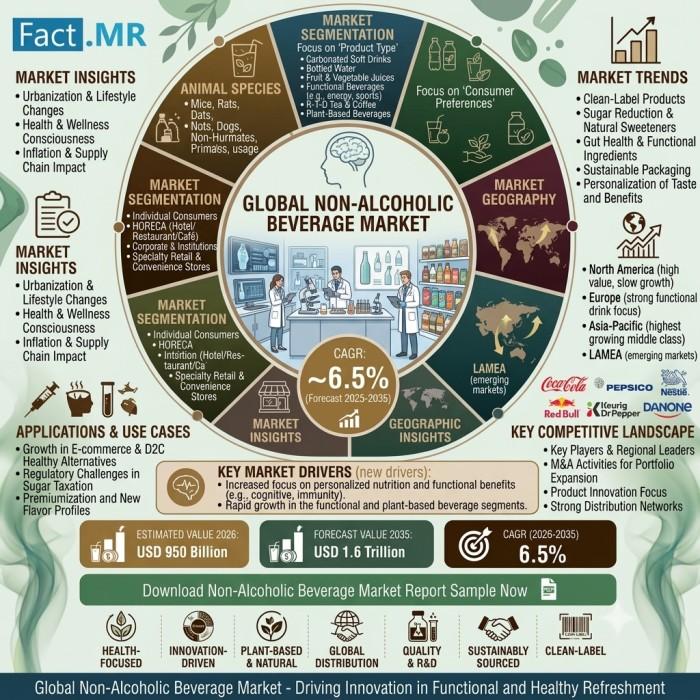
Sugar-reduction policies, functional beverage premiumization, and rising branded beverage penetration in emerging markets are reshaping demand through 2036, according to Fact.MR.
NEWARK, Del., October 8, 2026. The global non-alcoholic beverage market is valued at USD 972.9 billion in 2026 and is projected to reach USD 1,372.4 billion by 2036, expanding at a 3.5% CAGR, according to Fact.MR. The market was valued at USD 940.0 billion in 2025, creating an incremental opportunity of USD 399.5 billion between 2026 and 2036.
Get detailed market forecasts, competitive benchmarking, and pricing trends:
Demand is shifting beyond conventional soft drinks
The strongest market trigger is the shift toward lower-sugar, functional, plant-based, and naturally sourced beverages. Fact.MR reports that government sugar-reduction policies, including tiered sugar taxes in the United Kingdom and similar levies across Southeast Asia, are encouraging reformulation and improving the relative price position of zero-sugar and naturally sweetened products.
The report also identifies organized food service as an important source of incremental beverage demand. Expansion of quick-service restaurants, cloud kitchens, and organized food service in India, China, and Brazil is moving beverage consumption beyond conventional retail channels.
Where growth is fastest
- India — 5.4% CAGR: The fastest-growing country market, supported by urbanization, rising disposable incomes, branded beverage penetration, and a shift from unpackaged to branded beverages. Packaged beverage consumption remains below 30 liters per capita annually, leaving room for volume expansion.
- China — 4.0% CAGR: Growth is supported by consumer movement toward sugar-free and functional beverages. Beverage e-commerce penetration exceeds 15% of total retail sales, helping new product concepts scale rapidly.
- Brazil — 3.3% CAGR: An expanding urban middle class and wider adoption of modern retail formats are supporting packaged beverage demand. Juices, nectars, and dairy-based beverages remain important categories.
- Germany — 3.0% CAGR: Regulatory pressure and consumer awareness are supporting demand for zero-sugar, organic, and functional beverages, while mineral water and herbal teas continue to outperform carbonated soft drinks in growth.
- South Korea — 2.9% CAGR: A dense convenience-store network supports ready-to-drink coffee, flavored milk, and probiotic beverages, while product innovation continues to shape demand.
- USA — 2.8% CAGR: Functional beverages, enhanced water, and energy drinks are driving value growth as traditional carbonated soft drink volumes remain flat to declining.
- Japan — 2.6% CAGR: The mature market is seeing premiumization around lower-sugar and fortified beverages, specialty coffee, and craft soft drinks.
What leads the market
- Carbonated soft drinks — 28.9% share: Established global brands, broad distribution, and strong penetration of single-serve PET and can formats keep carbonated soft drinks as the largest product category.
- Daily hydration — 33.7% share: Water, flavored water, and light refreshment beverages account for the largest application share.
- Supermarkets and hypermarkets — 38.2% share: Grocery chains remain the leading distribution channel for multi-pack, family-size, and pantry-oriented beverage purchases.
- Ready-to-drink formats — 72.4% share: Grab-and-go convenience continues to support bottled and canned beverage formats.
The Coca-Cola Company holds a 21.0% market share and leads the competitive field, according to Fact.MR.
The hurdle
Input costs remain a central constraint. Sugar, fruit concentrate, PET resin, aluminum, and other packaging materials are exposed to commodity cycles and trade tariffs. Fact.MR notes that a 10% to 15% increase in input costs can compress manufacturer margins by 200 to 300 basis points if the increase cannot be passed on to consumers.
Regulatory fragmentation adds another challenge. Labeling, health-claim, and ingredient-approval requirements vary across countries, increasing compliance costs and potentially delaying launches. Packaging scrutiny, including single-use plastic restrictions and extended producer responsibility schemes, is also increasing investment requirements.
Recent developments
Industry activity is increasingly focused on reformulation, plant-based products, capacity expansion, and functional beverages.
- Q1 2025: The Coca-Cola Company rolled out an updated zero-sugar Coca-Cola formulation across more than 30 markets, with the report stating that the reformulation was supported by more than USD 200 million in global marketing investment.
- Mid-2025: PepsiCo introduced oat-based beverages under its Naked brand in North America and Western Europe, targeting plant-based nutrition and on-the-go consumption across retail and food service.
- Early 2026: Nongfu Spring began production at a new 500,000-square-meter bottling facility in Hubei Province, China, adding capacity for bottled water, flavored tea, and functional beverages.
Key companies profiled include The Coca-Cola Company, PepsiCo, Inc., Nestle S.A., Danone S.A., Suntory Holdings Limited, Keurig Dr Pepper Inc., Tingyi (Cayman Islands) Holding Corp., Nongfu Spring Co., Ltd., Asahi Group Holdings, Ltd., Red Bull GmbH, Monster Beverage Corporation, AJE Group, Coca-Cola FEMSA, S.A.B. de C.V., Tata Consumer Products Limited, and Britvic plc.
Analyst perspective
S.N. Jha, Principal Consultant at Future Market Insights, said:
“The non-alcoholic beverage market is transitioning from volume-led carbonated soft drink growth toward value-led expansion in functional, plant-based, and low-sugar categories. Consumers in developed markets are paying a premium for beverages with added health benefits, clean labels, and sustainable packaging. In emerging markets, branded penetration is still at an early stage, and per-capita consumption of packaged non-alcoholic beverages remains well below developed-market benchmarks. This gap presents a multi-year volume opportunity. Companies that invest in localized formulation, cold-chain infrastructure, and digital-first distribution are positioned to capture disproportionate share gains through 2036.”
What this means for beverage manufacturers and buyers
1. Prioritize localized portfolios. Country growth varies substantially, from 5.4% CAGR in India to 2.6% in Japan. Product formats, pricing, and distribution should therefore reflect local consumption patterns rather than rely on a single global proposition.
2. Balance core volumes with higher-value categories. Carbonated soft drinks remain the largest product segment, but functional, plant-based, low-sugar, and enhanced-water products are driving premiumization. Portfolio planning should protect established volume while allocating development resources to these faster-moving categories.
3. Build distribution around emerging channels. Supermarkets and hypermarkets remain the largest channel at 38.2%, but online retail is expanding rapidly. In markets such as China, where online beverage sales exceed 15% of total retail beverage sales, digital and direct-to-consumer routes can provide an alternative path to consumers.
Read the full Non-alcoholic Beverage Market:
Report coverage
The Non-alcoholic Beverage Market Analysis and Forecast, 2026 to 2036 covers product type, application, end use, distribution channel, form, ingredient base, and regional markets across six regions and 40+ countries.
Explore More Related Studies Published by Fact.MR Research
Concentrated Liquid Smoke Market
About Fact.MR
Fact.MR is a market research and consulting firm providing syndicated research, customized research, investment research, and market intelligence across a broad range of industries. Its research coverage includes food and beverage, healthcare, pharmaceuticals, biotechnology, consumer products, chemicals and materials, technology, industrial goods, and packaging.
Fact.MR provides market intelligence designed to help organizations understand market dynamics, emerging opportunities, competitive developments, and changing industry requirements.
Media Contact
Fact.MR
Email: sales@factmr.com
Phone: +1 (628) 251-1583
Website: www.factmr.com

 English
 Arabic
 French
 Spanish
 Portuguese
 Deutsch
 Turkish
 Dutch
Dutch
 Russian
 Romaian
 Portuguese (Brazil)
 Greek
Greek
