


Poppy Seeds Market Growth, Predictable to Witness Sustainable Evolution Analysis By Fact.MR
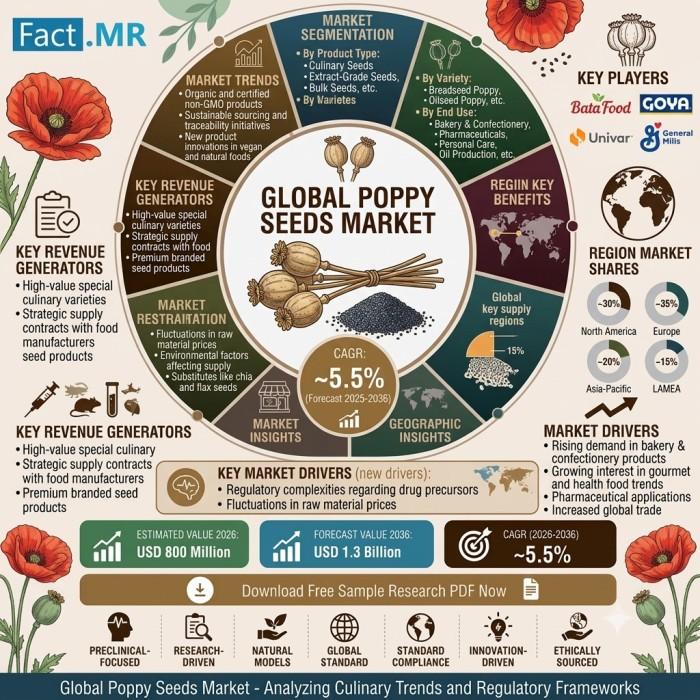
Supply concentration, alkaloid compliance requirements, and growing demand for specialty bakery ingredients are reshaping procurement priorities, according to Fact.MR.
NEWARK, Del., October 8, 2026. The global poppy seeds market is projected to grow from USD 369.118 million in 2026 to USD 562.352 million by 2036, advancing at a 4.3% CAGR during the forecast period, according to Fact.MR. The market is expected to create an incremental opportunity of USD 193.234 million between 2026 and 2036.
The market is supported by demand from artisanal and specialty bakeries in Europe and North America, expanding culinary use, and increasing interest in poppy seed oil and seed-derived ingredients. Fact.MR identifies supply concentration and regulatory oversight of opium alkaloid levels as major commercial considerations for buyers.
Get detailed market forecasts, competitive benchmarking, and pricing trends:
Regulatory compliance raises the bar for food-grade supply
Food-grade poppy seeds must meet alkaloid content limits established by national regulators. The report cites European Commission Regulation (EU) 2021/2142 and Codex Alimentarius guidelines as primary reference standards. These requirements increase the need for washing, thermal treatment, and batch testing across the supply chain.
The report also identifies geographic concentration as a supply vulnerability. The Czech Republic, Turkey, Hungary, and India account for more than 80% of global food-grade poppy seed production, meaning crop disruptions in a major origin market can affect downstream availability and pricing.
Where growth is fastest
- India — 5.2% CAGR: Demand for white poppy seeds, or khus khus, is expanding alongside Indian cuisine and processed food manufacturing. The report says India's licensed opium poppy cultivation covered approximately 12,000 hectares in the 2024 season, according to Central Bureau of Narcotics data.
- Czech Republic — 5.0% CAGR: Strong production capabilities and processing infrastructure support the country's premium position in blue poppy seeds. Czech Statistical Office data cited by Fact.MR shows production exceeding 28,000 tonnes in the 2024 harvest.
- China — 4.8% CAGR: Expansion of Western-style bakery chains is increasing demand for poppy seed-topped breads and pastries and supporting imports of European-origin blue poppy seeds.
- Hungary — 4.3% CAGR: Traditional bakery consumption and domestic production underpin demand, while processors are expanding value-added products such as poppy seed paste and oil.
- Germany — 4.3% CAGR: Bakery demand and organic food consumption support adoption. Germany is identified as Europe's largest poppy seed consuming market by volume.
- Turkey — 4.1% CAGR: Domestic consumption and production expansion support the market, while processors are investing in export-oriented cleaning and grading infrastructure.
- USA — 4.0% CAGR: Bakery applications, specialty foods, and premium and organic products support demand. The USA generated USD 138.788 million in revenue in 2025.
What leads the market
- Raw poppy seeds — 38.4% of the product segment: Whole, unprocessed seeds remain the principal commercial form for bakery toppings, fillings, seed mixes, and culinary applications.
- Bakery and confectionery — 44.7% of application demand: Traditional European bakery products and expanding use in breads, rolls, cakes, pastries, and confectionery make this the largest application segment.
- Direct sales — 63.8% of distribution channel demand: Direct B2B transactions reflect trade between growers, processors, and food manufacturers.
- Food grade — 47.2% of quality-grade demand: Food-grade products represent the largest quality category and require compliance with applicable alkaloid limits.
The hurdle: concentrated supply and compliance costs
The biggest procurement challenge is not a lack of end-use demand but the limited number of major production origins. The report notes that production is concentrated in a handful of countries, while regulatory controls add costs for cleaning, heat treatment, testing, and documentation.
Poppy seeds also face competition from sesame, chia, flax, and hemp in bakery and snack applications. These alternatives can provide similar visual and nutritional positioning without the same regulatory complexity associated with opium alkaloid management.
Recent developments
Fact.MR identifies several company developments, although the report page provides years rather than specific months:
- 2025 — Solo Foods: Expanded its poppy seed filling range with organic and reduced-sugar formulations for retail bakers and commercial bakery customers in North America.
- 2025 — Bob's Red Mill Natural Foods: Established a direct organic poppy seed sourcing programme with certified organic farming cooperatives in the Czech Republic.
- 2026 — PROBI spol: Launched a premium cold-pressed Czech blue poppy seed oil targeting European culinary and personal care markets, with traceability documentation.
- 2025 — P.P.H.U. Kampol: Expanded in-house alkaloid testing capacity at its Polish processing facility for batch-level morphine and codeine quantification.
The report profiles Solo Foods Inc., Bob's Red Mill Natural Foods, Frontier Natural Products Co-op, Bio Nutrition Inc., Olivenation LLC, Woodland Foods, P.P.H.U. Kampol, PROBI spol, Bata Food, and Unifood. Solo Foods is reported to hold approximately 12.0% of global revenue.
Analyst perspective
The report page provides an “Analyst Opinion” attributed to the report analysis rather than a named analyst quotation. It states:
“The poppy seeds market is a niche agricultural commodity sector where growth is determined by bakery industry ingredient demand, regulatory environment around opium alkaloid thresholds, and agricultural production capacity in a limited number of source countries. The commercial challenge is supply-side: poppy seed production is geographically concentrated in the Czech Republic, Turkey, Hungary, India, and Australia, with strict regulatory oversight limiting new cultivation.”
It continues:
“Companies that secure reliable supply partnerships with origin-country producers and invest in processing to meet alkaloid compliance standards will maintain pricing power.”
The report identifies S.N. Jha, Principal Consultant, as its author, but the page does not explicitly present the above passage as a named quotation from him.
What this means for food manufacturers and ingredient buyers
1. Diversify sourcing by origin.
Procurement teams should avoid excessive dependence on one production country. The concentration of food-grade supply means a crop disruption or export constraint in a major origin can affect both availability and prices.
2. Build alkaloid compliance into supplier qualification.
Washing, thermal treatment, testing, and batch-level documentation can affect procurement costs and lead times. Buyers should assess compliance capabilities before selecting suppliers rather than treating testing as a downstream requirement.
3. Evaluate value-added formats alongside whole seeds.
The report identifies cold-pressed poppy seed oil, poppy seed paste, flour, and other derivatives as opportunities for higher-value applications. Manufacturers can assess these formats where they fit culinary, personal care, nutraceutical, or food-processing requirements.
Read the full Poppy Seeds Market:
Report coverage
Fact.MR's Poppy Seeds Market report covers product, application, end use, nature, distribution channel, form, quality grade, regional markets, country-level forecasts, and competitive analysis through 2036.
Explore More Related Studies Published by Fact.MR Research
Concentrated Liquid Smoke Market
About Fact.MR
Fact.MR is a market research and consulting firm providing syndicated research, customized research, investment research, and market intelligence across a broad range of industries. Its research coverage includes food and beverage, healthcare, pharmaceuticals, biotechnology, consumer products, chemicals and materials, technology, industrial goods, and packaging.
Fact.MR provides market intelligence designed to help organizations understand market dynamics, emerging opportunities, competitive developments, and changing industry requirements.
Media Contact
Fact.MR
Email: sales@factmr.com
Phone: +1 (628) 251-1583
Website: www.factmr.com

 English
 Arabic
 French
 Spanish
 Portuguese
 Deutsch
 Turkish
 Dutch
Dutch
 Russian
 Romaian
 Portuguese (Brazil)
 Greek
Greek
