


Mono-Material Stand-Up Pouch Barrier Films Market Growth Strengthens With Rising Food Packaging Consumption Worldwide
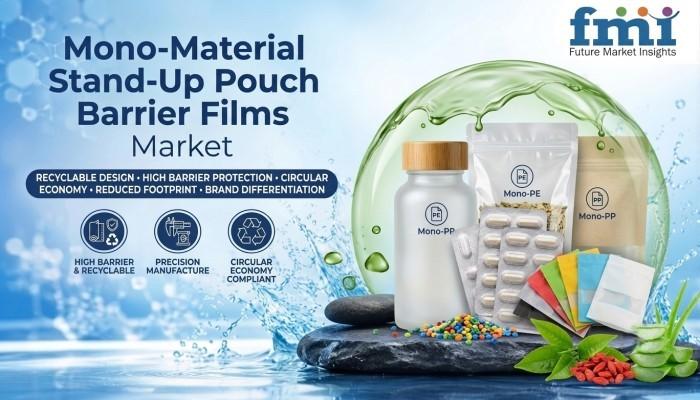
The global Mono-Material Stand-Up Pouch Barrier Films Market is projected to reach USD 120.0 million by 2036, up from USD 50.0 million in 2026, expanding at a 9.1% CAGR during the forecast period, according to Future Market Insights (FMI).
The market is being shaped by a practical shift in flexible packaging design. Film manufacturers are replacing mixed-polymer laminates with structures built around a single main polymer family while working to retain oxygen and moisture protection, seal stability, and commercial filling-line performance.
Regulatory requirements are adding another consideration to packaging specifications. United Kingdom guidance updated in April 2026 requires large producers to meet material-specific recycling obligations and pay waste-disposal fees for covered household packaging. These obligations increase the commercial relevance of pouch structures that can provide clearer material documentation without compromising product shelf life.
Get detailed market forecasts, competitive benchmarking, and pricing trends:
https://www.futuremarketinsights.com/reports/sample/rep-gb-34247
In the United States, packaging programs increasingly connect producer fees with measurable recycling outcomes across household product portfolios. Oregon's Recycling Modernization Act, which began on July 1, 2025, assigns program costs to companies selling packaging into the state and affects flexible plastic packaging placed into state collection systems.
India presents a different operating environment. Pouch projects rely more heavily on nearby film-making support and registered recovery routes, while collection capacity varies across regions. These differences can affect qualification timelines when brands plan national launches.
Mono-Material PE Leads Material Demand
Mono-material PE is expected to account for 41.0% of the market in 2026, making it the leading material category. Its established sealing behavior and broad polyethylene processing experience support adoption across refill and flexible packaging programs.
Mono-material PE allows packaging engineers to assess barrier coatings and print layers without introducing another major polymer into the primary structure. Qualification remains more demanding for applications requiring retort temperatures or extended oxygen protection.
Commercial activity is also supporting the category. Amcor and Mediacor launched a two-liter spouted stand-up pouch for Nana laundry and cleaning products across Italy, Germany, and Austria in July 2025.
Pouches Remain the Leading Format
Pouches are forecast to hold 30.0% share in 2026, supported by low empty-pack weight and compatibility with refill and portioned products.
Premade pouches can help smaller product lines adopt recyclable structures without installing forming equipment. Rollstock provides another route for higher-volume operations seeking tighter control over forming and sealing.
ProAmpac presented its R-2300 recyclable film platform in March 2026 for food, pet-care, and home-care applications. The platform was offered as both rollstock and premade pouches.
Food Accounts for More Than Half of End-Use Demand
Food is projected to represent 52.0% share in 2026. Frequent packaging turnover and strict shelf-life requirements make barrier retention and seal integrity central to commercial qualification.
Coveris confirmed in June 2025 that MonoFlexBE cheese packaging was already being used with major United Kingdom retailers, including Tesco, Sainsbury's, and ASDA. The format offers high-barrier performance and shelf life reaching 120 days.
Grease resistance is another important specification. This category is projected to account for 13.0% share in 2026, particularly where oily foods and pet-food products can expose films and printed surfaces to fat contact.
Analyst Perspective
“Commercial approval depends on one polymer structure protecting shelf life and sealing consistently on existing filling lines. The same pouch must also fit a documented recovery route in every intended sales market. Film manufacturers that combine barrier data with line-trial records and country-specific recyclability evidence can reduce repeated qualification work across food, home-care and pet-food launches.”
Nandini Roy Choudhury, Principal Analyst, Future Market Insights
Regulatory Differences Create a Key Market Challenge
The technical performance of a pouch does not automatically translate into equal recyclability acceptance across countries. Sorting, collection, recovery, and assessment practices vary by market.
This creates additional work for multinational brand owners. A pouch that performs successfully on a filling line may require separate evaluation against the recovery conditions and reporting requirements of each target market.
At the same time, improved orientation and coating technologies offer an opportunity to raise barrier performance without adding incompatible layers. Constantia Flexibles commissioned a new MDO line in July 2025 to produce EcoLamHighPlus mono-PE film at its Pirk facility.
Regional Growth Outlook
India is forecast to record the fastest growth among the profiled countries at 12.3% CAGR, followed by the United States at 11.4%, Germany at 10.5%, France at 9.6%, Japan at 8.6%, and the United Kingdom at 7.7%.
These markets differ in collection systems, producer obligations, film-making capacity, and customer qualification requirements. As a result, country-level growth rates need to be assessed alongside local recovery routes and commercial approval conditions.
Competitive Landscape
Notable companies profiled in the market include Amcor, Mondi, ProAmpac, Constantia Flexibles, UFlex, Coveris, Dow, and Huhtamaki.
Competition centers on film development, barrier performance, sealing behavior, conversion support, and geographic reach. Recent activity includes Amcor's expansion of its Lugo di Vicenza facility for high-barrier recycle-ready films, Mondi's mono-PE spouted pouch development, Dow's mono-PE pet-food pouch collaboration, and Coveris' MonoFlexBE polyethylene pouch commercialization.
Report Scope
The FMI study covers the market by material, format, barrier or feature, end use, and region. The analysis spans North America, Latin America, Western Europe, Eastern Europe, East Asia, South Asia and Pacific, and the Middle East and Africa.
The forecast covers 2026 to 2036 and uses a hybrid bottom-up and top-down market-sizing approach supported by primary interviews and official desk research.
Related Report Links:
FMI Custom Research: Strategic Intelligence for Confident Decision-Making
In today’s rapidly evolving business environment, leadership teams need more than market data—they need clear, actionable intelligence tailored to their strategic objectives. FMI’s Custom Research solutions are designed around the specific business questions organizations need answered, enabling executives to evaluate growth opportunities, validate investments, assess competitive dynamics, and reduce uncertainty before making critical decisions. By combining deep industry expertise, primary research, and proprietary market intelligence, FMI delivers insights that help organizations move from assumptions to evidence-based strategies with greater speed and confidence.
Business Impact
FMI helps organizations transform market complexity into strategic clarity, enabling leadership teams to identify growth opportunities faster, optimize resource allocation, strengthen competitive positioning, and make high-stakes business decisions with confidence.
To explore how FMI Custom Research can support your strategic priorities, please connect with our team at – sales@futuremarketinsights.com
About Future Market Insights (FMI)
Future Market Insights, Inc. (FMI) is an ESOMAR-certified, ISO 9001:2015 market research and consulting organization, trusted by Fortune 500 clients and global enterprises. With operations in the U.S., UK, India, and Dubai, FMI provides data-backed insights and strategic intelligence across 30+ industries and 1200 markets worldwide.

 English
 Arabic
 Spanish
 Portuguese
 Deutsch
 Turkish
 Dutch
Dutch
 Italiano
 Russian
 Romaian
 Portuguese (Brazil)
 Greek
Greek
