


Potable Water Testing Services Market Set to Hit USD 2.33 Billion by 2036, China Leads at 6.9% CAGR
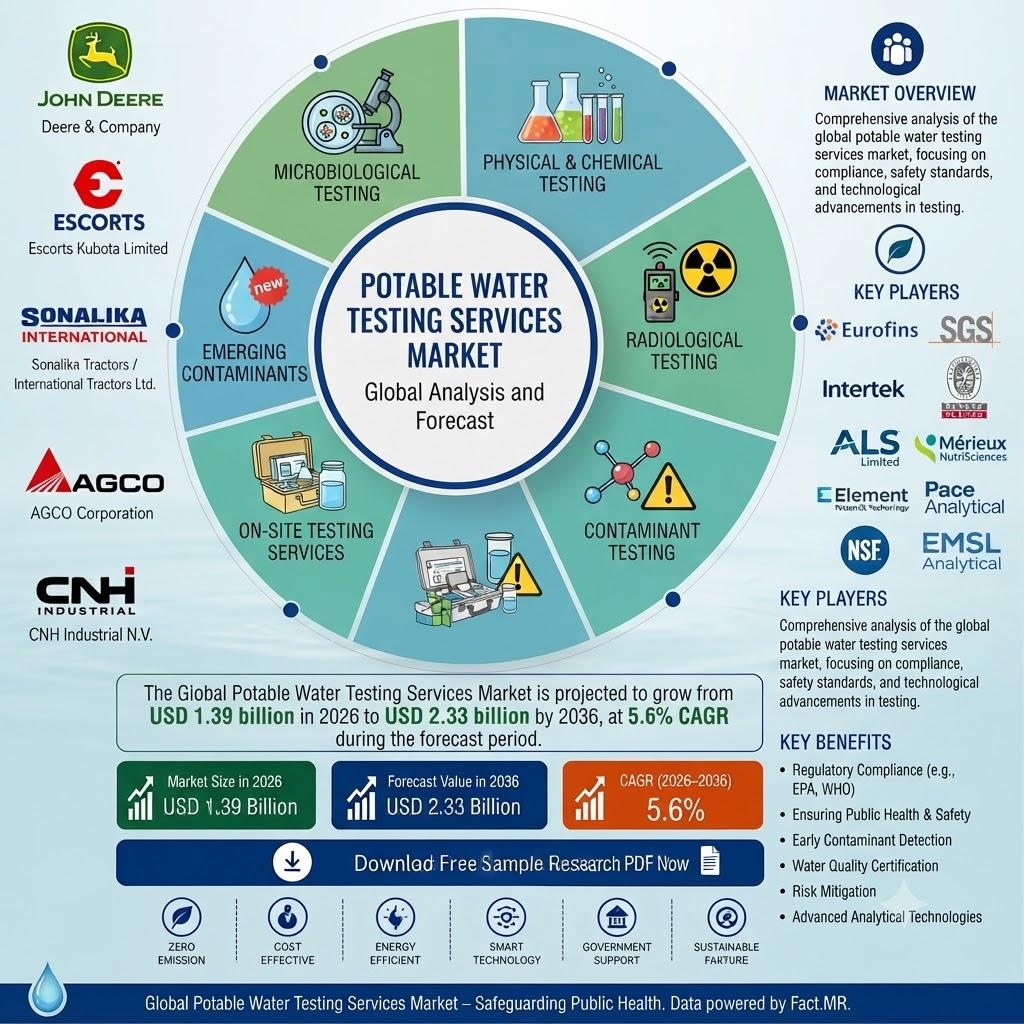
The global potable water testing services market is valued at USD 1.39 billion in 2026 and is projected to reach USD 2.33 billion by 2036, expanding at a 5.6% CAGR during the forecast period. Fact.MR estimates an absolute dollar opportunity of USD 0.94 billion between 2026 and 2036, supported by tighter water quality regulations, rising concerns over pathogens and chemical contaminants, urban infrastructure expansion, and growing requirements for public health protection.
Potable water testing services help utilities, industrial facilities, bottled water brands, and other users identify microbiological, chemical, physical, and mineral contaminants. Testing is becoming more closely linked with regulatory compliance as governments strengthen water safety frameworks and municipalities expand monitoring across treatment and distribution systems.
Get detailed market forecasts, competitive benchmarking, and pricing trends: https://www.factmr.com/connectus/sample?flag=S&rep_id=13417
Microbiological testing leads the service landscape
Microbiological testing accounts for 34.0% share of the market in 2026, making it the leading test type. Its importance is tied to pathogen detection and contamination identification, which remain central to drinking water safety programs.
Testing laboratories are investing in advanced analytical infrastructure to improve detection capabilities and support standardized monitoring. Service providers are also developing testing approaches that can address different water sources and environmental conditions while maintaining reliable analytical performance.
Municipal utilities remain the largest customer segment
Municipal utilities account for 36.0% share in 2026, making them the leading customer segment. Public water systems require routine testing to verify water quality, identify contamination risks, and demonstrate compliance with regulatory requirements.
Industrial facilities, bottled water brands, and commercial buildings represent additional demand centers. Testing requirements vary by application, with routine compliance, incident response, and facility audits forming key sampling models across the market.
China, Brazil, and the U.S. create strong country-level opportunities
China is projected to grow at a 6.9% CAGR through 2036, supported by expanding municipal water infrastructure, environmental regulations, and greater adoption of advanced testing technologies across urban regions.
Brazil follows at 6.4% CAGR, driven by municipal infrastructure investment, environmental awareness, and expanding water quality monitoring capabilities. The U.S. is forecast to grow at 5.4% CAGR, supported by its emphasis on analytical precision, water quality standards, and advanced technology integration.
South Korea is expected to expand at 5.1% CAGR, while Germany and the UK are projected to grow at 5.0% and 4.9%, respectively. Japan is forecast to register a 4.4% CAGR through 2036.
Automated testing and multi-parameter systems reshape service priorities
Automated testing configurations and multi-parameter compatibility are emerging as important market trends. Automated systems can reduce sampling requirements and operational costs while supporting more consistent monitoring.
Service providers are also developing testing systems capable of addressing multiple parameters across different water applications. However, high service costs and the technical complexity of integrating specialized testing protocols into existing water management processes remain constraints on broader adoption.
Analyst Perspective
Fact.MR analysis indicates that potable water testing is increasingly becoming an integral part of public health and water-management infrastructure rather than a periodic compliance activity. The combination of stronger regulatory oversight, expanding municipal systems, and rising contamination concerns is increasing the frequency and scope of testing requirements.
The market is also moving toward more automated analytical workflows as utilities and testing providers seek to reduce operational costs while maintaining reliable contaminant detection and compliance documentation.
Water safety monitoring opens new market opportunities
Expansion of municipal water infrastructure is creating opportunities for testing providers across developing and rapidly urbanizing markets. China and Brazil are expected to remain important growth markets as governments invest in water systems and strengthen environmental monitoring.
Industrial facilities and bottled water brands also provide additional opportunities. These customers require testing to verify quality, support regulatory compliance, and respond quickly to contamination events. Global testing networks can benefit from offering broader analytical coverage and standardized service capabilities across multiple regions.
Competitive landscape
The potable water testing services market is characterized by competition among established environmental laboratories, analytical service providers, and integrated water quality testing companies. Providers are focusing on advanced testing technologies, analytical precision, service networks, and consistent quality control.
Key companies profiled by Fact.MR include Eurofins, SGS, Intertek, Bureau Veritas, ALS Limited, Mérieux NutriSciences, Element Materials Technology, Pace Analytical, NSF, and EMSL Analytical.
Eurofins, SGS, Intertek, and Bureau Veritas maintain broad testing networks serving institutional and commercial customers, while ALS Limited, Mérieux NutriSciences, Element Materials Technology, Pace Analytical, NSF, and EMSL Analytical participate across specialized analytical and environmental testing services.
Market Snapshot
The potable water testing services market is valued at USD 1.39 billion in 2026 and is forecast to reach USD 2.33 billion by 2036 at a 5.6% CAGR. The market is expected to generate an absolute dollar opportunity of USD 0.94 billion during the forecast period. Microbiological testing accounts for 34.0% share, while municipal utilities represent 36.0% share in 2026.
China leads country-level growth at 6.9% CAGR, followed by Brazil at 6.4% and the U.S. at 5.4%. The report covers more than 40 countries and evaluates test type, customer, sampling model, provider type, regional demand, technological developments, and competitive strategies.
The detailed Potable Water Testing Services Market report by Fact.MR provides forecasts through 2036, covering microbiological testing, chemical contaminants, metals and minerals, municipal utilities, bottled water brands, industrial facilities, sampling models, provider types, regional markets, country-level trends, and competitive landscape.
To View Related Reports
https://sportgalax.com/read-blog/24877
https://afgbfh.blogspot.com/2026/10/patient-monitoring-system-market.html
About Fact.MR
Fact.MR is a market research and consulting company providing market intelligence, competitive analysis, and forecasting across global industries. Its research covers emerging technologies, evolving consumer trends, industrial developments, and changing business environments. Fact.MR delivers data-driven insights designed to support strategic planning, investment decisions, and market-entry initiatives.

 English
 Arabic
 French
 Spanish
 Portuguese
 Deutsch
 Turkish
 Dutch
Dutch
 Italiano
 Romaian
 Portuguese (Brazil)
 Greek
Greek
