


Aroma-Infused Liners Market to Grow from USD 175.75M to USD 399M
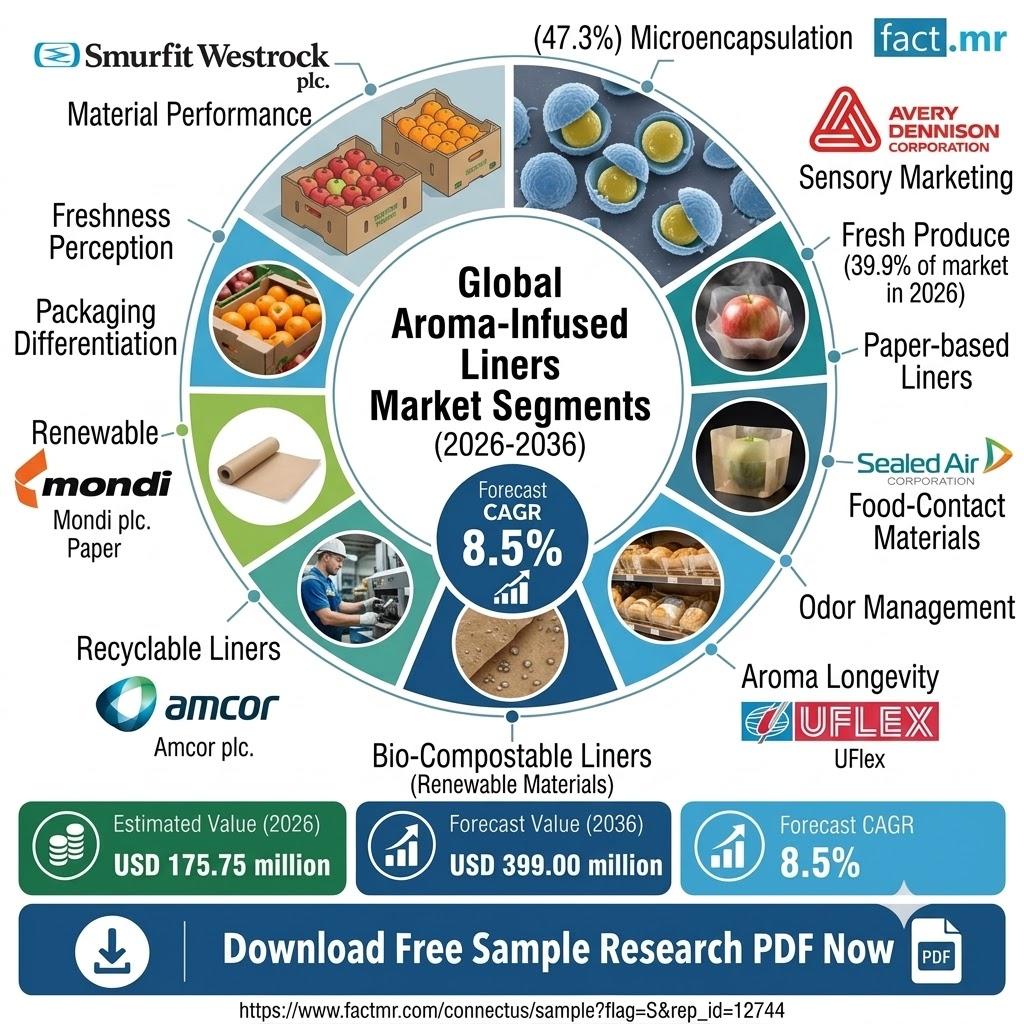
Market expands from USD 175.75 million in 2026 to USD 399.00 million by 2036 at an 8.5% CAGR, led by fresh produce, paper-based liners, and microencapsulation.
October 8, 2026 — The global aroma-infused liners market is projected to reach USD 399.00 million by 2036, rising from USD 175.75 million in 2026 at a CAGR of 8.5%, according to Fact.MR analysis. The market is gaining attention as packaging manufacturers combine sensory appeal with functional liner performance, particularly for food products where freshness, odor management, and presentation influence the consumer experience.
The aroma-infused liners market is being shaped by the growing use of packaging as a direct marketing and product-quality signal. Aroma-infused liners can release curated scents to mask undesirable odors, reinforce brand identity, or influence perceptions of freshness when consumers open or encounter packaged products.
Get detailed market forecasts, competitive benchmarking, and pricing trends: https://www.factmr.com/connectus/sample?flag=S&rep_id=12744
The timing reflects a practical shift in packaging design. Food companies need solutions that perform during transportation and retail display while also meeting rising expectations around sustainable materials. Fact.MR identifies fresh produce as the leading application segment at 39.9%, while paper-based liners account for 42.0% of the product type segment in 2026.
Aroma-Infused Liners Market Growth Reflects Advances in Scent-Control Technology
Microencapsulation holds the leading position among aroma technologies, representing 47.3% of the market in 2026. The technology places aroma oils inside microscopic shells that help limit premature evaporation or degradation. Release can then be triggered by conditions such as friction, moisture, or time.
That detail matters for packaging applications. Consistent scent performance must be maintained from manufacturing through transportation and eventual consumer use. The report's analysis also examines aroma longevity and stability under different humidity and temperature conditions, alongside the recyclability and end-of-life compatibility of infused liners.
Fact.MR is a market research and consulting organization that provides market intelligence, forecasts, and industry analysis across global markets.
The strongest application opportunity comes from fresh produce. The segment's 39.9% share reflects the need to manage ethylene gas and earthy odors during transit and display. Aroma-infused liners can release subtle scents designed to support consumers' perception of freshness and quality at the point of purchase.
Paper-based liners lead product types with a 42.0% share. Their position is tied to the packaging industry's focus on renewable and recyclable materials. Fact.MR notes that aroma technologies have been integrated into porous paper matrices, supporting applications such as bakery products and fresh produce where breathability and an eco-conscious packaging profile are relevant.
"The market is moving toward packaging that does more than contain a product," said a Fact.MR market analyst. "With aroma release becoming more controlled, brands can work on the sensory experience while also considering the material used for the liner."
The competitive environment is also technically demanding. Smurfit Westrock plc., Mondi plc., Amcor plc., UFlex, Sealed Air Corporation, and Avery Dennison Corporation are identified among the key players. Competition centers on combining material expertise with scent technologies while maintaining performance and, where required, recyclability or compostability.
Country-level growth adds another dimension. India is projected to record the fastest CAGR at 12.3% from 2026 to 2036, followed by China at 10.0%, Brazil at 8.0%, the USA at 7.4%, Germany at 7.2%, and Japan at 5.5%.
India's projected 12.3% CAGR is associated with the expansion of modern retail, including supermarkets and quick-commerce platforms, alongside increased consumption of packaged fresh foods, baked goods, and ready-to-eat meals. China's 10.0% CAGR is linked to modernization across its food logistics network and investment in cold-chain infrastructure.
In the USA, a 7.4% CAGR is supported by premium retail applications involving organic produce, artisan bakery products, and ready meals. Germany's 7.2% CAGR reflects demand for technical packaging that combines odor management with recyclable or compostable material profiles.
"Paper-based liners are particularly interesting because the packaging has to carry the aroma technology without losing the material characteristics buyers increasingly expect," said a Fact.MR analyst. "That balance is where much of the technical work is happening."
Cost remains a restraint. Aroma systems can add complexity compared with standard liners, which may limit adoption in low-margin, high-volume applications. Regulations covering volatile organic compounds and food-contact materials also vary across markets.
Fact.MR identifies bio-compostable liners with effective aroma infusion as a key opportunity. The report also evaluates consumer sensory perception, purchase intent, regulatory compliance costs, and scent performance across food categories.
Top trending Reports :
https://ayushjadhavblogs.blogspot.com/2026/10/multi-material-body-in-white-fasteners.html
https://www.panchit.com/blogs/112076/Direct-to-Chip-Cold-Plate-Market-Poised-for-Strong-Growth
https://uddokta64.com/blogs/10938/Oil-Gas-Flow-Control-Equipment-Market-Sees-Rising-Demand-for
About Fact.MR
Fact.MR is a market research and consulting firm providing market intelligence, forecasts, and strategic analysis across industries worldwide. Its research covers market sizing, segmentation, competitive landscapes, regional trends, and emerging technologies.

 English
 Arabic
 French
 Spanish
 Portuguese
 Deutsch
 Turkish
 Dutch
Dutch
 Italiano
 Russian
 Portuguese (Brazil)
 Greek
Greek
