


AWD Coupling System Market to Climb to USD 8.0 Billion by 2036, India Registers 7.2% CAGR
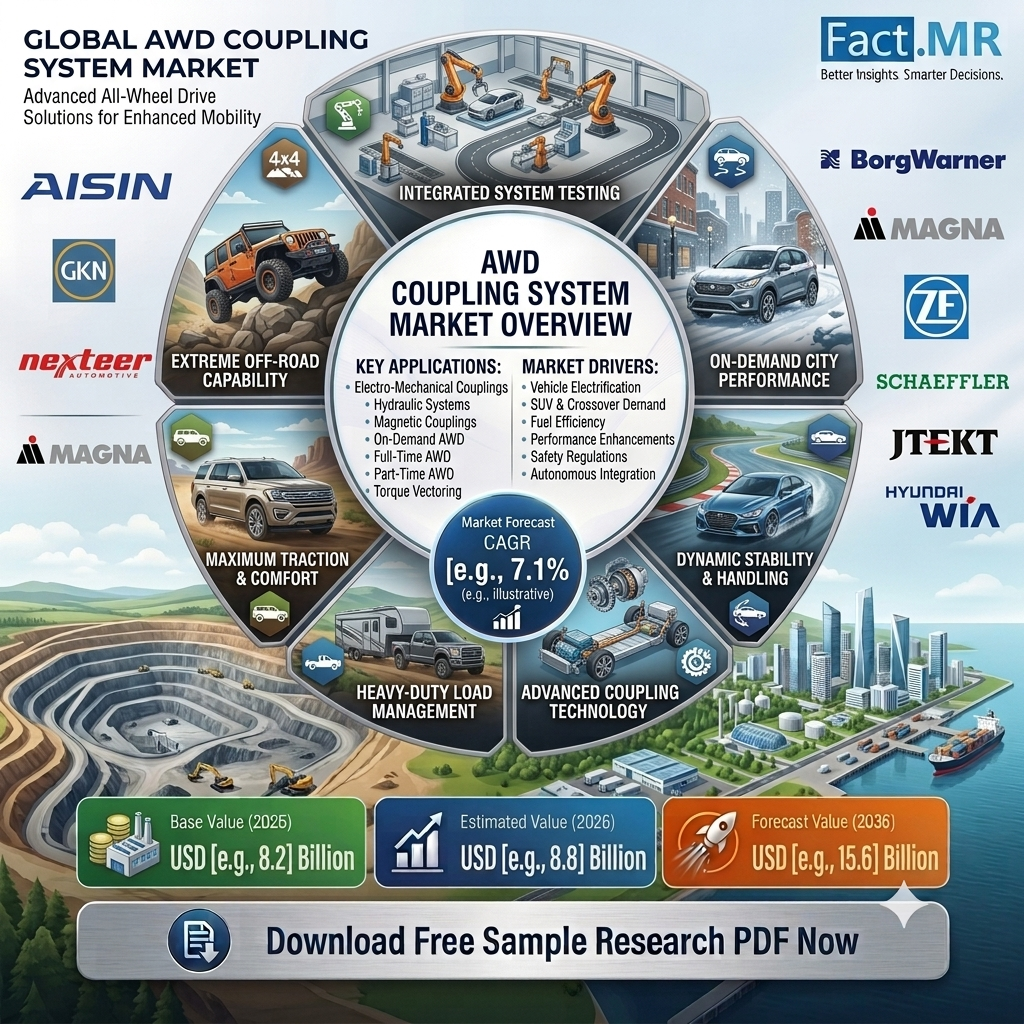
The AWD coupling system market is forecast to expand from USD 5.2 billion in 2026 to USD 8.0 billion by 2036, registering a 4.4% CAGR over the forecast period. Fact.MR attributes this expansion to rising demand for all-wheel-drive systems across SUVs, crossovers, passenger vehicles, and hybrid platforms, as automakers seek to improve traction, fuel efficiency, driving performance, and drivetrain flexibility.
The transition toward electrified and hybrid powertrains is also influencing AWD coupling system development. OEMs and Tier-1 suppliers are focusing on lighter, electronically controlled, and predictive systems that can manage torque more efficiently. Regulatory requirements surrounding vehicle efficiency are further encouraging manufacturers to adopt disconnecting and on-demand AWD technologies that can reduce unnecessary drivetrain losses during normal driving conditions.
Get detailed market forecasts, competitive benchmarking, and pricing trends:
https://www.factmr.com/connectus/sample?flag=S&rep_id=14072
First Fit (OEM) Sales Channel Retains Dominant Position
By sales channel, the First Fit (OEM) segment is expected to account for 84% of the AWD coupling system market in 2026. Its leading position is supported by the increasing integration of AWD coupling hardware and software with vehicle chassis control networks. OEMs are increasingly adopting electronically controlled and on-demand coupling systems to improve traction while reducing weight, complexity, and fuel consumption.
The development of predictive coupling technology is adding another layer of functionality. Sensors can monitor factors such as ambient conditions, vehicle inclination, and traction requirements to engage the secondary axle before wheel slip occurs. This approach enables manufacturers to improve response times while optimizing energy use during changing driving conditions.
ICE or HEV powertrains represent another major area of demand, accounting for 74% of the market in 2026. These vehicles continue to rely on mechanical or electro-hydraulic coupling systems to transfer torque between axles. Rising hybrid vehicle adoption is supporting demand because AWD coupling systems must increasingly manage torque blending between internal combustion engines and electric motors.
On-demand coupling systems are also gaining importance, with this coupling type projected to command a 50.0% share of the market in 2026. Their ability to engage the secondary axle when required and disconnect it during stable driving conditions makes them relevant to automakers seeking a balance between all-weather traction and improved fuel efficiency.
India, China, and Germany Show Strong Growth Potential
India is projected to register the fastest growth among the highlighted countries, advancing at a 7.2% CAGR from 2026 to 2036. The expansion of the domestic SUV market and rising consumer preference for AWD in premium and mid-size models are supporting demand. Production Linked Incentive initiatives and increasing localization of electronic AWD controllers are also strengthening the country's position in the automotive component supply chain.
China is expected to record a 5.9% CAGR during the same period. Strong passenger vehicle production and increasing AWD penetration in mid-premium segments are supporting market development. The growing use of plug-in hybrid and extended-range electric vehicles is creating additional demand for compact, high-torque AWD coupling systems capable of coordinating engine and electric-motor operation.
Germany is projected to advance at a 4.3% CAGR through 2036. Premium OEM production, performance vehicles, and sophisticated AWD applications are supporting demand for high-precision coupling systems. Preparations surrounding Euro 7 requirements are also encouraging manufacturers to improve drivetrain efficiency and integrate intelligent torque-management technologies into next-generation AWD platforms.
The USA and South Korea are also important markets, with projected CAGRs of 5.0% and 4.9%, respectively. SUV and crossover demand is supporting AWD adoption in the USA, while South Korea is seeing greater use of electronically controlled AWD systems and lightweight driveline components.
Competitive Landscape
Competition in the AWD coupling system market includes established automotive drivetrain manufacturers with capabilities spanning mechanical, electro-hydraulic, electronic, and software-controlled AWD technologies. Key companies profiled by Fact.MR include ZF Friedrichshafen AG, BorgWarner Inc., GKN Automotive, Magna International Inc., Haldex AB, Aisin Corporation, Schaeffler AG, JTEKT Corporation, Dana Incorporated, and Nidec Corporation.
Competition is increasingly shifting toward integrated traction-management solutions. ZF and BorgWarner are advancing software-oriented AWD architectures, while GKN Automotive and Magna are developing modular eDrive platforms that can provide AWD capability through independent electric drive units. Remanufacturing and recycling initiatives are also becoming more relevant as suppliers seek to reduce lifecycle emissions and improve resource efficiency.
Electrification and Intelligent AWD Technology Shape the Market
The AWD coupling system market is undergoing a technology transition as manufacturers move from conventional mechanical friction devices toward electronically controlled and software-defined traction systems. Predictive coupling can respond to environmental and vehicle conditions before wheel slip occurs, while disconnecting AWD systems can decouple the secondary axle during stable highway driving to reduce parasitic losses.
Electrification is creating both opportunities and challenges for traditional AWD coupling suppliers. ICE and hybrid vehicles continue to require coupling systems, while many BEVs use dual-motor architectures or electric rear drive units instead of conventional mechanical AWD components. This is encouraging drivetrain suppliers to develop modular eDrive systems, integrated controllers, and technologies capable of supporting hybrid and electrified vehicle platforms.
As automakers increase the use of SUVs, hybrid powertrains, predictive traction control, and electronically managed drivetrains, AWD coupling systems are expected to remain an important component of vehicle performance and efficiency strategies. The full Fact.MR report provides detailed forecasts, segment analysis, country-level outlooks, competitive assessment, and technology trends through 2036.
Top Reports:
https://adamaamresearch.blogspot.com/2026/10/laparoscopic-gynecological-procedures.html
https://zeuspage.org/blogs/67414/Laparoscopic-Gynecological-Procedures-Market-Size-to-Reach-USD-29-3
https://kaamkaaziclub.com/read-blog/66657
https://net-pals.com/blogs/45886/Laparoscopic-Gynecological-Procedures-Market-Poised-to-Reach-USD-29-3
About Fact.MR
Fact.MR is a market research and consulting company providing market intelligence, competitive analysis, and forecasting across global industries. Its research supports businesses with data-driven insights into emerging markets, technology trends, competitive dynamics, regional opportunities, and changing demand patterns.

 Arabic
 French
 Spanish
 Portuguese
 Deutsch
 Turkish
 Dutch
Dutch
 Italiano
 Russian
 Romaian
 Portuguese (Brazil)
 Greek
Greek
