


Oil & Gas Flow Control Equipment Market Sees Rising Demand for Digital Valves
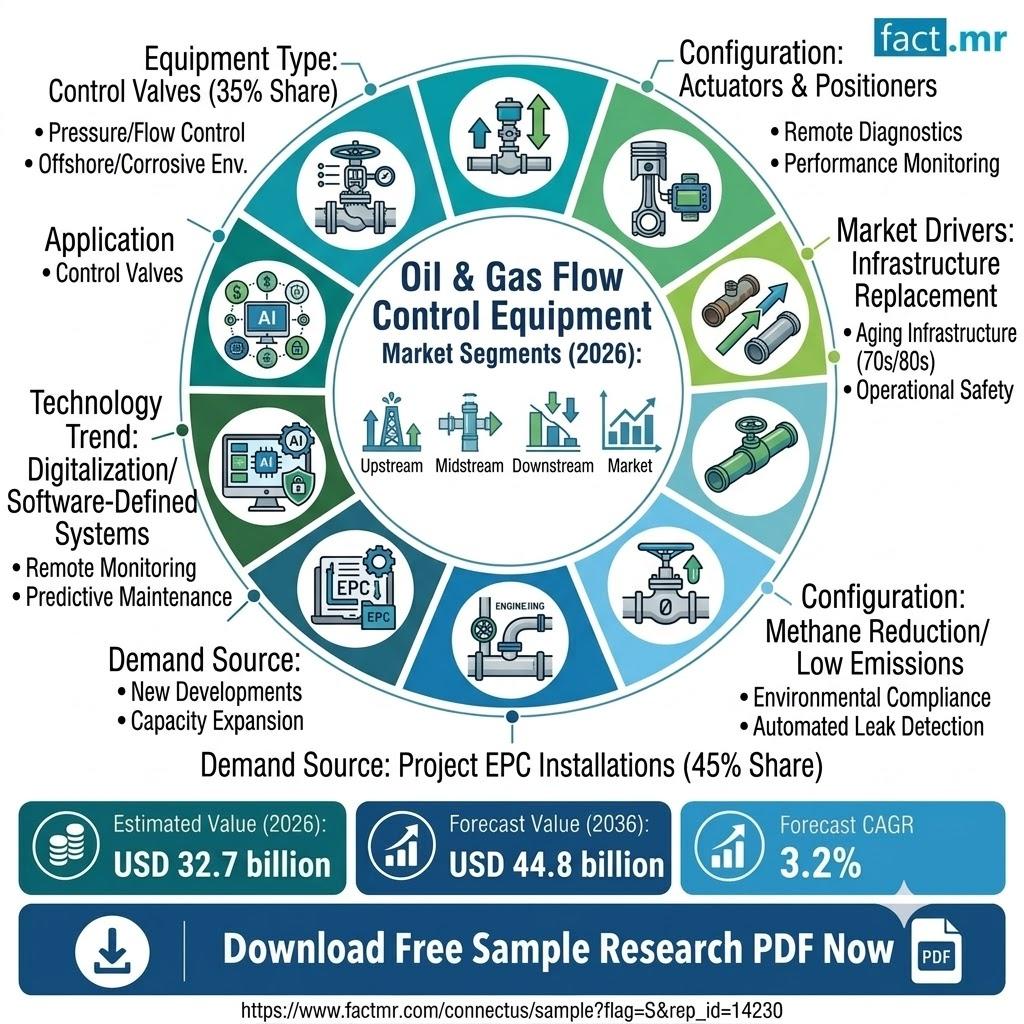
The oil & gas flow control equipment market is projected to grow at a 3.2% CAGR from 2026 to 2036, driven by infrastructure replacement and digital control systems.
ROCKVILLE, MD — October 7, 2026 — The global oil & gas flow control equipment market is projected to increase from USD 32.7 billion in 2026 to USD 44.81 billion by 2036, expanding at a compound annual growth rate (CAGR) of 3.2%, according to Fact.MR. Demand is being supported by aging oil and gas infrastructure, investments in new energy projects, and the adoption of digitally enabled flow control equipment.
The market serves upstream production, midstream transportation, and downstream processing operations. Operators need equipment that can regulate pressure, temperature, and fluid movement under demanding conditions. Fact.MR identifines control valves as the leading equipment category, accounting for 35% of the market in 2026. Project engineering, procurement, and construction (EPC) installations represent 45% of total demand, reflecting the role of new developments and capacity expansions in equipment purchasing.
Get detailed market forecasts, competitive benchmarking, and pricing trends: https://www.factmr.com/connectus/sample?flag=S&rep_id=14230
Oil & Gas Flow Control Equipment Market: Replacement Demand and Digitalization Shape Investment
Much of the industry's installed infrastructure dates to the construction boom of the 1970s and 1980s. As this equipment approaches the end of its service life, operators are introducing phased replacement programs to maintain operational safety and reliability. The need to replace aging assets is creating a continuing source of demand alongside purchases for new production facilities and processing capacity.
Equipment selection depends on operating conditions. Control valves, actuators, chokes, and manifold or wellhead assemblies must perform reliably in environments involving corrosive fluids, high pressure, and changing temperatures. According to Fact.MR, some control valve applications face pressures exceeding 10,000 psi, while offshore installations must withstand saltwater corrosion and challenging subsea conditions.
These requirements influence material specifications and equipment design. Carbon steel, alloy steel, and stainless or exotic materials serve different operating needs. Digital valve controllers also support remote diagnostics and continuous performance monitoring, helping operators identify maintenance requirements before equipment problems interrupt operations.
Software-Defined Systems Change Flow Control Requirements
The industry is moving beyond conventional mechanical equipment toward integrated platforms combining valves, actuators, positioners, and analytics software. These systems allow operators to monitor equipment performance and adjust operations using digital information rather than relying entirely on traditional control arrangements.
Emerson Electric's Project Beyond illustrates this direction. The initiative focuses on software-defined automation and operational technology, including artificial intelligence, machine learning, and cybersecurity capabilities. Such approaches can allow operators to update system functionality through software enhancements instead of replacing hardware whenever control requirements change.
Environmental compliance is another consideration. Methane reduction initiatives are increasing attention on low-emission valves, zero-venting technologies, automated leak detection, and continuous monitoring. In the United Kingdom, regulatory requirements and North Sea operations are contributing to interest in enhanced telemetry and remote monitoring capabilities.
China Leads Country-Level Market Growth
China is forecast to record the fastest growth among the countries assessed by Fact.MR, with a CAGR of 5.0% from 2026 to 2036. Pipeline expansion targeting 240,000 kilometers of infrastructure is supporting demand for high-pressure valves, actuators, and related safety equipment. Investments connected with energy security and natural gas transportation are also contributing to equipment requirements.
Brazil follows with a projected CAGR of 4.6%. Pre-salt offshore developments and infrastructure programs associated with Petrobras are supporting demand for equipment designed for deepwater operations and corrosive environments. Refinery modernization and natural gas pipeline expansion add to the country's requirements.
The United States and United Kingdom are each projected to grow at a 3.5% CAGR over the forecast period. In the United States, refinery upgrades, shale basin maintenance, and LNG export terminal expansion support equipment demand. In the United Kingdom, aging infrastructure replacement and methane reduction initiatives are shaping investment priorities.
Germany is forecast to grow at 3.4%, supported by industrial modernization and hydrogen infrastructure development. South Korea is projected to expand at 3.0%, reflecting demand associated with LNG carrier construction and petrochemical operations. Japan records a projected CAGR of 2.3%, with maintenance and LNG import terminal operations supporting demand despite slower domestic fossil fuel demand.
Competitive Priorities Extend Beyond Mechanical Equipment
Competition increasingly involves digital capabilities, application expertise, and lifecycle services. Major participants identified by Fact.MR include Emerson (Fisher), SLB Cameron, Baker Hughes, SAMSON, Flowserve, IMI, Velan, Metso Neles, CIRCOR, and KOSO.
Suppliers are developing solutions for demanding applications where material performance, precise control, and reliability influence equipment selection. Digital monitoring and predictive maintenance are also becoming important areas of product development. At the same time, hydrogen production and carbon capture projects are creating potential applications for specialized valves and materials, although these uses require appropriate testing and material validation.
The market continues to face constraints. Oil price volatility can delay capital-intensive upstream projects, while specialty alloy availability and long lead times can affect delivery schedules. Companies must also manage skilled labor shortages and uncertainty around long-term energy investment.
Market Outlook Through 2036
Fact.MR projects the oil & gas flow control equipment market will reach USD 44.81 billion by 2036. Replacement programs, project EPC installations, and digital control upgrades are expected to remain important sources of demand during the forecast period. Country-level growth will vary, with China and Brazil recording the highest projected CAGRs among the seven countries detailed in the report.
Fact.MR is a market research and consulting company that provides industry analysis, market forecasts, and strategic insights to support business decision-making. Its research examines market size, segment performance, regional developments, and competitive positioning across industries.
Top Trending Reports :
https://ayushjadhavblogs.blogspot.com/2026/10/dysphagia-diet-thickening-agent-market.html
https://uddokta64.com/blogs/10706/Dental-Loupe-Market-Set-to-Double-as-Demand-for-Dental
About Fact.MR
Fact.MR is a market research and consulting company providing market intelligence, industry forecasts, and strategic analysis across global markets. The Direct-to-Chip Cold Plate Market study covers market value, cooling configuration, end application, material, distribution channel, regional performance, and key companies through 2036.

 English
 Arabic
 French
 Spanish
 Portuguese
 Deutsch
 Turkish
 Dutch
Dutch
 Italiano
 Romaian
 Portuguese (Brazil)
 Greek
Greek
