


How to Organize Your Moving Boxes Before Moving Day
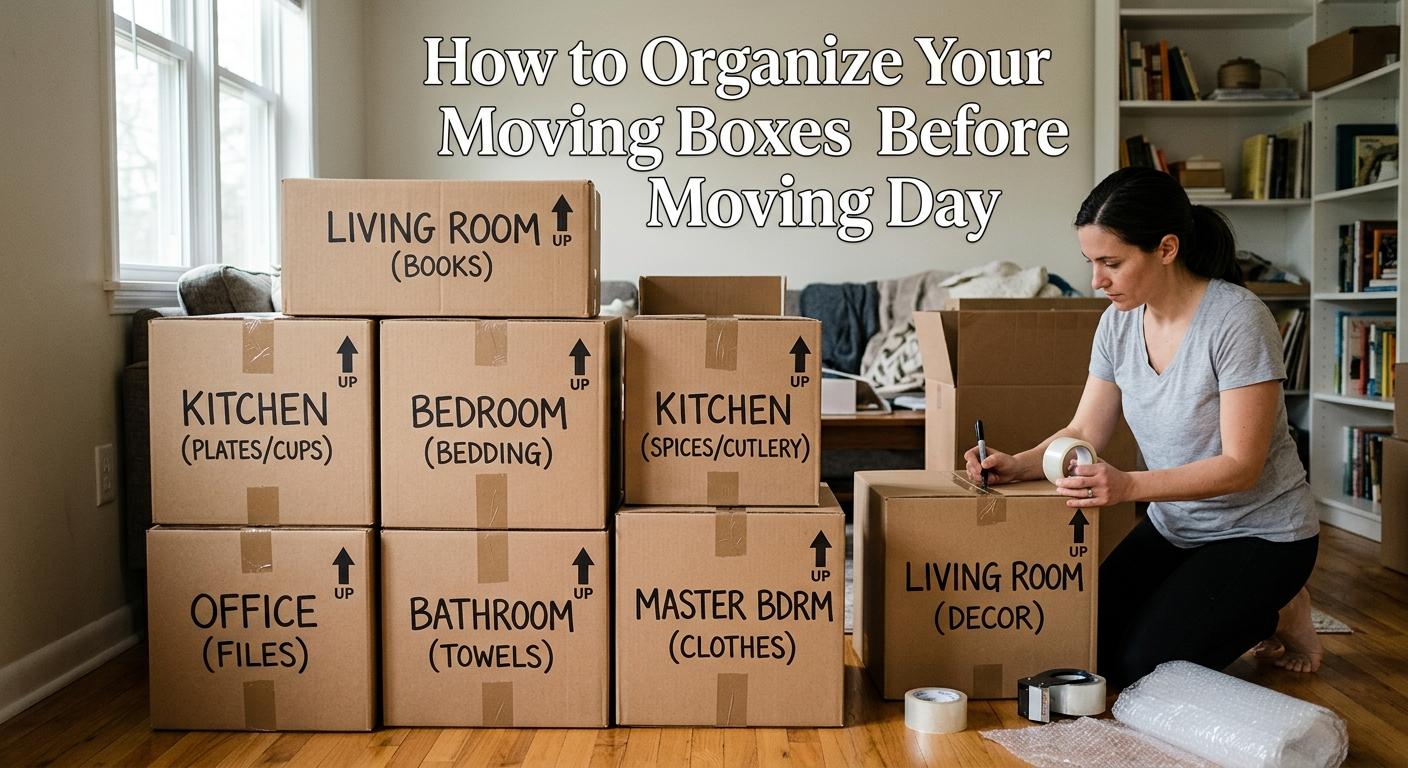
Moving day becomes much easier when every box has a purpose, a label, and a designated destination.
Without a clear system, even carefully packed belongings can turn into a confusing pile once the truck arrives.
A little organization before moving day can save hours of searching, lifting, rearranging, and unpacking later.
The best approach is not simply to pack everything that fits into a box. A household needs a system that makes sense during packing, loading, transportation, and unpacking.
Here is how to build one.
Start Organizing Before the First Box Is Packed
Good box organization actually begins before packing.
One of the biggest mistakes households make is buying boxes and immediately filling them with whatever is nearby. That approach may clear a room quickly, but it creates problems when boxes need to be sorted at the new home.
Instead, belongings should first be divided into four basic groups:
-
Items that will move to the new home
-
Items that can be donated
-
Items that can be sold
-
Items that should be discarded or recycled
This reduces the number of unnecessary belongings that need to be packed, transported, and unpacked.
For households still comparing movers, planning costs, or researching the moving process, My Moving Journey can also be used as a moving directory and resource website while preparing for relocation.
Once unwanted items have been removed, packing becomes much more systematic.
Create a Room-by-Room Packing System
Every box should belong to one room whenever possible.
Mixing kitchen utensils, bedroom accessories, books, and bathroom products in the same carton might save a box, but it usually creates more work later.
A room-based system allows movers or family members to place boxes directly where they belong.
For example:
-
Kitchen — K01, K02, K03
-
Primary bedroom — PB01, PB02, PB03
-
Living room — LR01, LR02, LR03
-
Bathroom — B01, B02
-
Home office — HO01, HO02
Numbering boxes also makes it easier to build an inventory.
If a household has eight kitchen boxes, the list should show K01 through K08. If only seven arrive at the destination, the missing carton can be identified immediately.
Keep Similar Items Together
Room organization can be taken one step further by grouping similar belongings.
A kitchen, for example, contains several very different categories. Glassware should not necessarily be packed with heavy cookware, even though both belong in the same room.
Instead, boxes can be divided into groups such as:
-
Everyday dishes
-
Glassware
-
Pots and pans
-
Small appliances
-
Pantry goods
-
Baking supplies
This approach makes unpacking more controlled because each box can be opened when its contents are actually needed.
Use the Right Box for the Right Items
Not every moving box should be treated the same.
Smaller boxes generally work better for dense, heavy belongings such as books, canned goods, tools, and certain kitchen items. Larger cartons are more practical for lightweight belongings such as bedding, pillows, towels, and clothing.
Overloading a large box with books is a common packing mistake. It can make the carton difficult to lift and increase the chance of the bottom failing during handling.
Specialty boxes may also be useful for particular belongings. Wardrobe boxes, dish packs, mirror cartons, and television boxes provide shapes or protective features designed for items that can be awkward to pack in standard cartons.
Whenever possible, sturdy corrugated boxes should be used instead of damaged cartons that have already lost their structural strength.
Estimate Packing Supplies Before Packing Gets Serious
Running out of boxes halfway through packing often disrupts an otherwise organized process.
The number of boxes required varies considerably based on the size of the home, number of occupants, storage habits, and amount of clutter accumulated over time. Two households living in equally sized apartments can require very different quantities of packing materials.
That is why estimates should be treated as planning figures rather than guarantees.
A household that wants a starting point can use a moving packing calculator to estimate the packing supplies that may be required based on the move.
It is also sensible to keep a few additional boxes, rolls of tape, markers, and protective materials available for last-minute belongings.
Build a Labeling System That Anyone Can Understand
Writing “stuff” on the side of a carton is not an effective labeling system.
A useful label should answer at least three questions:
Where does this box go?
What type of items are inside?
Does it require special handling?
For example:
KITCHEN — K04 — GLASSWARE — FRAGILE
That label provides much more information than simply writing “Kitchen.”
Labels should appear on the top and at least one or two sides of each carton. Boxes are often stacked during transportation, which means a label written only on top may become impossible to see.
Consider Color Coding
Color coding can make room identification even faster.
A household might assign:
-
Blue to bedrooms
-
Green to the kitchen
-
Yellow to the living room
-
Orange to bathrooms
-
Purple to the home office
Colored tape, stickers, or large markers can be used.
A matching color can also be placed on the doorway of each room at the destination. Movers can then identify where a carton belongs without repeatedly asking for directions.
The system should remain simple. Too many colors, symbols, and categories can make organization harder rather than easier.
Create a Simple Box Inventory
An inventory does not need to list every spoon, shirt, or book.
It only needs enough information to identify the general contents of each box.
A basic inventory might look like this:
K01 — Pots and pans
K02 — Plates and bowls
K03 — Small appliances
PB01 — Everyday clothing
PB02 — Shoes and accessories
LR01 — Books
The inventory can be maintained on paper, in a spreadsheet, or in a notes app.
For valuable items, more detail may be appropriate. Photos of electronics, furniture, artwork, and other higher-value belongings can also help document their condition before transportation.
Receipts, serial numbers, and appraisal records for particularly valuable possessions should be stored separately from ordinary moving boxes.
Mark Fragile Boxes Clearly
Fragile belongings require more than additional packing material.
The outside of the box should clearly indicate that careful handling is necessary.
Labels such as FRAGILE, GLASS, THIS SIDE UP, or DO NOT STACK should be easy to see.
Inside the carton, empty spaces should be minimized so objects cannot move freely during transportation. Packing paper, appropriate cushioning materials, and dividers can help reduce movement.
Plates are commonly packed vertically rather than laid completely flat in a stack because proper vertical packing can help distribute pressure more effectively. Glasses and other breakable objects should be individually protected rather than placed loosely together.
The carton should also be strong enough for the weight of its contents.
Separate Items That Should Not Go on the Moving Truck
Some belongings should remain with the household instead of being packed into the main shipment.
These commonly include:
-
Identification documents
-
Passports
-
Important financial or legal records
-
Keys
-
Essential medications
-
Phones and chargers
-
Jewelry and small valuables
-
Moving paperwork
-
Wallets and payment cards
Professional movers may also restrict certain hazardous materials, including some flammable, explosive, or corrosive products.
Requirements can differ between companies, so customers should check the mover's prohibited-items policy before packing chemicals, fuel, propane, paint, or similar products.
Prepare an Essentials Box for the First 24 Hours
One box should be treated differently from every other carton.
The essentials box contains belongings the household will need immediately after reaching the new home.
It might include:
-
Toilet paper
-
Basic toiletries
-
Towels
-
A change of clothes
-
Phone chargers
-
Basic cleaning supplies
-
Paper towels
-
A few cups and plates
-
Simple tools
-
Snacks and bottled water
-
Pet essentials, when applicable
This box should be labeled clearly and kept somewhere accessible.
It makes little sense to place the first-night box at the back of a fully loaded moving truck where it cannot be reached until everything else has been unloaded.
Create a Separate Open-First Category
The essentials box handles immediate personal needs, but several household boxes may also deserve priority.
These can be labeled OPEN FIRST.
Examples might include basic cookware, children's bedtime items, coffee-making supplies, work equipment, shower supplies, or bedding.
This creates an unpacking hierarchy:
-
Essentials
-
Open-first boxes
-
Everyday belongings
-
Nonessential items
-
Storage and seasonal belongings
Instead of opening random boxes, the household knows exactly where to begin.
Organize Boxes by Weight Before Moving Day
Box organization also affects loading.
As a general handling principle, heavier and sturdier cartons should remain below lighter or more delicate ones when boxes are stacked.
Heavy cartons placed on top of lightweight boxes can crush the boxes underneath.
Each box should also remain at a manageable lifting weight. A carton that is technically strong enough to hold an item may still be unsafe or impractical for one person to carry.
When a box becomes difficult to lift comfortably, the contents should be divided between smaller cartons.
Do Not Leave Boxes in Walkways
As moving day approaches, packed boxes often begin taking over the home.
They should not block:
-
Hallways
-
Staircases
-
Entry doors
-
Main walking routes
-
Access to frequently used rooms
Keeping pathways clear reduces unnecessary obstacles for anyone carrying furniture or boxes.
If possible, completed cartons can be grouped along walls or in a designated staging area while leaving clear paths through the home.
Finish Most Packing Before the Movers Arrive
Moving morning should not become packing morning.
Unless professional packing services have been arranged, most belongings should already be boxed, sealed, and labeled before the moving crew arrives.
Last-minute packing can slow down loading and create rushed decisions.
A final walkthrough the evening before moving day should check whether anything remains in:
-
Cabinets
-
Closets
-
Drawers
-
Attics
-
Basements
-
Garages
-
Outdoor storage areas
-
Behind doors
-
Under beds
Chargers, cleaning products, bathroom items, and food stored in refrigerators or cabinets are particularly easy to overlook.
Avoid These Common Box Organization Mistakes
Even a good packing plan can fail because of a few simple mistakes.
Using Vague Labels
“Bedroom” is better than no label, but “Bedroom — Bedding — B03” provides much more useful information.
Mixing Several Rooms in One Box
Mixed boxes create unnecessary sorting at the destination. Room-specific packing is usually more efficient.
Making Boxes Too Heavy
Large boxes encourage overpacking. Heavy belongings should generally be distributed among smaller cartons.
Forgetting an Inventory
Without box numbers or an inventory, it becomes harder to notice whether something is missing.
Packing Essential Documents
Important documents should remain accessible rather than being buried among household belongings.
Leaving Everything Until the Final Days
Packing under time pressure often leads to poor labeling, overloaded cartons, and unnecessary items being moved.
A Final Box Check Before Moving Day
Before moving day begins, each carton should pass a quick check.
The household should confirm that:
-
The bottom is securely taped.
-
The top is properly closed.
-
The box has a room label.
-
A box number has been assigned.
-
Fragile contents are clearly identified.
-
The carton is not excessively heavy.
-
Empty space inside has been filled where necessary.
-
Essential belongings have been separated.
-
Important documents and valuables are being carried personally.
-
The inventory reflects all packed boxes.
This final review can catch small problems before they become moving-day problems.
Conclusion
Organizing moving boxes is less about creating a perfect packing system and more about making every stage of the move easier to manage.
Room codes, clear labels, box numbers, sensible weight distribution, an inventory, and a dedicated essentials box provide a practical structure from the moment packing begins until the last carton is opened.
When each box has an obvious destination and priority, movers can unload more efficiently and the household can start unpacking without searching through dozens of mystery cartons. A few extra minutes spent organizing before moving day can prevent hours of confusion after arrival.

 English
 Arabic
 French
 Spanish
 Portuguese
 Turkish
 Dutch
Dutch
 Italiano
 Russian
 Romaian
 Portuguese (Brazil)
 Greek
Greek
