


Cell Expansion Market Set to Hit USD 86.7 Billion by 2036, India - CAGR 15.9%, China - CAGR 15.4%, USA - CAGR 11.8%
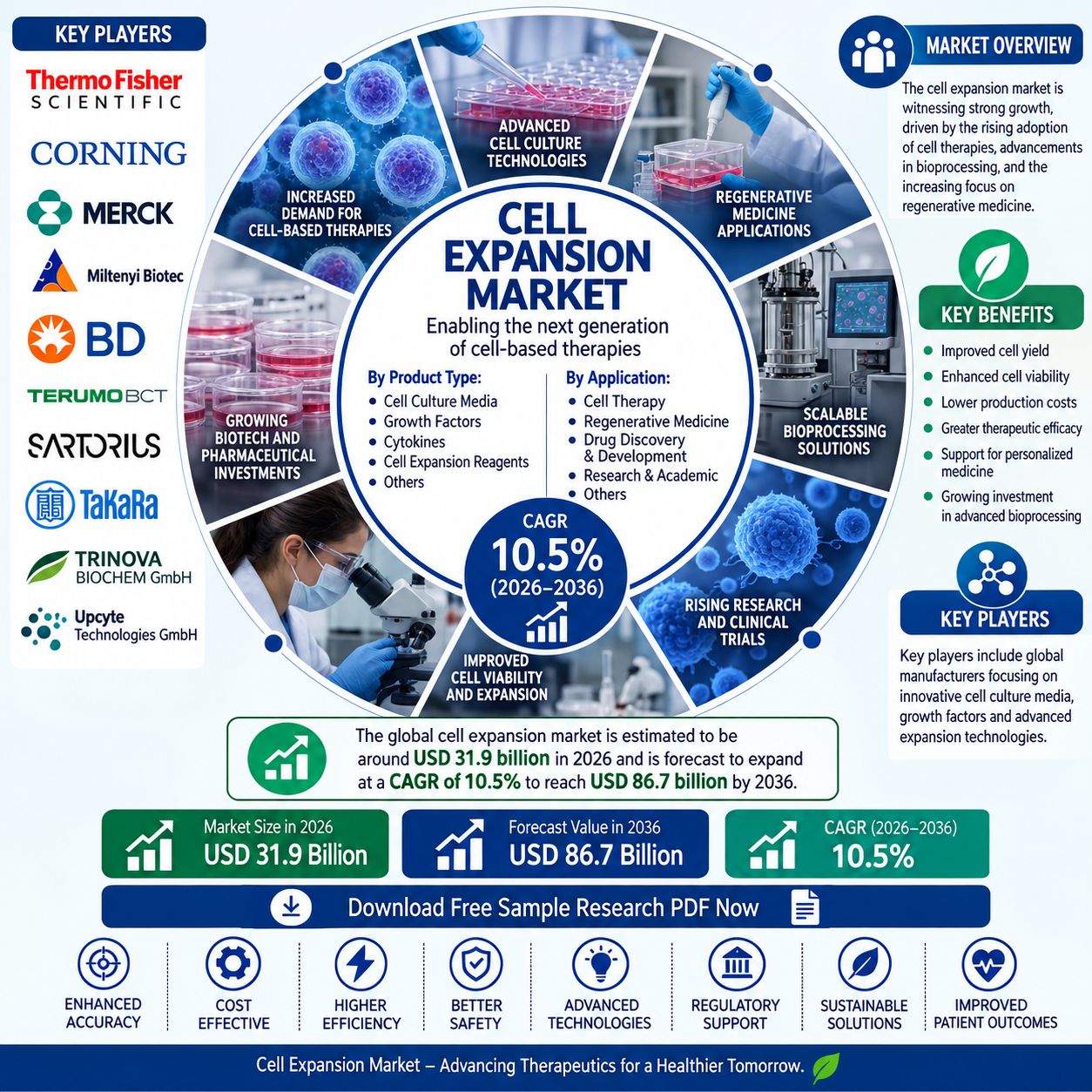
The global cell expansion market is estimated at USD 31.9 billion in 2026 and is projected to reach USD 86.7 billion by 2036, expanding at a 10.5% CAGR during the forecast period. Fact.MR estimates an absolute dollar opportunity of USD 54.7 billion between 2026 and 2036, as expanding cell and gene therapy pipelines, commercial production of approved cell therapies, and rising biopharmaceutical manufacturing capacity increase demand for scalable cell expansion systems and consumables.
The market covers cell expansion systems, culture media, reagents and supplements, culture vessels, and bioreactors used to scale cell populations for therapeutic and production applications. The transition from manual flask-based culture toward automated and closed-system expansion is becoming increasingly important as manufacturers seek greater process control, reproducibility, and contamination risk reduction.
Growing investment in stem cell biology, cancer immunology, regenerative medicine, and cell therapy research is also sustaining demand. At the commercial level, the expansion of CAR-T and other cell therapies is shifting requirements from clinical-scale processing toward larger and more standardized manufacturing workflows.
Get detailed market forecasts, competitive benchmarking, and pricing trends: https://www.factmr.com/connectus/sample?flag=S&rep_id=11809
Cell expansion systems lead the product landscape
Cell expansion systems account for 44% of the product segment in 2026, making them the leading product category. Automated and closed-system bioreactor platforms are increasingly used for therapeutic cell manufacturing, where regulatory expectations for process control and batch consistency favor validated systems over manual expansion methods.
Cell culture media represents another major product category, including serum-free, chemically defined, and specialized stem cell formulations. Reagents and supplements such as growth factors, cytokines, and interleukins support expansion optimization, while cell culture vessels and bioreactors complete the broader product landscape.
Cell and gene therapy accounts for 52% of application demand in 2026, driven by CAR-T cell expansion, autologous cell therapy manufacturing, and allogeneic cell therapy production. Autologous manufacturing creates particularly high per-patient consumable requirements because each treatment campaign is designed around an individual patient.
Pharmaceutical and biotechnology companies account for 58% of end-use demand in 2026, reflecting the concentration of commercial cell expansion requirements in therapy manufacturing and biopharmaceutical production.
India, China, and the USA create strong country-level opportunities
India is projected to be the fastest-growing major market, advancing at a 15.9% CAGR through 2036. Growing investment in cell therapy manufacturing, expanding biopharmaceutical production capacity, and increased research spending on stem cell biology and immunology are supporting demand for expansion systems and consumables.
China follows with a projected 15.4% CAGR, supported by national biotechnology programs, commercial cell therapy manufacturing expansion, and investment in automated bioprocessing infrastructure. Government-supported cell therapy centers are also creating concentrated demand for automated expansion platforms and validated consumables.
The USA is forecast to expand at an 11.8% CAGR, supported by its large concentration of cell therapy developers, commercial manufacturing facilities, CDMOs, and established automated expansion platforms.
Brazil is projected to grow at a 12.3% CAGR, while Germany and France are expected to expand at 10.6% and 10.2%, respectively. Japan is forecast to register a 9.9% CAGR through 2036.
Automated closed-system platforms reshape competitive priorities
The transition from manual, open flask-based culture toward automated, functionally closed bioreactor systems is emerging as the defining product trend in the cell expansion market. These platforms can integrate cell seeding, feeding, monitoring, and harvesting within a controlled workflow.
Growing commercial approval of cell therapies is increasing the installed base of automated expansion platforms. Each installation can also generate recurring demand for media, reagent sets, disposable tubing, and culture bags, creating an ongoing consumables opportunity for suppliers with integrated product portfolios.
Bioreactors are identified as the fastest-growing product sub-segment, supported by single-use adoption and increasing cell therapy manufacturing requirements. Integration with process analytical technology, electronic batch recording, and real-time monitoring is creating additional opportunities for platform manufacturers.
Analyst Perspective
Shambhu Nath Jha, Principal Consultant at Fact.MR, said: “The cell expansion market is at an inflection point where the transition from clinical-scale manual expansion to commercial-scale automated production is creating the largest growth opportunity. Companies that offer integrated expansion platforms combining automated hardware, optimized media, and process monitoring will capture disproportionate share.
The convergence of cell therapy manufacturing with industrial bioprocessing principles is reshaping the competitive dynamics, with traditional bioprocessing companies and specialized cell therapy equipment makers competing for the same commercial manufacturing contracts.”
Commercial cell therapy scale-up opens new opportunities
Commercial cell therapy manufacturing represents one of the highest-value demand channels for integrated expansion platforms and consumables. As approved therapies move into larger-scale production, manufacturers require validated systems capable of maintaining consistency across increasingly complex manufacturing campaigns.
Allogeneic cell therapy is another important opportunity. Unlike patient-specific autologous production, allogeneic therapies can require substantially larger batch sizes, creating demand for industrial-scale expansion systems with higher throughput.
The expansion of contract cell therapy manufacturing capacity is also creating opportunities for suppliers. CDMOs require validated expansion platforms and standardized consumable supplies to support outsourced manufacturing programs.
At the same time, high capital costs can limit adoption among smaller therapy developers and research institutions. Long validation timelines and supply-chain concentration for specialized media and growth factors also remain important constraints.
Competitive landscape
The cell expansion market includes broad-portfolio bioprocessing companies as well as specialized cell therapy equipment manufacturers. Key companies profiled by Fact.MR include Thermo Fisher Scientific Inc., Corning Incorporated, Merck KGaA, Miltenyi Biotec, BD (Becton, Dickinson and Company), Terumo BCT, Inc., Sartorius AG, Takara Bio Inc., TRINOVA BIOCHEM GmbH, and Upcyte Technologies GmbH.
Thermo Fisher Scientific, Merck KGaA, and Corning Incorporated hold leading positions through broad portfolios spanning media, reagents, vessels, and bioreactor systems. Miltenyi Biotec and Terumo BCT compete through specialized platforms for immune-cell and stem-cell manufacturing, while BD, Sartorius, Takara Bio, TRINOVA BIOCHEM, and Upcyte Technologies participate through focused cell therapy and bioprocessing technologies.
Recent industry developments include Miltenyi Biotec's 2025 expansion of CliniMACS Prodigy capabilities, Terumo BCT's 2025 enhancements to the Quantum Cell Expansion System, and Thermo Fisher Scientific's 2026 expansion of cell therapy media and expansion reagent manufacturing capacity.
Market Snapshot
The cell expansion market is valued at USD 31.9 billion in 2026 and is forecast to reach USD 86.7 billion by 2036 at a 10.5% CAGR. Cell expansion systems account for 44% of the product segment, while cell and gene therapy represents 52% of application demand. Pharmaceutical and biotechnology companies lead end use with a 58% share. India leads country-level growth at 15.9%, followed by China at 15.4% and Brazil at 12.3%.
The detailed Cell Expansion Market report by Fact.MR provides forecasts through 2036, including analysis by product, application, end use, region, technology, formulation, distribution channel, competitive landscape, and emerging automated cell expansion technologies.
To View Top Reports
https://afgbfh.blogspot.com/2026/10/bath-shower-toiletries-market-could.html
https://sohomoy.com/blogs/61515/Bath-Shower-Toiletries-Market-Revenue-to-Reach-USD-127-77
https://social.art-inpa.com/blogs/32871/Bath-Shower-Toiletries-Market-Size-to-Reach-USD-127-77
About Fact.MR
Fact.MR is a market research and consulting company providing market intelligence, competitive analysis, and forecasting across global industries. Its research covers emerging technologies, evolving consumer trends, industrial developments, and changing business environments. Fact.MR delivers data-driven insights designed to support strategic planning, investment decisions, and market-entry initiatives.

 English
 Arabic
 French
 Spanish
 Portuguese
 Deutsch
 Dutch
Dutch
 Italiano
 Russian
 Romaian
 Portuguese (Brazil)
 Greek
Greek
