


Breast Cancer Core Needle Biopsy Market Set to Hit USD 1.5 Billion by 2036, China - CAGR 5.0%, India - CAGR 4.7%, USA - CAGR 4.5%
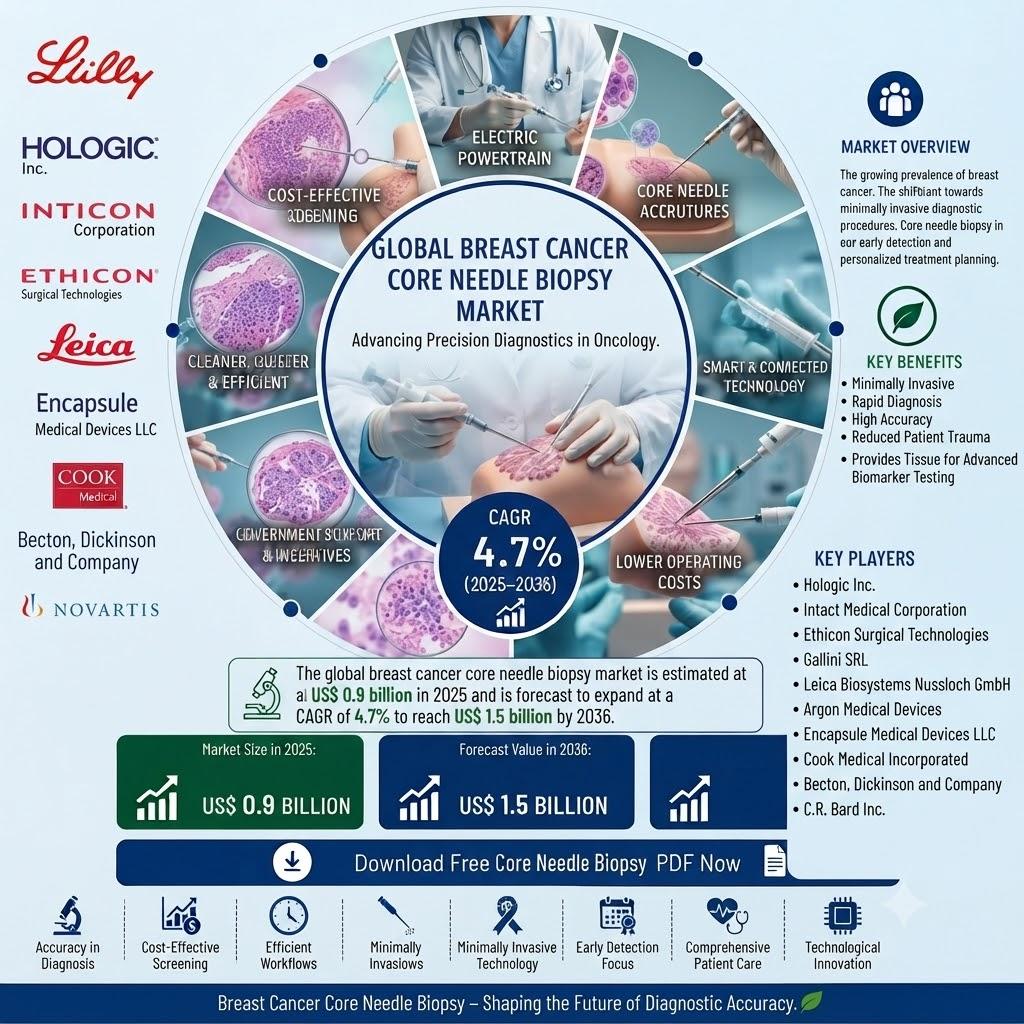
The global breast cancer core needle biopsy market is estimated at USD 1.0 billion in 2026 and is projected to reach USD 1.5 billion by 2036, expanding at a 4.7% CAGR during the forecast period. Fact.MR estimates an absolute dollar opportunity of approximately USD 0.6 billion between 2026 and 2036, as rising breast cancer screening rates and wider use of minimally invasive tissue sampling increase demand for biopsy devices across hospitals and diagnostic centers.
Breast cancer core needle biopsy systems are used to obtain tissue samples from suspicious breast lesions identified through mammography, ultrasound, or MRI-guided imaging. The procedure provides tissue specimens for histological diagnosis while generally creating less procedural burden than open surgical biopsy. Growing diagnostic imaging capacity is therefore expanding the number of facilities able to perform image-guided tissue sampling.
Healthcare providers are also focusing on biopsy accuracy and specimen adequacy. Automated biopsy needles, vacuum-assisted systems, and image-guided technologies are helping clinicians address different lesion types while supporting more consistent tissue acquisition. As screening programs identify abnormalities earlier, biopsy services remain an important step between imaging detection and definitive diagnosis.
Get detailed market forecasts, competitive benchmarking, and pricing trends: https://www.factmr.com/connectus/sample?flag=S&rep_id=11930
Core needle biopsy devices lead the product landscape
Core needle biopsy devices are projected to account for 46.0% of the product segment in 2026, making them the leading product category. Automated spring-loaded biopsy needles, particularly 14-gauge and 16-gauge configurations, are widely used for breast tissue sampling and provide specimens suitable for histological assessment.
Manual biopsy needles, vacuum-assisted biopsy systems, and biopsy accessories represent other important product categories. Vacuum-assisted systems can collect larger tissue volumes and are increasingly relevant when lesion characterization requires multiple or more substantial samples.
Breast cancer diagnosis is expected to account for 54.0% of application demand in 2026, retaining its position as the leading application segment. Suspicious masses, microcalcifications, and architectural distortions identified through breast imaging can require tissue sampling to establish a definitive diagnosis.
Hospitals are projected to account for 62.0% of end-use demand in 2026. Hospital radiology departments and dedicated breast centers benefit from integrated imaging, biopsy, pathology, and oncology infrastructure. Diagnostic imaging centers and specialty breast clinics represent additional opportunities as screening and biopsy procedures increasingly move into dedicated outpatient settings.
China, India, and the USA create the strongest country-level opportunities
China is projected to be the fastest-growing major country market, advancing at a 5.0% CAGR through 2036. Expansion of breast cancer screening programs, increasing diagnostic imaging capacity, and rising breast cancer detection rates are supporting demand for core needle biopsy devices. The expansion of healthcare infrastructure is also creating new procurement opportunities across hospitals and imaging facilities.
India follows with a projected 4.7% CAGR. Growing awareness of breast cancer, expanding hospital biopsy capabilities, and increasing adoption of image-guided tissue sampling are supporting market development. Greater access to diagnostic imaging is also creating opportunities for biopsy equipment suppliers as healthcare providers expand diagnostic capacity.
The United States is forecast to expand at a 4.5% CAGR. Established breast cancer screening programs, high diagnostic imaging utilization, and preference for advanced biopsy technologies provide a stable demand base. Premium vacuum-assisted systems and integrated image-guided procedures are contributing to value growth.
Japan is projected to grow at a 4.3% CAGR, while Germany is expected to expand at 4.2%. Brazil is forecast to register a 4.1% CAGR, followed by the United Kingdom at 3.9%.
The contrast between emerging and mature markets is influencing supplier strategies. Developing markets offer opportunities through new screening capacity and hospital infrastructure, while established markets place greater emphasis on procedural efficiency, advanced imaging integration, premium devices, and diagnostic accuracy.
AI-assisted targeting changes competitive priorities
Artificial intelligence integration is emerging as an important technology trend in breast cancer core needle biopsy. AI-enabled image-guided systems can assist clinicians in identifying lesions, planning biopsy trajectories, and improving targeting precision. These capabilities are particularly relevant for small, subtle, or difficult-to-access lesions where accurate positioning can influence tissue adequacy.
Shambhu Nath Jha, Principal Consultant at Fact.MR, said: “The breast cancer core needle biopsy market is a mature diagnostic procedure category where growth is driven by screening rate expansion and technology driven procedure refinement. Hologic's position reflects its integrated approach combining screening, imaging, and biopsy platforms. The growth opportunity lies in developing market screening program scale up, vacuum assisted system penetration in ambulatory settings, and AI enhanced targeting that improves diagnostic yield per procedure.”
The growing adoption of breast MRI and digital breast tomosynthesis is also creating additional biopsy demand. More sophisticated imaging can identify lesions that may not be visible through conventional screening methods, increasing the number of abnormalities requiring tissue characterization.
Vacuum-assisted biopsy systems provide another avenue for product innovation. Their ability to acquire multiple tissue samples through a single insertion can support procedures where larger specimens are desirable. Suppliers are therefore competing on device reliability, tissue acquisition performance, compatibility with imaging systems, and ease of use.
Screening expansion opens new market opportunities
The expansion of breast cancer screening programs remains a central demand driver. As healthcare systems increase screening coverage, more suspicious lesions enter the diagnostic pathway and require tissue sampling. This creates recurring demand for disposable biopsy needles, biopsy kits, tissue preservation products, and marking clips.
Developing markets represent a particularly important opportunity. New diagnostic imaging centers and upgraded hospital facilities are increasing access to image-guided biopsy procedures. Institutional procurement programs can also support adoption as healthcare providers standardize breast cancer diagnostic pathways.
At the same time, mature markets are focused on improving procedural efficiency. Healthcare providers seek devices that reduce procedure time, improve sample adequacy, and integrate smoothly with existing imaging and pathology workflows. Suppliers that can demonstrate reliable performance while supporting streamlined procedures can strengthen their position with hospitals and diagnostic centers.
Regulatory compliance and product quality remain essential purchasing considerations. Biopsy devices directly interact with patients and biological tissue, requiring manufacturers to maintain stringent quality-control processes and meet applicable medical-device requirements across individual markets.
Competitive landscape
The breast cancer core needle biopsy market includes medical-device companies competing through device reliability, tissue acquisition performance, imaging integration, product breadth, and clinical support. Key companies profiled by Fact.MR include Hologic Inc., Intact Medical Corporation, Ethicon Surgical Technologies, Gallini SRL, Leica Biosystems Nussloch GmbH, Argon Medical Devices, Encapsule Medical Devices LLC, Cook Medical Incorporated, Becton, Dickinson and Company, and C.R. Bard Inc.
Hologic maintains a strong position through its integrated breast imaging and biopsy portfolio, while Intact Medical Corporation focuses on breast biopsy technologies. Ethicon Surgical Technologies contributes established surgical and biopsy expertise, while Gallini and Leica Biosystems participate through specialized diagnostic and tissue-sampling solutions.
Argon Medical Devices, Encapsule Medical Devices, Cook Medical, Becton, Dickinson and Company, and C.R. Bard add competition across biopsy needles, tissue sampling systems, accessories, and related medical technologies. Competitive priorities increasingly include accurate tissue acquisition, vacuum-assisted technology, image-guided compatibility, AI integration, and procedural efficiency.
Market Snapshot
The breast cancer core needle biopsy market is valued at USD 1.0 billion in 2026 and is forecast to reach USD 1.5 billion by 2036 at a 4.7% CAGR. Core needle biopsy devices account for 46.0% of the product segment, while breast cancer diagnosis represents 54.0% of application demand. Hospitals lead end-use demand with a 62.0% share. China leads country-level growth at 5.0%, followed by India at 4.7% and the USA at 4.5%.
The detailed Breast Cancer Core Needle Biopsy Market report by Fact.MR provides forecasts through 2036, including analysis by product, application, end use, region, country, competitive landscape, biopsy technology, imaging integration, and emerging trends in minimally invasive breast cancer diagnosis.
To View Top Reports
https://afgbfh.blogspot.com/2026/10/wearable-computing-devices-market-to.html
https://sportgalax.com/read-blog/24624
About Fact.MR
Fact.MR is a market research and consulting company providing market intelligence, competitive analysis, and forecasting across global industries. Its research covers emerging technologies, evolving consumer trends, industrial developments, and changing business environments. Fact.MR delivers data-driven insights designed to support strategic planning, investment decisions, and market-entry initiatives.

 English
 Arabic
 French
 Spanish
 Portuguese
 Deutsch
 Turkish
 Dutch
Dutch
 Italiano
 Romaian
 Portuguese (Brazil)
 Greek
Greek
