


Pyrogen Testing Market Sees Rising Demand for rFC and Monocyte Activation Tests
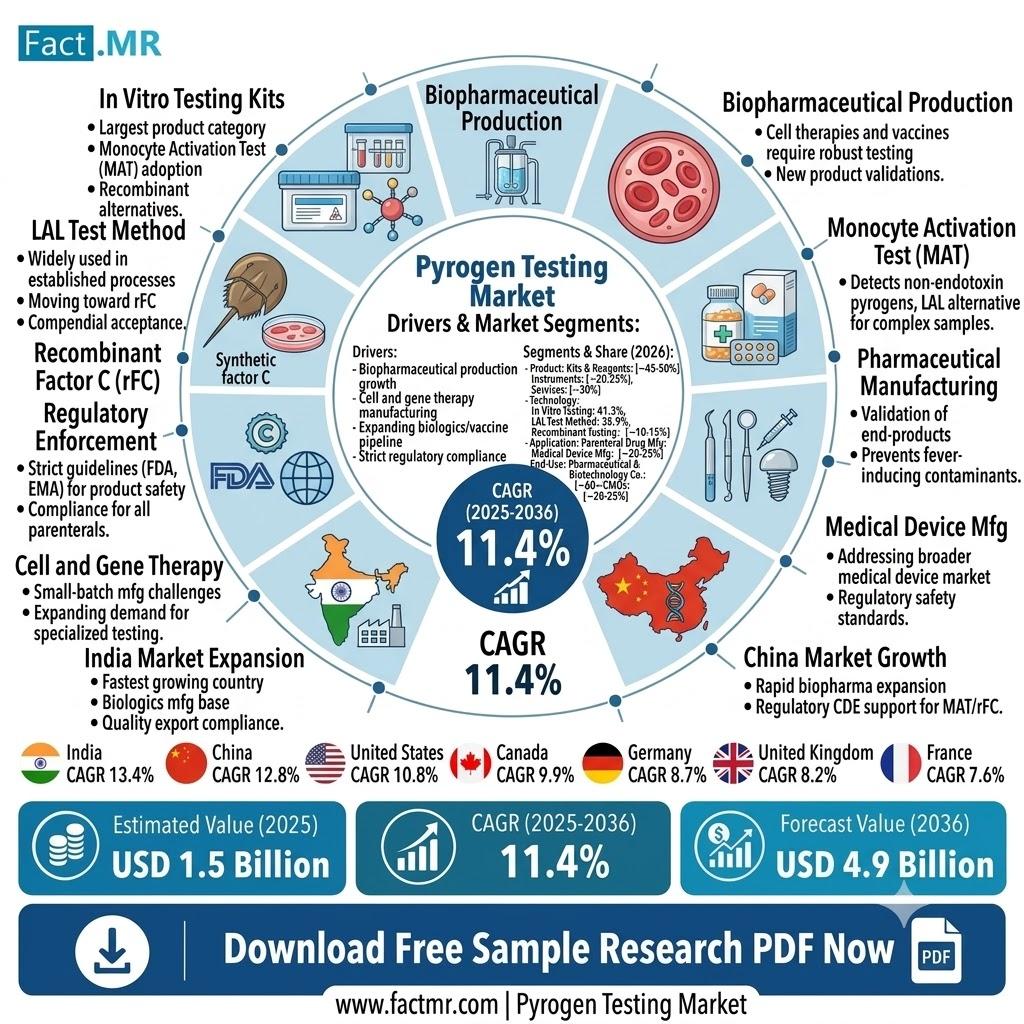
The Pyrogen Testing Market is projected to grow from US$ 1.5 billion in 2025 to US$ 4.9 billion by 2036 at an 11.4% CAGR, according to Fact.MR.
ROCKVILLE, MD — October 5, 2026 — The Pyrogen Testing Market is projected to reach US$ 4.9 billion by 2036, rising from approximately US$ 1.5 billion in 2025 at a CAGR of 11.4%, according to Fact.MR. The market is expected to reach US$ 1.7 billion in 2026, creating an absolute dollar opportunity of US$ 3.2 billion between 2026 and 2036.
The growth is closely tied to pharmaceutical manufacturing, where pyrogen testing validates that pharmaceutical products, medical devices, and biologics are free from fever-inducing contaminants before patient administration. Regulatory requirements from the FDA, EMA, and pharmacopoeial standards continue to support demand for validated testing products across parenteral drug manufacturing.
Get detailed market forecasts, competitive benchmarking, and pricing trends: https://www.factmr.com/connectus/sample?flag=S&rep_id=10200
In Vitro Testing Leads Established Demand
Fact.MR is a market research company that provides market intelligence through forecasting, primary research, and demand-side analysis.
In 2026, In Vitro Pyrogen Testing Kits account for 38.6% of the product segment, making them the largest product category in the Pyrogen Testing Market. The installed base of these kits supports continued procurement across major end-use applications, with Monocyte Activation Test kits and Endotoxin Detection Kits generating procurement activity.
The technology landscape shows a similar concentration. In Vitro Testing Technology accounts for 41.3% of the technology segment in 2026, while the LAL Test Method represents 35.9% of the method segment. LAL remains widely used across established pharmaceutical manufacturing processes.
The shift toward recombinant testing is also becoming more visible. Recombinant Factor C (rFC) provides a synthetic, animal-free alternative to LAL and removes dependence on wild-caught horseshoe crab blood. European Pharmacopoeia has accepted rFC as a compendial method, while FDA acceptance is progressing through individual product validations.
LAL-to-rFC Transition Shapes Competition
“The LAL-to-rFC transition is the defining competitive dynamic,” said Shambhu Nath Jha, Principal Consultant at Fact.MR. “Companies that establish rFC as the validated standard across their customer base will capture recurring revenue as manufacturing volumes grow.”
The transition is gradual because pharmaceutical companies must validate new methods against existing products. At the same time, rFC is becoming the default choice for new product development while LAL continues to serve established manufacturing processes.
“The monocyte activation test represents a separate growth vector,” said Shambhu Nath Jha, Principal Consultant at Fact.MR, referring to its ability to address non-endotoxin pyrogens that LAL and rFC cannot identify.
India and China Post Faster Growth
Regional growth is particularly strong across Asia. India is projected to expand at a 13.4% CAGR through 2036, making it the fastest-growing country market covered in the analysis. Pharmaceutical manufacturing expansion, export quality compliance, biologic production, and domestic reagent development support this trajectory.
China is projected to grow at a 12.8% CAGR through 2036. Biopharmaceutical manufacturing expansion, CDE regulatory standards, and pharmacopoeial updates supporting rFC and MAT methods are contributing to demand.
The USA is projected to grow at 10.8%, supported by FDA enforcement standards and cell and gene therapy manufacturing. Canada follows at 9.9%, while Germany is forecast at 8.7%. The UK and France are projected to grow at 8.2% and 7.6%, respectively.
Regulatory Needs Sustain Testing Demand
Biopharmaceutical production growth is increasing pyrogen testing requirements across manufacturing stages. The expansion of biologics, cell therapies, and gene therapies is generating additional testing demand, while medical device production is extending the addressable market beyond pharmaceutical manufacturing.
The market also faces constraints. Horseshoe crab blood harvesting creates sustainability concerns around LAL reagent supply, while the regulatory transition between LAL and rFC can require parallel testing and increase costs. Small-batch cell and gene therapy manufacturing can also result in higher testing costs per batch.
Fact.MR's analysis covers 30-plus countries, benchmarks 65-plus company product portfolios, and draws on 120-plus secondary sources and 25-plus primary interviews with manufacturers, distributors, buyers, and institutional users.
Pyrogen Testing Market Analysis and Forecast from Fact.MR for detailed market segmentation, country-level forecasts, competitive analysis, and technology trends. The report covers the 2026–2036 forecast period across product, technology, method, application, end use, and regional markets.
About Fact.MR
Fact.MR is a market research and consulting firm providing market intelligence, forecasting, and strategic analysis across global industries. Its research combines secondary research, primary interviews, demand-side modelling, pricing analysis, shipment validation, and company benchmarking.

 English
 Arabic
 Spanish
 Portuguese
 Deutsch
 Turkish
 Dutch
Dutch
 Italiano
 Russian
 Romaian
 Portuguese (Brazil)
 Greek
Greek
