


Perfume Market Set to Hit USD 77.8 Billion by 2036, China Leads at 7.0% CAGR, India at 6.7%, Germany at 5.5%
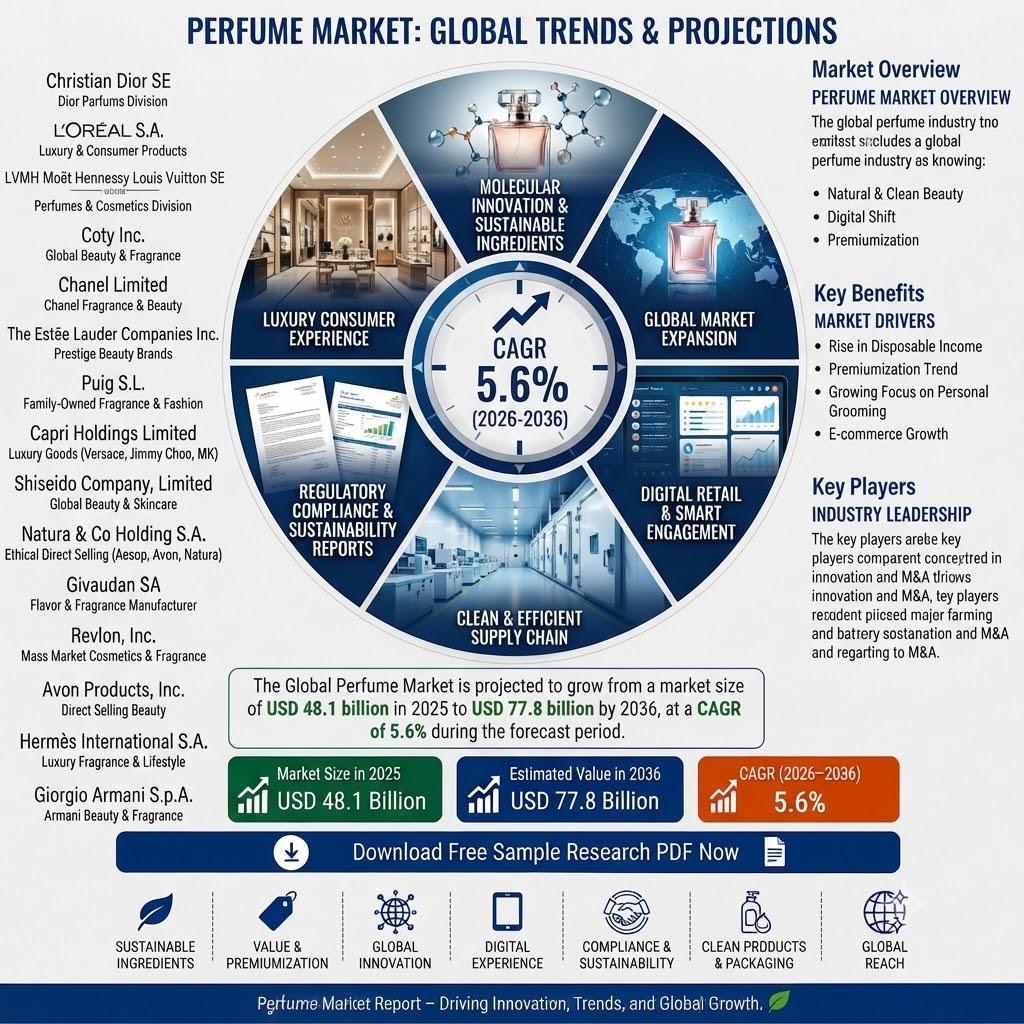
The global perfume market is estimated at USD 50.8 billion in 2026 and is projected to reach USD 77.8 billion by 2036, expanding at a 5.6% CAGR during the forecast period. The market is benefiting from rising consumer interest in premium and personalized fragrances, higher disposable incomes in emerging economies, and broader access through online and specialty retail channels.
Perfume remains closely linked with personal grooming, lifestyle, gifting, and luxury consumption. Fact.MR estimates an absolute dollar opportunity of USD 27 billion between 2026 and 2036. While established mass-market fragrances continue to generate substantial volume, premium, niche, and personalized products are becoming important sources of value growth as consumers look for distinctive scent profiles and stronger brand experiences.
Get detailed market forecasts, competitive benchmarking, and pricing trends: https://www.factmr.com/connectus/sample?flag=S&rep_id=7152
Synthetic perfumes hold a 70% market share
Synthetic perfumes are expected to account for 70% of the global market in 2026, making them the leading category by nature. Their cost efficiency, consistent quality, longer-lasting scent characteristics, and flexibility in creating complex aroma profiles support their broad use across consumer fragrance products.
Eau de Parfum is another leading category, projected to account for 35% of the market in 2026. Its relatively high fragrance-oil concentration and longer-lasting scent make it particularly relevant to consumers seeking premium perfume experiences. The segment also benefits from its positioning across both established luxury brands and newer niche fragrance labels.
The market is also seeing a shift toward more differentiated fragrance propositions. Niche and artisanal perfumes are gaining attention through unique scent combinations, experiential branding, and personalization. At the same time, regulatory requirements around cosmetic ingredients, safety, and labeling are influencing formulation and product-development decisions.
China and India emerge as the fastest-growing country markets
China is projected to register a 7.0% CAGR through 2036, the highest growth rate among the countries covered by Fact.MR. Rising personal care consumption, expanding luxury retail, growing middle-class spending, and increasing demand for branded fragrances are supporting the country's expansion. L'Oréal China, Procter & Gamble, and Coty Inc. are among the companies active in the market.
India follows with a projected 6.7% CAGR. Growing fragrance awareness, urbanization, retail expansion, and increasing adoption of premium and mid-range perfumes are creating new opportunities. Expansion in organized retail and wider availability of branded products are also improving access beyond traditional fragrance-buying channels.
Germany is forecast to grow at 5.5% CAGR, reflecting established demand for branded and high-quality fragrances, along with continued personal-care spending and e-commerce adoption. The United States is expected to expand at 5.2% CAGR, supported by both premium and mass-market demand and the increasing role of online fragrance retail. The United Kingdom is projected to grow at 4.8%, with premium fragrance consumption and established retail access supporting steady demand.
Competitive landscape
The perfume market is moderately concentrated, with luxury groups, beauty companies, fragrance specialists, and established consumer brands competing across price points and distribution channels. Key companies profiled by Fact.MR include LVMH Moët Hennessy Louis Vuitton SE, Christian Dior SE, Chanel Limited, The Estée Lauder Companies Inc., L'Oréal S.A., Coty Inc., Puig S.L., Capri Holdings Limited, Shiseido Company, Limited, Natura & Co Holding S.A., Givaudan SA, Revlon, Inc., Avon Products, Inc., Hermès International S.A., and Giorgio Armani S.p.A.
Competition extends beyond fragrance formulation. Brand equity, packaging, retail visibility, distribution reach, marketing capabilities, and consumer loyalty remain important factors in determining market position. Luxury boutiques, department stores, specialty retailers, and e-commerce platforms also influence product assortment and brand visibility, giving established companies with broad distribution networks an advantage.
Online retail expands market access
The expansion of e-commerce is changing how consumers discover and purchase perfumes. Online channels allow brands to reach consumers beyond traditional department stores and specialty outlets while supporting direct-to-consumer models. For emerging fragrance brands, digital distribution can also provide access to international consumers without requiring an extensive physical retail footprint.
At the same time, offline channels remain important for premium fragrances because consumers often value physical product experiences, packaging, brand presentation, and the ability to evaluate fragrances before purchase. This combination of digital discovery and physical retail is creating a more diversified route to market.
Market Snapshot
The perfume market is valued at USD 50.8 billion in 2026 and is forecast to reach USD 77.8 billion by 2036 at a 5.6% CAGR. Synthetic perfumes account for 70% of the market in 2026, while Eau de Parfum holds a 35% share. China leads country-level growth at 7.0%, followed by India at 6.7% and Germany at 5.5%.
To View Related Reports
https://afgbfh.blogspot.com/2026/09/marine-enzymes-market-outlook-through.html
https://sportgalax.com/read-blog/24367
About Fact.MR
Fact.MR is a market research and consulting company providing market intelligence, competitive analysis, and forecasting across global industries. Its research covers emerging technologies, evolving consumer trends, industrial developments, and changing business environments. Fact.MR delivers data-driven insights designed to support strategic planning, investment decisions, and market-entry initiatives.

 English
 Arabic
 Spanish
 Portuguese
 Deutsch
 Turkish
 Dutch
Dutch
 Italiano
 Russian
 Romaian
 Portuguese (Brazil)
 Greek
Greek
