


How Many Solar Panels Are Needed to Power a House in the UK?
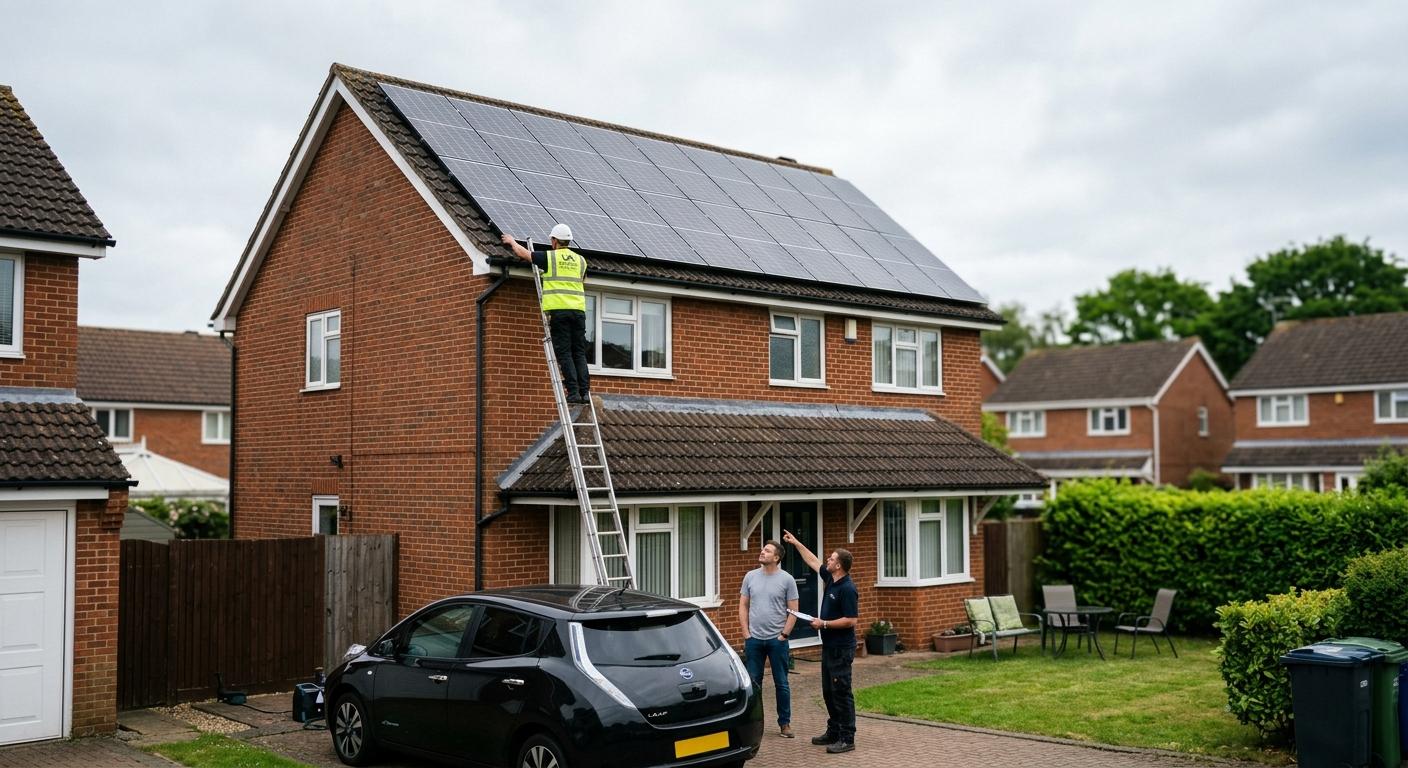
For many UK homes, around 10 to 14 solar panels can provide a substantial share of annual electricity demand. The exact number depends on your household's electricity use, available roof space, panel output, roof orientation and shading.
There is no single panel count that works for every property. A household with low electricity consumption may need fewer panels, while a larger home using an electric car, heat pump or other high-demand appliances could benefit from a larger system.
How Many Panels Does A Typical UK Home Need?
Energy Saving Trust says an average solar PV system is around 4.5kWp, usually using about 12 panels and requiring roughly 20–30m² of roof space.
That gives homeowners a useful starting point, but panel numbers alone can be misleading. A newer 450W panel produces more peak power than a 350W panel, so two systems with the same number of panels may have different capacities.
For example, 10 panels rated at 450W provide a 4.5kWp system, whereas 10 panels rated at 350W provide only 3.5kWp.
What Determines The Right Number?
Your electricity consumption should come before the roof calculation.
Look at your previous 12 months of electricity bills and identify how many kilowatt-hours (kWh) your household uses. Then an installer can assess how much solar generation your roof could realistically provide.
Roof conditions can change the result considerably. A clear, unshaded south-facing roof generally offers strong solar generation, while east- or west-facing roofs can still work but may produce less overall energy. Shading from trees, chimneys and nearby buildings can also reduce output.
There is another practical consideration: you may not need to generate every unit of electricity your home consumes. Solar generation changes throughout the day and across the seasons, so grid electricity can still be needed, particularly during winter evenings.
Can More Panels Mean Lower Electricity Bills?
They can, but only when the extra generation matches how your household uses electricity.
A larger system can produce more electricity, yet adding panels simply to reach a particular number is not always the best use of your roof. If much of the additional generation is exported rather than used at home, the financial benefit depends on the export tariff available to you.
A home with daytime electricity demand may use more of its solar generation directly. Battery storage can also change how much of the electricity generated during sunny periods is available later.
What Does Solar PV Panel Installation Involve?
A professional solar pv panel installation starts with a property assessment rather than simply counting available roof spaces.
The installer should consider roof structure, orientation, shading, panel layout, system capacity and your expected electricity use. They can then recommend a system size that fits both the property and your household.
Energy Saving Trust recommends comparing quotes from at least three MCS-certified installers.
How Much Does A Solar System Cost?
The cost of installing solar panels depends on system size, equipment, roof complexity and whether you add battery storage.
As a current UK reference point, Energy Saving Trust puts the average rooftop solar installation at around £7,600.
A larger system will normally require more panels and equipment, but price should not be judged solely by the number of panels. The expected generation, installation quality, warranties and suitability for your household are equally important.
So, How Many Panels Do You Need?
For a typical UK property, around 12 panels is a reasonable starting point, but it should not be treated as a fixed requirement. Your annual electricity consumption and the performance of your particular roof should determine the final system size.
A good installer can turn those figures into a practical design rather than simply filling every available section of roof.

 Arabic
 French
 Spanish
 Portuguese
 Deutsch
 Turkish
 Dutch
Dutch
 Italiano
 Russian
 Romaian
 Portuguese (Brazil)
 Greek
Greek
