


Global Aircraft Sensors Market Projected to Hit US$7.4 Billion by 2036 as Sensor Density Grows
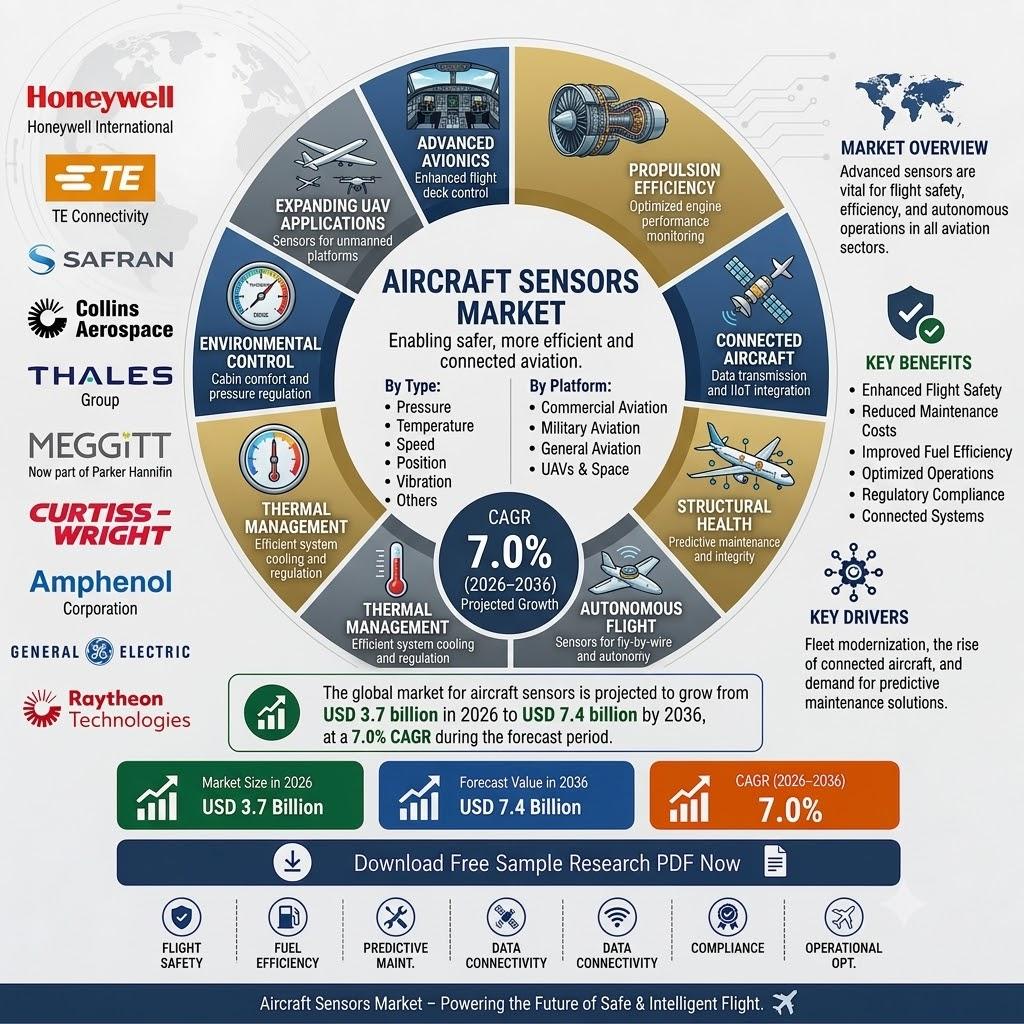
The global aircraft sensors market is projected to reach US$ 7.4 billion by 2036, rising from an estimated US$ 3.7 billion in 2026 at a CAGR of 7%, according to Fact.MR analysis. Higher aircraft production rates and increasing sensor density per airframe are expanding demand across engine, fuel, flight control, and structural monitoring systems.
The market is expected to create an absolute dollar opportunity of US$ 3.6 billion between 2026 and 2036. Commercial aircraft represent 52% of aircraft-type demand in 2026, while Engine and Fuel Systems account for 38% of application share. Pressure Sensors hold 30% of sensor-type share during the same year.
Get detailed market forecasts, competitive benchmarking, and pricing trends: https://www.factmr.com/connectus/sample?flag=S&rep_id=11837
Why Aircraft Sensor Demand Is Expanding
Aircraft sensors measure pressure, temperature, speed, position, proximity, and other flight parameters. These devices support monitoring across critical aircraft systems, with technologies including MEMS, piezoelectric, fiber optic, and thin-film sensor platforms.
Rising aircraft delivery rates from Airbus and Boeing are generating OEM demand. At the same time, avionics modernization is increasing the number of sensors installed on individual aircraft.
Predictive maintenance is adding another layer of demand. Airlines and operators are installing additional sensor arrays on in-service fleets to support condition-based maintenance and engine prognostics.
Shambhu Nath Jha, Principal Consultant at Fact.MR, said, “Higher production rates matter, but sensor density matters too. Every new aircraft type carries more sensors than its predecessor because monitoring requirements keep expanding.”
Fact.MR is a market research firm that combines secondary research, primary interviews, and forecast modelling to assess global market trends.
MEMS Technology Changes Sensor Economics
MEMS sensors are emerging as a key technology trend in the aircraft sensors market. Smaller dimensions, lower weight, and reduced power consumption can make sensor installation practical in aircraft subsystems where conventional solutions may have faced tighter cost or space constraints.
The shift toward higher sensor density is closely connected with MEMS adoption. As manufacturing volumes grow in automotive and consumer electronics markets, aerospace-qualified MEMS variants can benefit from improved manufacturing economics.
That creates opportunities for broader monitoring across aircraft structures and subsystems. Structural health monitoring is also increasing the potential for distributed sensor networks capable of detecting fatigue, strain, and damage.
“MEMS is the key enabler,” Jha added. “It brings sensor size and cost down enough to justify installation in subsystems that were previously unmonitored. That changes the calculation for OEMs and airlines.”
Pressure Sensors Lead Sensor-Type Demand
Pressure Sensors are projected to account for 30% of the global sensor-type segment in 2026. Their position is supported by established applications across aircraft systems and continued replacement requirements.
Engine and Fuel Systems represent 38% of application share in 2026. These systems depend on sensor measurements for monitoring operating conditions and supporting aircraft performance and maintenance activities.
Commercial aircraft account for 52% of aircraft-type share in 2026. Demand reflects the scale of commercial aviation production and the growing number of sensors incorporated into newer aircraft platforms.
Asia Pacific Posts the Fastest Country-Level Growth
India leads the country-level growth outlook with a projected 7.4% CAGR through 2036, followed by China at 6.8% and the UAE at 6.5%.
The United States is projected to expand at 6.2%, while Japan records a 5.8% CAGR. Germany and France are forecast to grow at 5.3% and 4.9%, respectively.
India's position reflects expanding end-use activity and adoption of higher-specification aircraft sensor products. China also shows a 6.8% CAGR through 2036 as demand expands across core applications.
Competitive Landscape
The global aircraft sensors market includes Honeywell International, TE Connectivity, Safran, Collins Aerospace, Thales Group, Meggitt PLC, Curtiss-Wright, Amphenol Corporation, General Electric, and Raytheon Technologies.
Honeywell International expanded its product portfolio in 2025 with models targeting higher-specification applications. TE Connectivity introduced upgraded technology across core product lines in 2026.
Safran expanded distribution into high-growth markets across Asia Pacific and Latin America in 2025.
Competition remains shaped by aerospace qualification requirements, technical capability, portfolio coverage, and aftermarket service. Stringent certification requirements can extend development timelines, while weight and power constraints limit sensor installation density in selected aircraft locations.
Fact.MR Aircraft Sensors Market Research
Fact.MR's Aircraft Sensors Market analysis covers the period from 2026 to 2036 across sensor type, application, aircraft type, technology, and region. The research combines 120+ secondary sources, 65+ company product portfolios, and 25+ primary interviews with manufacturers, distributors, and end users.
The methodology covers more than 30 countries and uses demand-side modelling with top-down validation. Forecast inputs include end-use activity, regulatory requirements, technology adoption, shipments, pricing trends, and product launches.
To View Top Reports
https://net-pals.com/blogs/33488/Global-AI-Vision-QC-Market-to-Reach-USD-1-7
https://uddokta64.com/blogs/7485/Global-AI-Vision-QC-Market-Set-to-Reach-USD-1
https://acmingle.com/blogs/19190/Global-AI-Vision-QC-Market-Projected-to-Hit-USD-1
https://zeuspage.org/blogs/53276/Global-AI-Vision-QC-Market-Forecast-to-Reach-USD-1
About Fact.MR
Fact.MR is a global market research and consulting firm providing syndicated and customized research across technology, industrial, chemical, automotive, aerospace, healthcare, and other sectors. Its research combines primary interviews, secondary data analysis, market modelling, and company-level benchmarking to support business and strategic decisions.

 Arabic
 French
 Spanish
 Portuguese
 Deutsch
 Turkish
 Dutch
Dutch
 Italiano
 Russian
 Romaian
 Portuguese (Brazil)
 Greek
Greek
