


What actually breaks in a Florida air conditioner
What actually breaks in a Florida air conditioner
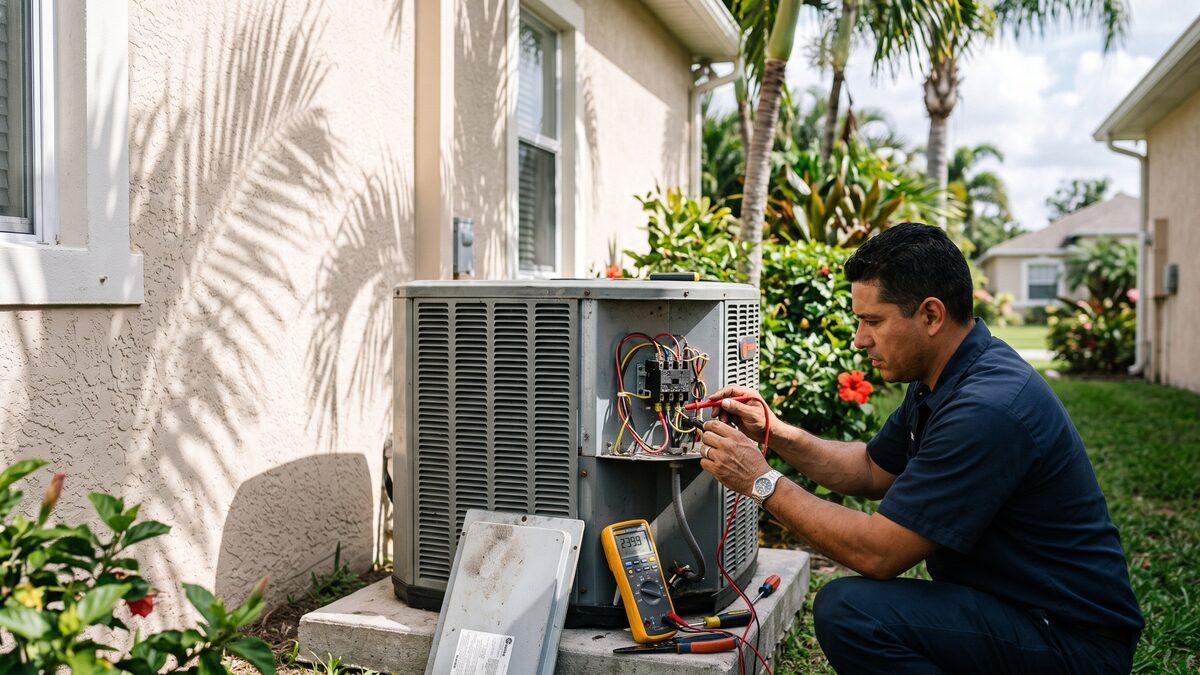
Most summer service calls in Southwest Florida come down to five parts: a run capacitor, a contactor, a blocked condensate drain, a leaking coil, or a failed fan motor. Four of the five are cheap parts. What makes them expensive is the time between the first symptom and the phone call, because a struggling system takes the compressor down with it.
Why the climate matters more than the brand
An air conditioner in Ohio runs perhaps 800 hours a year. The same model in Sarasota County runs 3,000 to 4,000. A system rated for a fifteen-year life somewhere with a real winter is doing fifteen years of work in about four here, and every component with a duty cycle ages accordingly.
Humidity does the second half of the damage. The unit is pulling gallons of water out of the air every day, which means a wet coil, a wet drain pan and a drain line that stays damp year round. That is a good environment for biological growth and a bad one for sheet metal. Add salt in the air near the coast and the outdoor coil starts losing fin material long before the compressor gives out.
None of this is a defect. It is the operating envelope, and it explains why the failure list here looks different from the one in a national maintenance guide.
The five failures behind most calls
Run capacitor. A cylinder about the size of a soda can that gives the compressor and fan motor the electrical kick they need to start. Capacitors are rated in microfarads and drift downward as they age. At 10 percent below rating the compressor still starts but draws more current than it should. At 20 percent below it starts hard, heats up and eventually stops starting at all. Heat accelerates the drift, which is why they fail in July and not in January.
Contactor. The relay that switches high voltage to the outdoor unit. Its contacts pit and burn over thousands of cycles, and in this climate they also corrode. A pitted contactor either fails to close, in which case nothing outside runs, or welds shut, in which case the condenser runs continuously even with the thermostat satisfied.
Condensate drain. The most common call of all and the one that does the most collateral damage. Biological growth clogs the line, the pan fills, and either a float switch cuts the system off or the water finds the ceiling below. Systems in attics and closets are the ones that cause damage; a garage air handler usually just makes a puddle.
Refrigerant leak. Low refrigerant is never a maintenance item. It means there is a hole. Evaporator coils develop formicary corrosion, pinhole damage caused by organic acids in indoor air, and outdoor coils fail at the fin-to-tube joint. A system running low on charge overheats the compressor windings, which is how a $400 leak becomes a system replacement.
Fan motors. The condenser fan motor lives outdoors in the weather and the blower motor runs whenever the system does. Bearings dry out, motors overheat, and thermal protection cuts in and out before the motor quits for good. Intermittent operation on hot afternoons is the classic sign.
| Symptom | Usual cause | What happens if ignored |
|---|---|---|
| Outdoor unit hums, fan does not spin | Run capacitor | Compressor overheats, locks out, eventually fails |
| Nothing runs outside, thermostat calling | Contactor or control voltage | No cooling; usually no further damage |
| System shuts off, water near the air handler | Clogged drain, float switch tripped | Ceiling and drywall damage, mould |
| Runs constantly, air not cold, ice on the line | Low charge from a leak | Compressor damage from overheating and liquid return |
| Cools for an hour, then stops, then restarts | Failing fan motor or overloaded compressor | Progressive; ends in a hard failure |
| Air blows but barely cools, high humidity indoors | Dirty coil, restricted airflow, undercharge | Rising bills, coil freeze, compressor stress |
The symptoms people read wrong
Ice on the refrigerant line looks like the system is working hard. It is the opposite. Ice forms when the coil runs colder than it should, which happens when airflow is restricted or the charge is low. Every hour of running iced up sends liquid refrigerant back toward a compressor built to handle vapour.
Air that blows but does not cool is not automatically low refrigerant. A dirty blower wheel, a collapsed flex duct or a filter nobody has changed since spring produce the same complaint, and the fix costs a fraction of what a refrigerant repair costs. This is the single most common reason for a second opinion changing the outcome.
A system that will not keep up on the hottest afternoon of the year is sometimes just undersized for the load after a room addition or a lanai enclosure. Nothing is broken. The calculation changed and the equipment did not.
What a repair call actually looks like
A competent visit follows the same sequence regardless of the symptom. The technician confirms the thermostat is calling, checks voltage at the disconnect, reads amperage on the compressor and fan, measures temperature split across the evaporator coil, and only then puts gauges on the system. Gauges first is a shortcut that produces wrong diagnoses, because pressures alone cannot separate an airflow problem from a charge problem.
Expect the visit to run 45 to 90 minutes for a straightforward failure. A capacitor or contactor is usually replaced from the truck the same day. A leak needs to be located before it can be quoted, and locating it properly means either an electronic detector or nitrogen pressure testing, not a guess based on how much refrigerant went in last time.
Ask for the readings, not just the verdict. Measured capacitor microfarads, compressor amp draw against the rating plate, and the supply-to-return temperature difference are three numbers that tell you whether the diagnosis was made or assumed. Any company doing honest AC repair in North Port, FL will hand those numbers over without being pushed, and a written quote should name the part, the price and the labour separately.
The real cost of waiting
The economics here are lopsided. A capacitor is a small part with a short labour time. A compressor is the most expensive component in the system, and on a unit past its warranty period the replacement often costs enough that a new system makes more sense. The path from the first to the second is short: a weak capacitor makes the compressor work harder, hard starts raise winding temperature, and heat degrades the windings until they short.
The same pattern holds for leaks. Topping off a leaking system twice a season buys cooling for a few weeks each time while the compressor runs undercharged, poorly cooled by the refrigerant that normally carries heat away from the windings. Two seasons of that reliably ends in a replacement.
Water damage follows its own logic. A clogged drain line costs very little to clear. The same clog left alone during a week away from home can mean a soaked ceiling, an insurance claim and a remediation crew.
What to check before you call
- The filter. If you cannot see light through it, replace it and give the system an hour.
- The breaker. Check both the panel and the disconnect box by the outdoor unit. Reset once. If it trips again, stop and call; a repeat trip means a fault, not a nuisance.
- The thermostat. Fresh batteries, set to COOL, fan on AUTO. A thermostat on FAN ON blows uncooled air between cycles and generates a surprising number of service calls.
- The drain. Look for water in the emergency pan or at the air handler base. Water there explains a system that shut itself off.
- The outdoor unit. Clear leaves and clippings from the coil and give it two feet of space on all sides.
If all five check out and the system still is not cooling, the problem is inside the sealed system or the electrical components, and neither is homeowner territory. Refrigerant handling requires EPA Section 608 certification, and the capacitor holds a charge that can injure you after the power is off.
Frequently asked questions
How long should an air conditioner last in Florida?
Ten to fifteen years is a realistic range with regular maintenance, against the twenty years often quoted nationally. Coastal installations at the shorter end of that range are normal, not a sign of a bad unit.
Is it worth repairing a system that is twelve years old?
It depends on the part. Capacitors, contactors and drain work are worth doing at any age. A compressor or evaporator coil on a twelve-year-old system deserves a replacement quote alongside the repair quote, partly because R-410A equipment stopped being manufactured on 1 January 2025 and parts pricing for those systems follows supply.
Why does my system freeze up only in the afternoon?
Longer run times on the hottest part of the day expose a marginal airflow or charge problem that shorter morning cycles hide. The underlying fault is there all day; the afternoon just makes it visible.
Does a maintenance visit actually prevent failures?
It prevents some and predicts others. Clearing the drain line and cleaning the coil prevent failures outright. Measuring capacitor drift and amp draw predicts them, which is the more useful half: a capacitor replaced in April costs the same as one replaced in July and avoids the week of running hard in between.
Figures and regulatory references current as of September 2026.

 Arabic
 French
 Spanish
 Portuguese
 Deutsch
 Turkish
 Dutch
Dutch
 Italiano
 Russian
 Romaian
 Portuguese (Brazil)
 Greek
Greek
