


Global Regenerative Braking Optimization Software Market Set to Reach $2.2 Billion by 2036
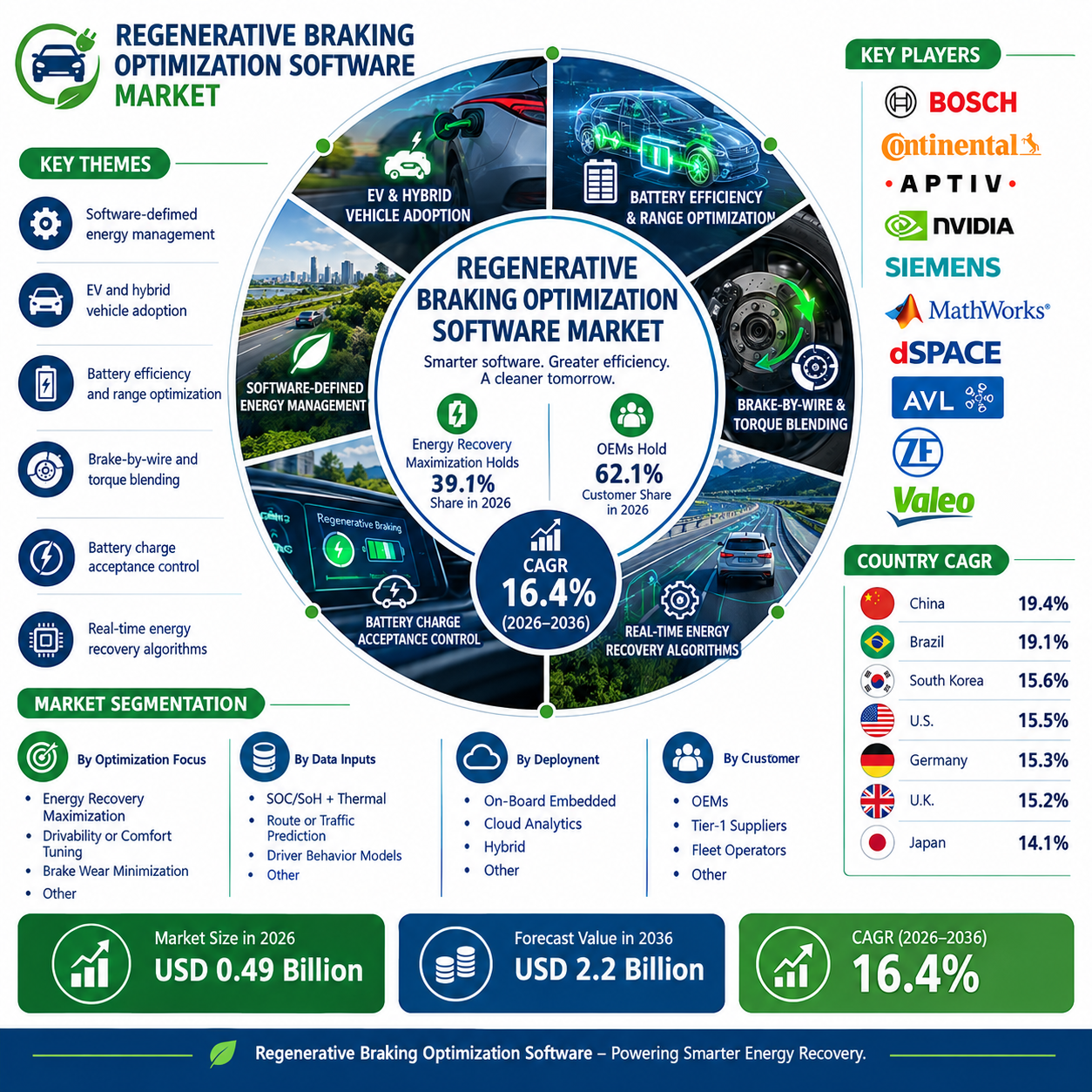
The global regenerative braking optimization software market is projected to grow from USD 0.49 billion in 2026 to USD 2.2 billion by 2036, registering a 16.4% CAGR over the forecast period, according to Fact.MR analysis. The market is expected to add USD 1.42 billion in absolute dollar opportunity, representing total growth of 289.8% between 2026 and 2036.
The growth comes as automotive manufacturers place greater emphasis on software that controls energy recovery in electric and hybrid vehicles. Regenerative braking optimization software supports torque blending, battery charge acceptance, brake feel calibration, stability control, and real-time energy recovery algorithms. These functions are increasingly connected with broader vehicle control architectures.
Get detailed market forecasts, competitive benchmarking, and pricing trends: https://www.factmr.com/connectus/sample?flag=S&rep_id=13474
Energy Recovery Maximization Holds 39.1% Share
Energy recovery maximization is the leading optimization focus, accounting for 39.1% of the market in 2026. Its position reflects the direct relationship between energy recovery, battery efficiency, and vehicle range.
OEMs represent the dominant customer segment, holding 62.1% share in 2026. Vehicle manufacturers are integrating optimization software at the vehicle-platform level, where braking controls interact with battery management, brake-by-wire systems, and torque management.
This integration creates a more software-driven approach to braking. Instead of focusing only on braking hardware, manufacturers are increasingly using control logic to coordinate energy recovery with vehicle performance requirements.
Regenerative braking optimization software is an automotive software category that manages energy recovery, torque blending, battery charge acceptance, brake feel, and real-time vehicle control functions.
EV Adoption Supports Software Demand
The expansion of electric and hybrid vehicles remains a primary demand driver for regenerative braking optimization software. Regenerative braking allows vehicles to recover energy during deceleration, making control algorithms increasingly relevant to battery efficiency and range management.
OEM investment is also being influenced by the growing complexity of vehicle control systems. Brake-by-wire technology, torque blending, battery management integration, and vehicle-level optimization require software capable of coordinating multiple operating parameters.
Regulatory pressure surrounding energy efficiency and emissions reduction adds another demand factor. Automotive manufacturers are therefore evaluating software solutions as part of broader vehicle efficiency programs.
At the same time, high software costs and technical complexity can limit adoption. Integrating specialized energy recovery protocols into existing vehicle management processes may require substantial engineering work and platform-level validation.
China Regenerative Braking Software Market Grows at 19.4%
China is projected to record a 19.4% CAGR from 2026 to 2036, making it the fastest-growing country among the markets highlighted in the Fact.MR analysis.
Brazil follows with a 19.1% CAGR, while South Korea is projected to expand at 15.6%. The U.S. market is expected to register a 15.5% CAGR, followed by Germany at 15.3% and the U.K. at 15.2%. Japan is forecast to grow at 14.1%.
China's market expansion is linked to its growing electric vehicle infrastructure, regulatory development, and technology initiatives supporting advanced energy recovery systems.
Brazil's regenerative braking optimization software market is also gaining attention, with automotive investment and technology service development supporting a projected 19.1% CAGR.
Software-Defined Vehicle Architectures Reshape Demand
The shift toward software-defined vehicle architectures is becoming an important market trend. Automated energy recovery configurations are being developed to reduce operational requirements and deployment costs, while multi-parameter compatibility systems are being designed to support different vehicle applications and operating conditions.
The market covers several optimization areas, including energy recovery maximization, drivability or comfort tuning, brake wear minimization, and other applications.
Software can also use different data inputs. These include state of charge and state of health with thermal data, route or traffic predictions, and driver behavior models. Deployment options span on-board embedded systems, cloud analytics, and hybrid architectures.
Bosch, Continental, Aptiv and NVIDIA Among Key Players
The competitive landscape includes Bosch, Continental, Aptiv, NVIDIA, Siemens, MathWorks, dSPACE, AVL, ZF, and Valeo.
These companies operate across automotive technology, vehicle control systems, software development, simulation, and energy management. Bosch, Continental, Aptiv, NVIDIA, and Siemens are specifically identified among the key companies active in the market.
The market is closely tied to automotive platform development because optimization software is integrated into vehicle control stacks. This makes software selection an important consideration during vehicle development and platform lifecycle planning.
To View Top Reports
https://social.mytamam.com/blogs/37323/Global-Grow-Light-Market-to-Reach-USD-8-84-Billion
https://net-pals.com/blogs/30308/Global-Grow-Light-Market-Set-to-Hit-USD-8-84
About Fact.MR
Fact.MR is a market research and consulting firm providing market intelligence, forecasts, competitive analysis, and strategic insights across global industries. Its research covers emerging technologies, evolving market demand, industry trends, and competitive developments.

 Arabic
 French
 Spanish
 Portuguese
 Deutsch
 Turkish
 Dutch
Dutch
 Italiano
 Russian
 Romaian
 Portuguese (Brazil)
 Greek
Greek
