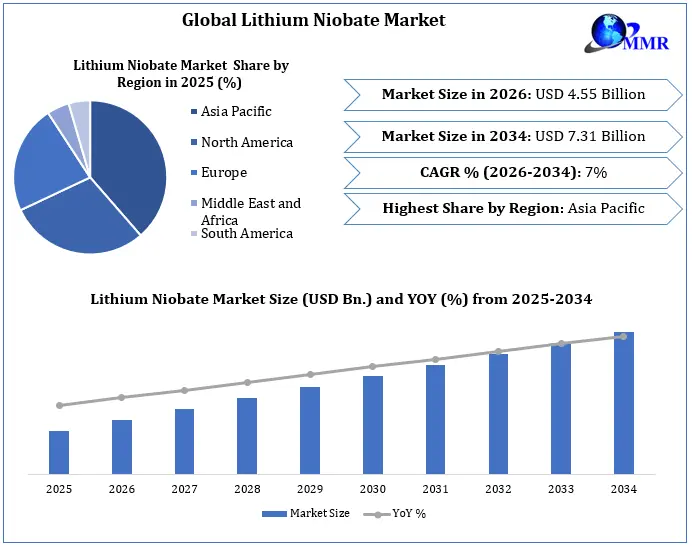
The Global Lithium Niobate Market is gaining strategic importance across the advanced materials, photonics, telecommunications, semiconductor, and electronics industries as demand rises for high-speed optical communication, compact photonic components, RF filtering, sensing, and next-generation computing technologies. According to Maximize Market Research, the global Lithium Niobate Market was valued at approximately USD 4.55 billion in 2025 and is expected to reach nearly USD 7.31 billion by 2034, expanding at a CAGR of 7% from 2025 to 2034. Lithium niobate (LiNbO₃) is valued for its distinctive electro-optic, piezoelectric, nonlinear optical, and acousto-optic properties, making it suitable for applications ranging from optical modulators and SAW filters to integrated photonics, frequency conversion, optical sensors, and quantum technologies. The market covers lithium niobate crystals, optical-grade wafers, thin-film lithium niobate, periodically poled lithium niobate (PPLN), and lithium-niobate-on-insulator (LNOI) substrates. The increasing movement toward photonic integration is creating particularly strong opportunities for thin-film lithium niobate because it combines high-speed electro-optic performance with low optical loss and compatibility with advanced nanofabrication processes.
𝐃𝐨𝐰𝐧𝐥𝐨𝐚𝐝 𝐅𝐫𝐞𝐞 𝐏𝐃𝐅 𝐁𝐫𝐨𝐜𝐡𝐮𝐫𝐞 @https://www.maximizemarketresearch.com/request-sample/318514/
Lithium Niobate Market Key Segmentations
The Lithium Niobate Market can be segmented by form, crystal type, application, end-use industry, and region. By form, the market includes powder, bulk crystal/ingot, wafer, and others. Wafer represents the leading form, accounting for approximately 48.5% of the market in 2025, supported by extensive use in SAW filters, RF devices, electro-optic modulators, optical waveguides, and integrated photonic circuits. The transition toward thin-film lithium niobate (TFLN) and lithium-niobate-on-insulator (LNOI) is further strengthening wafer demand because these platforms support compact, high-speed, and energy-efficient photonic devices. Bulk crystal and ingot products remain important for conventional optical and acoustic applications and also serve as the foundation for wafer manufacturing. Powder primarily supports crystal synthesis and specialized material-processing applications, while other forms include customized crystal blanks and specialized lithium niobate materials used in niche optical, acoustic, and research applications.
By crystal type, the market includes X-Cut Lithium Niobate, Y-Cut Lithium Niobate, Z-Cut Lithium Niobate, Rotated Y-Cut Lithium Niobate, and others. Rotated Y-Cut Lithium Niobate held the highest market share in 2025 at approximately 34.5%, supported by its strong piezoelectric properties and extensive application in SAW filters, RF components, resonators, and wireless communication devices. X-Cut Lithium Niobate is increasingly used for electro-optic modulators, thin-film lithium niobate platforms, and integrated photonic circuits. Z-Cut Lithium Niobate remains important for nonlinear optics, optical waveguides, frequency conversion, and electro-optic applications, while Y-Cut materials support acoustic and specialized optical devices. Different crystal orientations provide manufacturers with flexibility to optimize lithium niobate components according to their electrical, acoustic, and optical requirements.
By application, the market covers SAW filters and RF devices, electro-optic modulators, acousto-optic devices, integrated photonics and optical waveguides, nonlinear optics and frequency conversion, optical sensors, quantum photonic devices, and others. SAW Filters & RF Devices accounted for approximately 32.5% of the market in 2025, supported by lithium niobate's strong piezoelectric properties and its use in RF filters, resonators, smartphones, wireless communication systems, and 5G devices. Electro-Optic Modulators represented approximately 26.5%, driven by the increasing requirement for high-speed optical modulation across telecommunications and data-transmission networks. Integrated photonics and optical waveguides represent a particularly fast-growing application as TFLN and LNOI platforms enable compact and high-bandwidth photonic integrated circuits.
By end-use industry, the market includes telecommunications, consumer electronics, data centers and computing, industrial, aerospace and defense, healthcare and medical, research and quantum technology, and others. Telecommunications represented the leading end-use segment with approximately 35.5% of the market in 2025, supported by lithium niobate's use in electro-optic modulators, SAW filters, RF components, fiber-optic networks, and high-speed optical transmission systems. Consumer electronics benefit from lithium niobate-based SAW components used in smartphones, wearables, and connected devices. Meanwhile, data centers and computing are emerging as a particularly attractive growth area as AI infrastructure and expanding data traffic increase the requirement for high-bandwidth, energy-efficient optical interconnects.
Expansion of High-Speed Optical Communication Drives Growth
The increasing demand for high-capacity optical communication networks is one of the strongest growth drivers for the Lithium Niobate Market. Global data traffic continues to rise as cloud computing, video streaming, connected devices, artificial intelligence, and enterprise applications expand. Telecommunications providers and data-center operators consequently require optical technologies capable of supporting higher bandwidth, lower latency, and efficient data transmission.
Lithium niobate has strong electro-optic properties that make it well suited for high-performance optical modulators. As networks move toward 400G, 800G, and terabit-class transmission, advanced modulation technologies are becoming increasingly important. This trend is strengthening opportunities for lithium-niobate-based electro-optic components in telecom networks, data centers, optical backhaul, and emerging high-speed communication architectures.
Thin-Film Lithium Niobate Creates New Opportunities
One of the most significant developments in the industry is the growing commercialization of thin-film lithium niobate (TFLN). Compared with conventional bulk lithium niobate, thin-film platforms allow stronger optical confinement and integration with sophisticated photonic structures. Research published in Nature Reviews Physics highlights thin-film lithium niobate's combination of strong electro-optic coupling, ultralow optical loss, high microwave bandwidth, and compatibility with nanofabrication technologies.
These characteristics are supporting applications in photonic integrated circuits, optical communications, microwave photonics, sensing, quantum information, and computing. The development of LNOI platforms is also helping move lithium niobate from conventional discrete optical components toward more integrated photonic architectures. This shift is expected to create significant opportunities for manufacturers capable of producing high-quality thin films and scalable wafer platforms.
5G Adoption Supports SAW Filter Demand
The rapid deployment of 5G networks and connected consumer devices is another important growth factor. Modern smartphones support more frequency bands and increasingly sophisticated wireless connectivity requirements, creating demand for additional RF filtering components. Lithium niobate's piezoelectric properties make it valuable for SAW filters and resonators used in wireless communication systems.
The expansion of 5G smartphones, IoT devices, connected wearables, and other wireless electronics is therefore supporting demand for acoustic-grade lithium niobate wafers. As communication systems continue to evolve toward future 5G-Advanced and 6G architectures, requirements for high-performance RF components are expected to create further opportunities.
Data Centers and AI Infrastructure Accelerate Photonic Integration
The rapid expansion of AI computing and data-center infrastructure is changing the demand profile for optical technologies. AI workloads require significant data movement between processors, memory, servers, and networking equipment. Conventional electrical interconnects can face increasing challenges related to bandwidth, power consumption, and signal integrity as data rates rise.
Lithium-niobate-based photonic technologies can support high-speed optical modulation and interconnect applications. The growing transition toward 800G and 1.6T optical transceivers is therefore creating an attractive opportunity for TFLN-based modulators and integrated photonic components. As AI infrastructure continues to scale, the demand for compact, energy-efficient, and high-bandwidth optical technologies is expected to strengthen.
Quantum Photonics and Advanced Sensing Expand the Application Base
Beyond telecommunications and electronics, lithium niobate is becoming increasingly relevant to quantum photonics, precision sensing, spectroscopy, and frequency conversion. Its nonlinear optical properties make it suitable for generating and manipulating different optical frequencies, while its electro-optic characteristics support rapid optical control.
Lithium-niobate-based photonic platforms can also contribute to quantum communication and integrated quantum systems. At the same time, optical sensors and precision measurement systems can benefit from the material's ability to interact with optical and electrical signals. These emerging applications provide opportunities to diversify market demand beyond traditional RF and telecommunications products.
Manufacturing Costs and Fabrication Complexity Remain Challenges
Despite favorable growth prospects, the market faces challenges associated with high production costs, complex fabrication processes, photonic integration requirements, and long qualification cycles. Producing high-quality lithium niobate crystals and wafers requires precise control over purity, crystal orientation, thickness, surface quality, and other parameters. TFLN and LNOI manufacturing can involve additional processes such as wafer bonding, layer transfer, thinning, polishing, and advanced device fabrication.
These requirements can increase production costs and limit adoption in highly price-sensitive applications. Competition from alternative photonic platforms, including silicon photonics and other integrated optical materials, also creates technology-substitution pressure. Improving manufacturing yield and achieving larger wafer sizes will therefore remain important priorities for industry participants.
Asia Pacific Remains a Major Regional Market
Asia Pacific represents a major manufacturing and downstream application hub for lithium niobate, supported by established semiconductor, electronics, telecommunications, consumer electronics, and photonics industries across China, Japan, South Korea, and Taiwan. The region accounted for approximately USD 349.6 million in 2025 according to the market assessment and remains strategically important across the lithium niobate value chain.
China and Japan are particularly important because of their established electronics and telecommunications ecosystems, crystal and wafer manufacturing capabilities, and strong demand for RF and optical components. North America remains an important innovation and consumption center, particularly across integrated photonics, optical communications, aerospace, defense, data centers, and quantum technologies. Europe is also strengthening its position through investments in thin-film lithium niobate, photonic integration, and advanced optical technologies.
𝐃𝐨𝐰𝐧𝐥𝐨𝐚𝐝 𝐅𝐫𝐞𝐞 𝐏𝐃𝐅 𝐁𝐫𝐨𝐜𝐡𝐮𝐫𝐞 @https://www.maximizemarketresearch.com/request-sample/318514/
Recent Developments in the Lithium Niobate Market
Recent developments are increasingly focused on thin-film lithium niobate, LNOI platforms, photonic integration, high-speed optical modulation, and scalable manufacturing. One notable development highlighted by Maximize Market Research is a European Commission-funded project focused on developing a complete LNOI photonic platform that includes 150 mm optical-grade LNOI wafers, foundry fabrication, design software, and PIC packaging. The project received approximately USD 5.80 million in EU funding and targets applications across telecommunications, quantum technologies, microwave photonics, LiDAR, and sensing.
Another important development is the advancement of lithium niobate nanophotonics for broadband frequency conversion. A NIST demonstration showed that thin-film lithium-niobate waveguides could generate continuous frequency-comb coverage from 330 nm to 2,400 nm using only 90 pJ of 1,550 nm input pulse energy, demonstrating potential applications in chip-integrated clocks, spectroscopy, frequency synthesis, and quantum and atomic systems.
The market is also seeing increasing commercial attention toward TFLN-based optical modulators as data centers and telecommunications networks demand greater bandwidth and lower-power optical interconnects. These developments indicate that lithium niobate is increasingly moving beyond conventional bulk optical applications toward integrated, high-speed, and application-specific photonic technologies.
Competitive Landscape
The competitive landscape includes established crystal manufacturers, optical-component producers, photonics companies, and advanced-material suppliers. Key companies include Sumitomo Metal Mining Co., Ltd., Coherent Corp., CASTECH Inc., Exail, Gooch & Housego, Raicol Crystals Ltd., HC Photonics, Oxide Corporation, Shin-Etsu Chemical Co., Ltd., and Covesion Ltd. Companies are focusing on high-purity crystal production, wafer processing, nonlinear optical components, PPLN, electro-optic devices, and thin-film photonic technologies.
Competitive differentiation is increasingly based on material purity, crystal quality, wafer size, fabrication precision, thin-film capability, production scalability, optical performance, and application-specific engineering. Strategic investments in manufacturing capacity, partnerships with photonic foundries, research collaborations, and the development of next-generation optical components are expected to remain central to competition.
For full access to the comprehensive strategic report, visit:https://www.maximizemarketresearch.com/market-report/lithium-niobate-market/318514/
Future Outlook
The Lithium Niobate Market is expected to maintain steady expansion as demand increases for high-speed optical communication, 5G and future wireless technologies, AI data centers, integrated photonics, advanced sensing, quantum technologies, and frequency-conversion systems. The market is projected to increase from USD 4.55 billion in 2025 to nearly USD 7.31 billion by 2034 at a CAGR of 7%.
The industry's future is likely to be increasingly shaped by the transition from conventional bulk materials toward thin-film lithium niobate and LNOI-based integrated photonics. As manufacturers improve wafer scalability, fabrication efficiency, device integration, and production yields, lithium niobate is positioned to become an increasingly important material for next-generation optical and electronic systems. Its combination of electro-optic, piezoelectric, nonlinear optical, and acousto-optic properties provides a diverse technological foundation, allowing the material to serve established markets while simultaneously opening opportunities in AI infrastructure, quantum photonics, advanced sensing, and high-bandwidth communications.




 Arabic
 French
 Spanish
 Portuguese
 Deutsch
 Turkish
 Dutch
Dutch
 Italiano
 Russian
 Romaian
 Portuguese (Brazil)
 Greek
Greek
