


Complete Guide to HVAC AMC Contracts
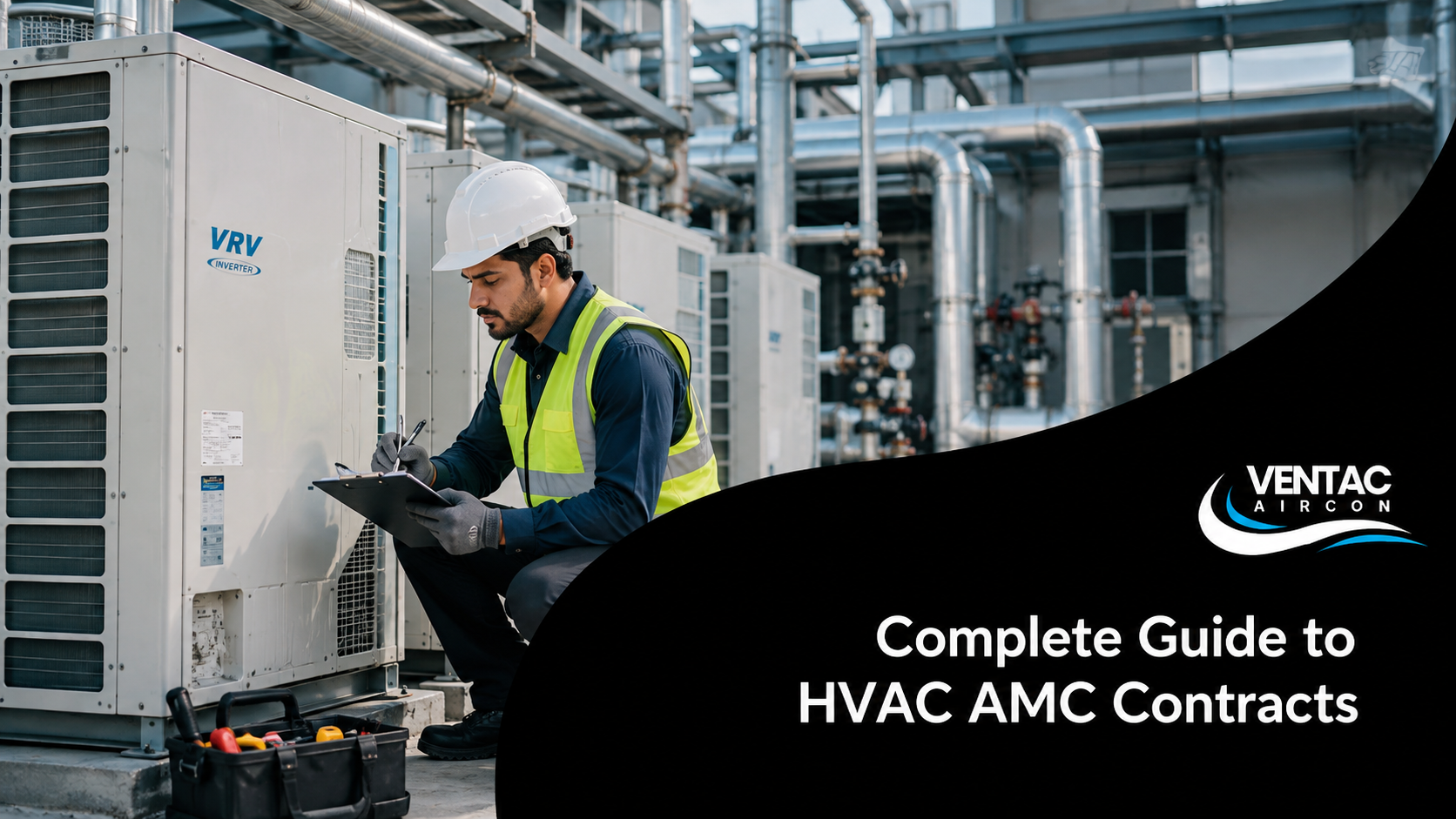
Complete Guide to HVAC AMC Contracts
An HVAC system is a long-term investment, but installing reliable equipment is only the beginning. Without regular maintenance, even a well-designed air-conditioning or ventilation system can develop problems that affect comfort, energy consumption and daily operations. A complete HVAC AMC contract provides a structured way to keep these systems working safely and efficiently.
For commercial buildings, hotels, hospitals, factories and other facilities, preventive maintenance is especially important. A failed air-conditioning system can disrupt business operations, while a neglected ventilation system may create indoor-air-quality and safety concerns.
An Annual Maintenance Contract (AMC) is an agreement between a property owner or facility manager and a service provider for the regular inspection, maintenance and servicing of HVAC equipment. Depending on the contract, it may also include breakdown support, replacement parts, emergency visits and performance checks.
However, not every AMC offers the same level of service. A low-cost agreement may cover only basic visits, while a comprehensive contract may include detailed inspections, preventive maintenance and faster breakdown response.
This guide explains how HVAC AMC contracts work, what they should include, how to compare service providers and how to choose a maintenance plan that suits your building's actual requirements.
Table of Contents
What Is an HVAC AMC Contract?
Why Preventive HVAC Maintenance Matters
What Does an HVAC AMC Usually Cover?
Types of HVAC AMC Contracts
How HVAC AMC Contracts Work
Choosing the Right HVAC Maintenance Contractor
HVAC Ductwork and Ventilation Maintenance
Industrial Ventilation System Maintenance
Emergency Repairs and Breakdown Support
How Much Does an HVAC AMC Cost?
Common Mistakes When Choosing an AMC
How to Prepare for an HVAC AMC
FAQs
Conclusion
What Is an HVAC AMC Contract?
An HVAC AMC contract is a service agreement that defines how a building's heating, ventilation and air-conditioning equipment will be maintained over a specific period, usually one year.
The agreement may cover equipment such as split air conditioners, VRV or VRF systems, chillers, air-handling units, package units, ducted systems, ventilation fans and associated controls.
The purpose is to move maintenance from a reactive approach to a planned one. Instead of waiting for an air conditioner to stop working, the service provider carries out scheduled inspections and identifies potential problems before they become major failures.
For example, a hotel may have dozens of indoor units operating throughout the day. A preventive maintenance plan can help identify blocked filters, drainage issues, unusual noise or declining cooling performance before these problems affect guests.
The exact scope depends on the equipment, building size, operating conditions and agreement between the client and contractor.
Why Preventive HVAC Maintenance Matters
HVAC equipment operates under different loads depending on the season, occupancy and building use. Dust, humidity, outdoor conditions and continuous operation can gradually affect performance.
A neglected system may consume more electricity, provide uneven cooling or require expensive repairs. In some cases, a small issue such as a blocked filter can contribute to reduced airflow and increased strain on the equipment.
Preventive maintenance helps facility teams identify these issues early. It also creates a maintenance history that can support budgeting, equipment replacement decisions and long-term asset management.
For a commercial building, the benefits may include:
More reliable equipment operation
Better indoor comfort and air quality
Reduced risk of unexpected breakdowns
Easier maintenance planning and budgeting
However, maintenance alone cannot compensate for an incorrectly designed or poorly installed system. If an HVAC system has persistent airflow problems, incorrect capacity or inadequate ventilation, the underlying design or installation issue may need to be addressed.
What Does an HVAC AMC Usually Cover?
The scope of an AMC should be clearly defined before the contract is signed. A basic agreement may include routine inspections and servicing, while a comprehensive plan may cover additional components and breakdown support.
For example, a commercial air-conditioning AMC may include cleaning filters, checking electrical connections, inspecting refrigerant-related components, examining condensate drainage and testing system operation.
For larger systems, maintenance may also involve checking pumps, valves, controls, air-handling units and other associated equipment.
A good contract should explain what the service provider will inspect, how often visits will occur and what happens if a fault is discovered.
Typical Maintenance Activities
The exact checklist depends on the equipment, but common activities may include:
Cleaning or replacing filters where required
Checking airflow, cooling performance and operating temperatures
Inspecting electrical connections, controls and safety devices
Examining condensate drainage and visible refrigerant-related components
Checking abnormal noise, vibration and signs of equipment wear
These activities should be performed according to the equipment manufacturer's recommendations and the system's operating requirements.
Types of HVAC AMC Contracts
Not all maintenance agreements provide the same level of protection. The most suitable option depends on the building's equipment and the consequences of a breakdown.
A non-comprehensive AMC generally covers routine maintenance and service visits. Replacement parts, refrigerant charges or major repairs may be billed separately.
A comprehensive AMC may include a wider range of maintenance services and certain replacement components, depending on the contract. However, the definition of "comprehensive" varies between providers, so the inclusions and exclusions should always be reviewed carefully.
For example, a hotel may choose a comprehensive agreement for critical guest-room systems, while a smaller office may prefer a non-comprehensive plan with separate repair charges.
The right choice depends on the equipment age, operating hours, maintenance history and available budget.
How HVAC AMC Contracts Work
A typical AMC begins with an assessment of the existing HVAC installation. The service provider reviews the equipment list, system condition, maintenance history and operational requirements.
This assessment helps establish the scope of work. A building with recently installed equipment may need a different maintenance plan from a factory with older systems operating continuously.
The contractor then prepares a service agreement covering the maintenance schedule, equipment included, response times, reporting requirements and commercial terms.
Once the agreement starts, technicians carry out scheduled visits and record the work completed. If they identify a fault, the contractor should explain the issue and recommend the appropriate corrective action.
For facility managers, these records are useful because they provide a clear history of maintenance activities, recurring faults and equipment condition.
Choosing the Right HVAC Maintenance Contractor
Selecting an AMC provider should involve more than comparing annual prices. The contractor's technical capability, response time, documentation and experience with similar systems are equally important.
A provider that mainly services residential split air conditioners may not be the right choice for a large commercial building with chillers, air-handling units, centralized controls or industrial ventilation.
When evaluating a contractor, consider:
Experience with the specific HVAC equipment and building type
Availability of trained service technicians and spare parts
Clear maintenance schedules, reporting and escalation procedures
Defined response times for breakdowns and emergency support
Transparent pricing, exclusions and replacement-part policies
For example, a hospital or manufacturing facility may require a different service arrangement from a small office because equipment downtime can have more serious operational consequences.
Ventac Aircon provides HVAC installation, maintenance and repair services for commercial and industrial applications, including air-conditioning and ventilation systems. Its website also describes annual maintenance contracts as part of its service offering. (ventac.in)
HVAC Ductwork and Ventilation Maintenance
Maintenance should not focus only on visible air-conditioning equipment. Ductwork, grilles, diffusers, dampers and ventilation fans also affect system performance.
For buildings with extensive ducted systems, the condition of the air distribution network can influence airflow, comfort and indoor air quality. Dust accumulation, damaged insulation, loose connections or poorly adjusted dampers may reduce performance.
This is why hvac ductwork installation contractors should also understand the maintenance requirements of the systems they install. Good installation practices make future inspection, cleaning and repair easier.
For example, a commercial office may experience uneven cooling because of incorrectly adjusted dampers or restricted airflow. A maintenance inspection can help identify whether the problem is related to the equipment, ductwork or controls.
In some buildings, duct cleaning or repair may be required as part of a separate specialist service rather than routine AMC visits. The contract should clearly state what is included.
Industrial Ventilation System Maintenance
Industrial and manufacturing facilities often have more demanding ventilation requirements than ordinary commercial buildings.
An industrial ventilation system may be used to remove heat, fumes, dust, moisture or other airborne contaminants, depending on the process and application. These systems require maintenance that reflects the actual operating environment.
For example, a factory may have exhaust fans, air-handling units, fresh-air systems and process ventilation equipment operating for long hours. Dust accumulation, corrosion, vibration and mechanical wear can affect performance over time.
Maintenance should therefore consider the condition of fans, motors, belts, bearings, filters, dampers and associated controls. Where applicable, airflow and system performance should also be checked against the intended design requirements.
The maintenance approach should be developed by competent professionals and should not replace any required industrial hygiene, process-safety or regulatory assessments.
Emergency Repairs and Breakdown Support
Preventive maintenance reduces the likelihood of breakdowns, but it cannot eliminate every failure. Equipment can still develop faults because of component wear, electrical issues, refrigerant-related problems or unexpected operating conditions.
This is why breakdown support should be clearly defined in the AMC.
A good agreement should explain how service requests are raised, the expected response time, whether emergency visits are included and how additional repair charges are handled.
For a hotel, a failed air-conditioning system in a guest room may require a faster response than a non-critical office area. Similarly, a manufacturing facility may need priority support for ventilation equipment serving an important production area.
The contract should reflect these operational priorities rather than applying the same response arrangement to every space.
How Much Does an HVAC AMC Cost?
The cost of an HVAC AMC depends on several factors, including the type of equipment, number of units, system capacity, building size, operating hours and level of service required.
A small office with a few split air conditioners will generally have different maintenance requirements from a hotel with multiple floors of guest rooms, centralized controls and extensive ventilation systems.
The condition and age of the equipment also matter. Older systems may require more frequent attention or additional repair work.
When comparing quotations, it is important to look beyond the annual price. A cheaper agreement may exclude important services or charge separately for parts and emergency visits.
The better approach is to compare the total expected maintenance cost, including scheduled servicing, likely repairs, replacement parts and downtime risks.
Common Mistakes When Choosing an AMC
One of the most common mistakes is selecting a contractor based only on the lowest quotation. Price matters, but it should be evaluated alongside technical scope and service quality.
Another mistake is signing a contract without checking the equipment list. If certain units, ventilation fans or controls are excluded, the building may still have unplanned maintenance costs.
Some clients also assume that every AMC includes unlimited breakdown support. In reality, many agreements have specific terms for emergency visits, refrigerant charges, spare parts and major repairs.
A further issue is failing to review maintenance reports. If the contractor repeatedly identifies the same fault without resolving it, the facility team should investigate whether a larger design, installation or equipment problem exists.
For mechanical ventilation contractors, this is particularly important because ventilation systems may serve safety-related or process-critical functions that require more detailed performance checks.
How to Prepare for an HVAC AMC
Before entering into an AMC, the facility team should collect basic information about the building's HVAC installation.
This includes the equipment list, model numbers, installation dates, maintenance history and any recurring problems. It is also useful to identify which areas are critical and which systems require priority service.
For example, a hospital may prioritize operating rooms and critical-care areas, while a hotel may prioritize guest rooms, kitchens and banquet facilities.
The contractor should then inspect the equipment and identify any existing faults before the agreement begins. This helps avoid confusion about whether a problem existed before the AMC started.
A clear contract should also define the reporting format, maintenance frequency, service response times, exclusions and approval process for additional work.
FAQs
1. What is an HVAC AMC contract?
An HVAC AMC contract is an agreement for the scheduled maintenance and servicing of air-conditioning, ventilation and related equipment. It may also include breakdown support and other services depending on the contract.
2. What is the difference between comprehensive and non-comprehensive AMC?
A non-comprehensive AMC usually covers routine maintenance, while a comprehensive AMC may include a wider range of repairs or replacement components. The exact inclusions and exclusions depend on the agreement.
3. How often should HVAC maintenance be carried out?
The frequency depends on the equipment, operating hours, environment and manufacturer's recommendations. Some systems may require more frequent attention because of dust, heavy use or critical operating conditions.
4. Does an HVAC AMC include spare parts?
Not always. Some contracts include selected replacement parts, while others charge separately. The agreement should clearly state which parts and repairs are covered.
5. Is HVAC AMC necessary for commercial buildings?
Regular maintenance is important for commercial buildings because HVAC systems often operate for long hours and serve many occupants. An AMC can help organize preventive maintenance and reduce the risk of unexpected failures.
6. Does an AMC cover duct cleaning?
Duct cleaning may or may not be included. It depends on the scope of the contract and the type of ductwork. Some projects require separate specialist cleaning or repair services.
7. Can an AMC reduce HVAC electricity consumption?
Preventive maintenance can help maintain system performance and identify issues that may contribute to inefficient operation. However, energy savings depend on the equipment condition, system design, operating conditions and other factors.
8. What should I check before signing an HVAC AMC?
Review the equipment list, maintenance schedule, service scope, response times, exclusions, spare-part policy, reporting requirements and additional repair charges. It is also useful to check the contractor's experience with similar systems.
Conclusion
A well-planned HVAC AMC contract helps building owners and facility managers maintain reliable air-conditioning and ventilation systems while reducing the risk of unexpected operational problems.
The most effective agreements are based on the actual equipment, building usage and maintenance requirements—not simply on a standard checklist or the lowest annual price.
For commercial and industrial facilities, preventive maintenance should also include the wider HVAC installation, including ductwork, controls, ventilation equipment and other associated components.
Whether you are managing a hotel, office, factory, hospital or commercial building, choosing the right maintenance partner can make a meaningful difference to system reliability, comfort and long-term operating costs.
Ventac Aircon offers HVAC maintenance and repair services for commercial and industrial applications, including annual maintenance contracts.

 Arabic
 French
 Spanish
 Portuguese
 Deutsch
 Turkish
 Dutch
Dutch
 Italiano
 Russian
 Romaian
 Portuguese (Brazil)
 Greek
Greek
