


Prebiotic Ingredients Market Growth Drivers: GOS, Supplements Push Market to USD 21.2 Billion by 2036
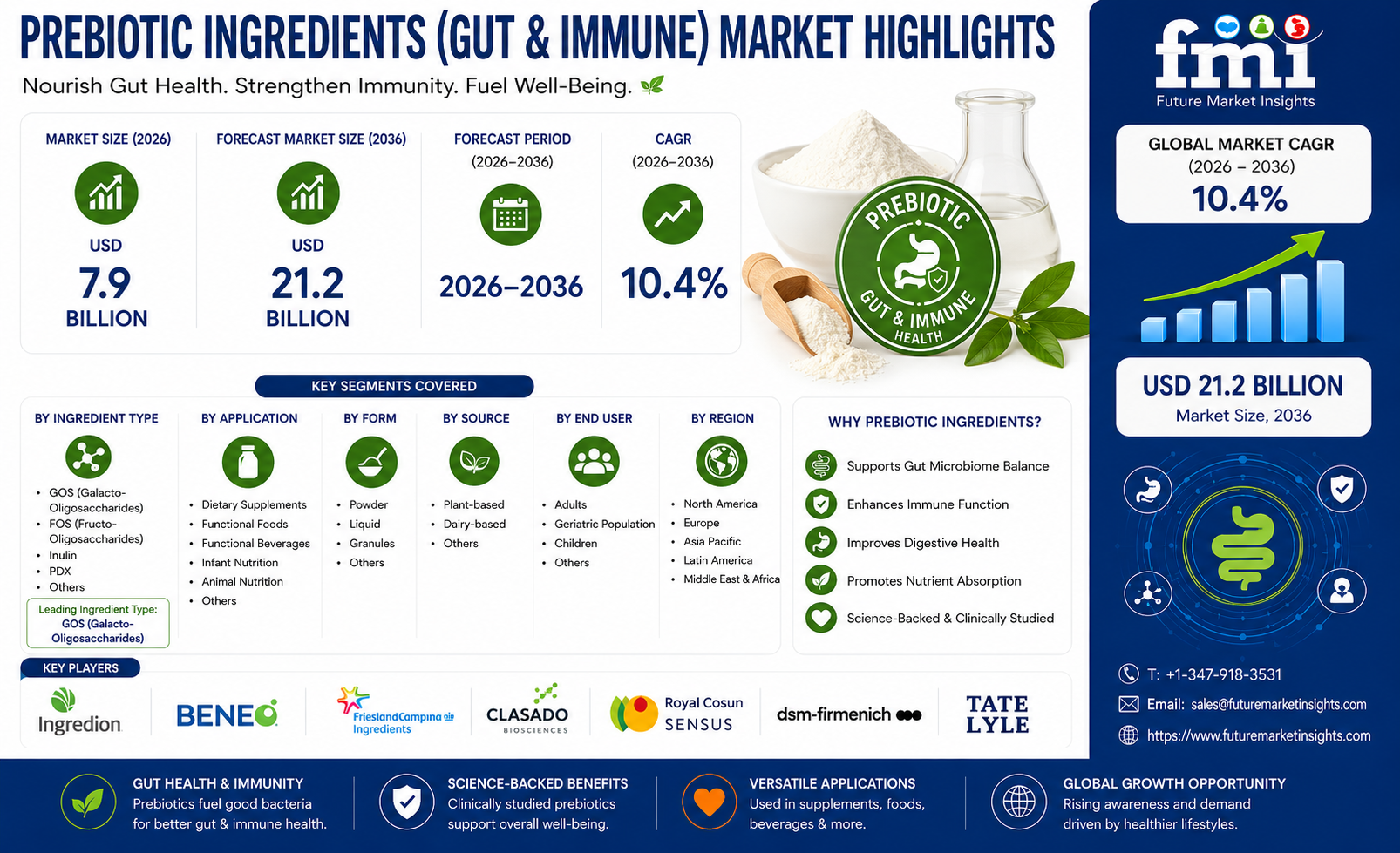
NEWARK, Del., August 5, 2026 — The global Prebiotic Ingredients (Gut & Immune) Market is projected to expand as food, beverage, and supplement manufacturers increasingly incorporate prebiotic ingredients into products targeting gut health and immune-support positioning. According to Future Market Insights (FMI), the market is expected to grow from USD 7.9 billion in 2026 to USD 21.2 billion by 2036, registering a 10.4% CAGR during the forecast period.
The market is benefiting from growing interest in microbiome-focused nutrition, increasing demand for clinically supported functional ingredients, and greater emphasis on precise dosing and sensory performance. However, national health-claim regulations, ingredient-specific evidence requirements, formulation constraints, and differences in permitted claims across finished formats remain important considerations for manufacturers.
👉 Request Your Free Sample Report: Explore the detailed market forecast, segmentation, trends, and competitive insights: https://www.futuremarketinsights.com/reports/sample/rep-gb-34352
Key Prebiotic Ingredients (Gut & Immune) Market Highlights
• Market Size (2026): USD 7.9 Billion
• Forecast Market Size (2036): USD 21.2 Billion
• Forecast Period: 2026–2036
• CAGR (2026–2036): 10.4%
Why Is the Prebiotic Ingredients (Gut & Immune) Market Growing?
The market is expanding as consumers and product developers increasingly focus on gut health, microbiome function, and nutrition strategies connected with immune wellness. Prebiotic ingredients provide manufacturers with opportunities to formulate products designed around targeted fiber intake, microbiome support, and functional nutrition positioning.
Greater formulation precision is also supporting market development. Manufacturers increasingly evaluate prebiotic ingredients according to identity, effective dose, sweetness, tolerance, texture, stability, and compatibility with the intended finished product.
In May 2026, FrieslandCampina Ingredients opened an application center in New Jersey focused on ready-to-drink products and functional snacks using protein and prebiotic solutions. The facility provides North American developers with local support for processing trials under realistic manufacturing conditions, highlighting the growing importance of application-specific formulation expertise.
Prebiotic ingredients must retain dose accuracy and sensory performance within their intended finished formats. As a result, ingredient suppliers increasingly need to support customers beyond ingredient supply through technical guidance, formulation assistance, and regulatory documentation.
Why Does GOS Lead the Ingredient Type Segment?
GOS is projected to remain the leading ingredient type, accounting for 42.6% share in 2026. The segment benefits from its suitability for controlled formulations and applications requiring practical serving levels and predictable sensory characteristics.
GOS can support formulations where manufacturers need precise ingredient incorporation while managing sweetness, taste, and product compatibility. Its application flexibility provides opportunities across supplements, functional foods, beverages, and other health-oriented formats.
Ingredient Type Highlights
• GOS accounts for 42.6% share in 2026.
• Supports controlled formulation strategies.
• Suitable for products requiring practical serving levels.
• Provides opportunities across multiple finished formats.
• Ingredient identity and dose accuracy remain important.
• Sensory performance influences consumer acceptance and repeat purchase.
Manufacturers increasingly evaluate GOS and other prebiotic ingredients according to their ability to deliver targeted functionality without creating unacceptable taste, texture, or tolerance issues.
Why Do Supplements Lead the Application Segment?
Supplements are projected to represent 46.2% of application demand in 2026, supported by their ability to deliver controlled doses through familiar daily formats.
Supplement products can provide manufacturers with greater control over ingredient dosage and multi-ingredient combinations. Capsules, powders, sachets, gummies, and other formats allow prebiotic ingredients to be incorporated into products targeting consumers seeking convenient gut and immune health solutions.
Application Highlights
• Supplements represent 46.2% share in 2026.
• Controlled serving sizes support dose precision.
• Familiar daily formats encourage repeat use.
• Multi-ingredient blends create formulation opportunities.
• Gut and immune health positioning supports product development.
• Regulatory claim requirements remain important during commercialization.
Supplement manufacturers can leverage precise serving formats to communicate ingredient quantities while managing formulation consistency and sensory considerations.
👉 Get the PDF Brochure: Discover the report's core insights, forecast highlights, and research: https://www.futuremarketinsights.com/reports/brochure/rep-gb-34352
Regional Outlook
Regional commercialization varies according to regulatory frameworks, consumer awareness, claim requirements, ingredient availability, and formulation infrastructure.
The United States remains an important market for prebiotic ingredient development, with formulators relying on ingredient-specific GRAS conclusions and application-focused regulatory assessment. Local technical capabilities are also becoming increasingly important as manufacturers develop ready-to-drink beverages, functional snacks, and other finished formats.
The European market operates within a more structured health-claim environment, requiring manufacturers to evaluate nutrition and health claims against authorized pathways. Ingredient-specific evidence and accurate documentation therefore remain important during product development.
Companies operating across multiple markets must account for differences in claim rules and ingredient specifications. A formulation developed for one market may require changes in serving size, wording, ingredient combination, or finished format before commercialization elsewhere.
Overall, successful commercialization depends on combining clinically supported ingredient functionality with precise dosing, acceptable sensory performance, regulatory readiness, and application-specific technical support.
Competitive Landscape
Competition in the Prebiotic Ingredients (Gut & Immune) Market continues to develop around ingredient innovation, clinical evidence, formulation expertise, application support, sensory performance, regulatory documentation, and supply reliability.
Key Companies Profiled: Ingredion, BENEO, FrieslandCampina Ingredients, Clasado Biosciences, Royal Cosun / Sensus, dsm-firmenich, and Tate & Lyle.
Browse the Full Report: https://www.futuremarketinsights.com/reports/prebiotic-ingredients-gut-and-immune-market
Frequently Asked Questions
What is the projected size of the Prebiotic Ingredients (Gut & Immune) Market by 2036?
The global Prebiotic Ingredients (Gut & Immune) Market is projected to reach USD 21.2 billion by 2036, growing from USD 7.9 billion in 2026.
What is the expected CAGR of the Prebiotic Ingredients (Gut & Immune) Market?
The market is expected to expand at a 10.4% CAGR between 2026 and 2036.
What is driving market growth?
Growing consumer interest in gut health, increasing microbiome-focused product development, rising demand for immune-health solutions, greater availability of ingredient-specific evidence, and growing adoption of prebiotic ingredients in supplements are key market growth drivers.
Which ingredient type dominates the Prebiotic Ingredients (Gut & Immune) Market?
GOS leads the ingredient type segment with a 42.6% share in 2026, supported by its suitability for controlled formulations and practical serving levels.
Which application dominates the Prebiotic Ingredients (Gut & Immune) Market?
Supplements lead the application segment with a 46.2% share in 2026, supported by precise dosing, familiar daily-use formats, and growing demand for gut and immune health products.
Related Reports
About Future Market Insights (FMI)
Future Market Insights, Inc. (ESOMAR certified and a recipient of the Stevie® Award) provides actionable market intelligence and consulting services across food & beverage, pharmaceuticals, chemicals, advanced materials, industrial manufacturing, sustainability, and consumer goods industries.
FMI delivers comprehensive market research, competitive intelligence, and strategic insights that help organizations identify emerging opportunities, evaluate market dynamics, and make informed business decisions across global markets.
For Press & Corporate Inquiries
Rahul Singh
AVP – Marketing and Growth Strategy
Future Market Insights, Inc.
For Sales: sales@futuremarketinsights.com
For Media: Rahul.singh@futuremarketinsights.com
For web: https://www.futuremarketinsights.com/

 English
 Arabic
 Spanish
 Portuguese
 Deutsch
 Turkish
 Dutch
Dutch
 Italiano
 Russian
 Romaian
 Portuguese (Brazil)
 Greek
Greek
