


What Innovations Are Introduced by a Modern Andrology Room Setup Company?
Introduction
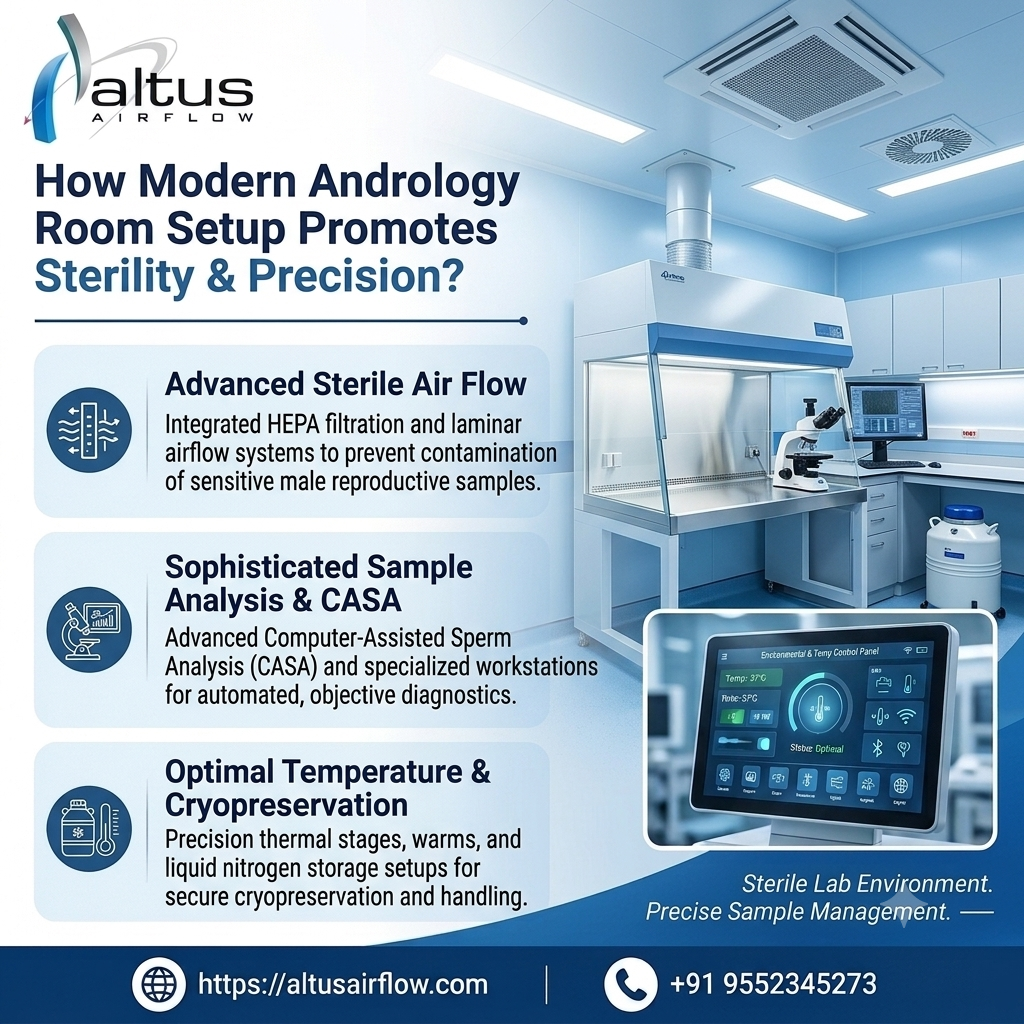
Altus Airflow understands that modern fertility laboratories require advanced infrastructure, specialised equipment, and carefully controlled working environments. An Andrology Room Setup Company introduces innovative solutions that help fertility centres improve laboratory organisation, maintain hygiene, and support accurate diagnostic procedures. Modern developments include smart ventilation systems, modular interiors, digital monitoring, ergonomic workstations, advanced lighting, and efficient equipment integration. These innovations help create organised laboratory spaces that support semen analysis, sample evaluation, and other andrology-related activities.
With increasing technological advancements in reproductive healthcare, laboratories are adopting improved designs and infrastructure to meet evolving clinical requirements. Selecting suitable innovations can help fertility centres establish functional, reliable, and well-organised andrology environments.
1. Smart Laboratory Design and Modular Infrastructure
One of the significant innovations in modern andrology laboratory development is the introduction of modular infrastructure. Traditional laboratory arrangements may have limitations in terms of flexibility, equipment positioning, and maintenance accessibility.
Modern modular designs address these challenges through carefully planned wall panels, ceilings, flooring, and integrated service provisions.
Important features include:
-
Modular wall systems with smooth, cleanable surfaces.
-
Seamless flooring arrangements for improved hygiene.
-
Integrated electrical and utility connections.
-
Flexible workstation configurations.
-
Accessible service panels for maintenance.
-
Organised storage and equipment placement.
Modular infrastructure also allows laboratories to plan different functional areas according to their activities. Sample preparation, microscopic examination, equipment storage, and administrative work can be organised to improve workflow.
Another advantage is adaptability. Laboratories can modify selected interior components and service arrangements when their operational requirements change.
2. Advanced Air Filtration and Ventilation Technologies
Air quality is an essential consideration in an andrology laboratory. Environmental conditions should be planned according to the laboratory's activities, equipment requirements, and contamination-control protocols.
Modern ventilation technologies help maintain controlled indoor conditions through filtration, air circulation, and environmental monitoring.
Some important innovations include:
HEPA filtration: High-efficiency particulate air filters help remove airborne particles from supplied air when appropriately selected and installed.
Controlled airflow: Properly designed air distribution helps maintain suitable ventilation patterns within laboratory spaces.
Temperature management: Modern HVAC systems provide controlled temperature settings to support laboratory activities and equipment operation.
Humidity monitoring: Environmental monitoring systems help maintain suitable humidity conditions according to laboratory requirements.
Differential pressure monitoring: Where required by the laboratory design, pressure monitoring helps identify unwanted changes in air movement between designated areas.
These technologies should be selected according to the laboratory's classification, applicable standards, and specific operational requirements.
Proper ventilation planning also requires coordination between air handling units, filtration systems, return air arrangements, and laboratory equipment.
3. Digital Monitoring and Smart Laboratory Management
Digital technology is transforming the way modern fertility laboratories monitor their working environments.
Smart monitoring systems allow laboratory personnel to observe important environmental parameters through digital displays and connected sensors.
Some commonly integrated technologies include:
-
Digital temperature monitoring.
-
Humidity sensors.
-
Air pressure monitoring devices.
-
Equipment status indicators.
-
Environmental alarm systems.
-
Centralised monitoring interfaces.
These systems can help laboratory managers identify environmental changes and respond to abnormal conditions more efficiently.
For example, digital temperature monitoring can alert staff when environmental conditions move outside established operating limits. Similarly, differential pressure indicators can notify facility personnel about ventilation abnormalities.
Some advanced monitoring platforms also maintain historical data and generate reports. These records can support internal quality management, equipment maintenance, and laboratory documentation.
However, digital monitoring systems should be appropriately calibrated, maintained, and validated to ensure reliable readings.
4. Advanced Microscopy and Diagnostic Equipment Integration
Microscopy is an important part of andrology laboratory operations. Modern laboratories are increasingly integrating advanced diagnostic equipment to support detailed examination and evaluation of reproductive samples.
Depending on the laboratory's services, equipment may include:
Digital microscopes: These systems provide enhanced image observation and may support image capture and documentation.
Computer-assisted semen analysis (CASA): CASA systems use specialised software and imaging technology to assess sperm concentration, motility, and other measurable parameters.
Digital imaging systems: These technologies help capture and store microscopic observations for laboratory documentation and review.
Precision laboratory instruments: Modern analytical instruments support controlled sample handling and diagnostic procedures.
Integrated computer systems: Equipment connectivity can help organise laboratory records and improve access to relevant diagnostic information.
An important consideration is equipment compatibility. Workstations, electrical connections, lighting, storage, and network provisions should be planned according to the specifications of the selected instruments.
Proper equipment integration helps prevent unnecessary movement and creates a more organised laboratory environment.
5. Ergonomic Workstations and Improved Laboratory Workflow
Laboratory professionals often perform repetitive activities involving microscopes, sample containers, analytical equipment, and computer systems.
Poor workstation design can create physical discomfort and make routine activities less convenient.
Modern laboratory planning therefore gives considerable attention to ergonomics.
Important workstation innovations include:
-
Adjustable laboratory chairs.
-
Suitable working heights.
-
Ergonomic microscope positioning.
-
Organised equipment layouts.
-
Accessible storage compartments.
-
Proper task lighting.
-
Convenient electrical and data connections.
A well-designed workstation allows laboratory professionals to perform activities comfortably while maintaining an organised working area.
Equipment should be arranged according to the sequence of laboratory operations. Frequently used instruments should remain accessible, while storage areas should be positioned to minimise unnecessary movement.
Workstation design should also provide sufficient space for sample handling and documentation.
These improvements can contribute to better workflow organisation and a more comfortable laboratory environment.
6. Advanced Lighting Systems for Accurate Laboratory Activities
Lighting is another important innovation in modern andrology room development.
Laboratory professionals require suitable illumination when examining samples, operating microscopes, handling laboratory materials, and documenting results.
Modern lighting systems provide improved control over brightness and illumination distribution.
Some useful features include:
LED lighting: Energy-efficient LED fixtures provide consistent illumination and generally have a long operating life.
Adjustable brightness: Dimming options allow users to modify illumination according to different laboratory activities.
Task lighting: Focused lighting provides additional visibility at workstations.
Reduced glare: Appropriate fixture positioning helps minimise unwanted reflections on screens and laboratory surfaces.
Balanced ambient lighting: General illumination supports comfortable movement and visibility throughout the laboratory.
Lighting should be selected according to the specific activities being performed. Microscope-based examinations may require different illumination arrangements from general sample preparation or documentation areas.
Proper lighting design also considers colour rendering, fixture placement, and compatibility with laboratory equipment.
7. Improved Sample Handling and Storage Solutions
Sample handling is an important aspect of andrology laboratory operations. Modern infrastructure innovations help laboratories organise sample movement, storage, and identification procedures.
Well-planned storage arrangements can reduce unnecessary handling and support organised laboratory activities.
Some important features include:
-
Dedicated sample preparation workstations.
-
Clearly identified storage compartments.
-
Appropriate temperature-controlled storage equipment.
-
Organised consumable storage.
-
Easy-to-clean storage surfaces.
-
Secure access to sensitive laboratory materials.
Modern digital identification and laboratory information management systems can also support sample traceability.
Barcode-based identification, where integrated into laboratory workflows, helps associate samples with the correct records and reduces dependence on manual identification processes.
Storage requirements should be established according to the type of material, laboratory protocol, and equipment manufacturer's recommendations.
Temperature-sensitive materials may require specialised storage systems with continuous monitoring and alarm provisions.
8. Integration of Laboratory Information Management Systems
Digital documentation is becoming increasingly important in modern reproductive laboratories.
Laboratory Information Management Systems (LIMS) help organise sample records, test information, equipment details, and laboratory documentation.
Depending on the software and its configuration, these systems may provide:
Sample tracking: Digital records help identify and monitor samples throughout laboratory processes.
Result management: Diagnostic observations and reports can be stored in an organised digital format.
Equipment records: Maintenance schedules, calibration details, and equipment performance information can be documented.
User access management: Role-based permissions help control access to laboratory information.
Reporting features: Digital platforms can generate operational reports and support internal quality reviews.
Integration between diagnostic equipment and laboratory software may also reduce manual data entry, depending on equipment compatibility.
Hospitals and fertility centres should evaluate data security, user permissions, backup arrangements, and software validation before implementing these systems.
9. Modern Electrical and Utility Management
Advanced laboratory equipment requires reliable electrical infrastructure and appropriately planned utility connections.
Modern laboratory designs incorporate organised electrical distribution and utility provisions to support equipment operation.
Important innovations include:
-
Dedicated electrical circuits for sensitive equipment.
-
Properly positioned power outlets.
-
Suitable earthing arrangements.
-
UPS backup for designated critical equipment.
-
Organised cable management.
-
Electrical load monitoring.
-
Accessible maintenance provisions.
UPS systems can provide temporary backup power to selected equipment during electrical interruptions. The equipment requiring uninterrupted supply should be identified through a laboratory-specific assessment.
Laboratories should also consider the requirements of water supply, drainage, data connectivity, and other utilities where applicable.
Proper planning reduces installation conflicts and helps maintain an organised working environment.
10. Enhanced Hygiene and Contamination-Control Features
Maintaining hygienic laboratory conditions is essential for reproductive healthcare facilities.
Modern laboratory infrastructure incorporates design features that support routine cleaning and contamination-control procedures.
These may include:
Non-porous surfaces: Smooth surfaces are generally easier to clean and disinfect.
Sealed joints: Properly finished connections help reduce dirt accumulation.
Appropriate flooring: Seamless or suitably jointed flooring supports routine housekeeping.
Controlled access: Access management helps organise personnel movement within designated laboratory areas.
Dedicated storage: Separate storage arrangements help organise clean supplies and used materials according to laboratory protocols.
Hand hygiene provisions: Conveniently located handwashing or hand hygiene facilities support established hygiene practices.
The laboratory layout should also separate activities where necessary to reduce the risk of cross-contamination.
Cleaning procedures, environmental monitoring, and staff training remain essential even when advanced infrastructure is installed.
11. Sustainable and Energy-Efficient Laboratory Technologies
Energy efficiency is becoming an important consideration in modern healthcare infrastructure.
Laboratories use ventilation equipment, refrigeration systems, lighting, microscopes, and other electrical devices that require continuous or frequent operation.
Modern technologies can help improve energy management without compromising essential laboratory requirements.
Examples include:
-
Energy-efficient LED lighting.
-
High-efficiency HVAC equipment.
-
Variable-speed ventilation controls where appropriate.
-
Smart environmental monitoring.
-
Efficient refrigeration systems.
-
Automated lighting controls.
-
Improved equipment scheduling.
Energy-efficient ventilation systems should still maintain the required air quality and environmental conditions.
Similarly, equipment operation should follow manufacturer recommendations and laboratory protocols rather than reducing essential performance to achieve energy savings.
A carefully planned infrastructure helps fertility centres balance operational efficiency with laboratory requirements.
12. How to Select the Right Andrology Laboratory Infrastructure Partner?
Selecting an experienced infrastructure partner is important when developing or upgrading an andrology laboratory.
A suitable Andrology Room Setup Company should understand laboratory planning, modular construction, ventilation, electrical infrastructure, and equipment integration.
Hospitals and fertility centres should evaluate potential partners based on the following factors:
Technical experience: Review experience in fertility laboratory and specialised healthcare infrastructure projects.
Design capabilities: Examine architectural layouts, workstation arrangements, ventilation drawings, and equipment integration plans.
Material quality: Verify that modular construction materials are durable and compatible with laboratory cleaning procedures.
Engineering coordination: Ensure that ventilation, electrical systems, lighting, and utility requirements are considered together.
Installation expertise: Evaluate the ability to execute the project according to approved technical drawings.
Testing and commissioning: Confirm that installed systems undergo suitable performance testing before handover.
After-installation support: Check the availability of maintenance guidance and technical assistance.
A detailed consultation with laboratory professionals and technical specialists helps ensure that the final design supports the facility's actual requirements.
13. Future Trends in Andrology Room Design
Andrology laboratories are likely to adopt further technological improvements as reproductive healthcare continues to develop.
Some emerging trends include:
Artificial intelligence-assisted analysis: AI-based software may support image analysis and diagnostic workflows when appropriately validated for the intended application.
Connected laboratory equipment: Greater equipment connectivity can improve information exchange and digital documentation.
Advanced environmental monitoring: Integrated sensors can provide more detailed information about laboratory conditions.
Flexible modular layouts: Adaptable interiors can help laboratories accommodate changing equipment and operational requirements.
Automated documentation: Digital workflows may reduce repetitive manual recordkeeping.
Improved laboratory ergonomics: Future designs are expected to place greater emphasis on user comfort, accessibility, and efficient workflow arrangements.
These innovations should be adopted based on clinical relevance, technical validation, data security, and compatibility with existing laboratory procedures.
Conclusion
Modern andrology laboratories are evolving through innovations in modular infrastructure, smart ventilation, digital monitoring, advanced microscopy, ergonomic workstations, and integrated laboratory management systems. These technologies help fertility centres organise laboratory activities, maintain controlled environmental conditions, and support efficient diagnostic workflows. Hospitals should evaluate each innovation according to their clinical requirements, equipment specifications, and applicable technical standards before implementation.
A well-planned Andrology Room Setup Company approach combines functional laboratory design with suitable technology, hygienic materials, and coordinated engineering systems.
Altus Airflow specialises in modular healthcare and fertility laboratory infrastructure, helping facilities develop organised and technically coordinated laboratory environments. With attention to ventilation, modular interiors, utility planning, and equipment integration, Altus Airflow supports modern andrology laboratory development.
Frequently Asked Questions (FAQs)
1. What innovations are introduced by a modern andrology room setup company?
An Andrology Room Setup Company introduces modular interiors, smart ventilation, digital monitoring, advanced microscopy integration, ergonomic workstations, and improved sample storage solutions.
2. Why is modular infrastructure important in andrology laboratories?
It provides flexible layouts, organised workstations, hygienic surfaces, and convenient maintenance access.
3. How does digital monitoring improve laboratory management?
It helps monitor temperature, humidity, pressure, and other environmental parameters through connected sensors.
4. What is the role of CASA technology in andrology laboratories?
Computer-assisted semen analysis helps assess sperm concentration, motility, and other measurable parameters.
5. Why is HEPA filtration important in andrology rooms?
HEPA filtration helps remove airborne particles from supplied air when properly selected and installed.
Read Our Previous Blog ---------------> How does an Andrology Room Design Company ensure long-term laboratory reliability?

 English
 French
 Spanish
 Portuguese
 Deutsch
 Turkish
 Dutch
 Italiano
 Russian
 Romaian
 Portuguese (Brazil)
 Greek
