


From Crane Serial to Confirmed Part Number
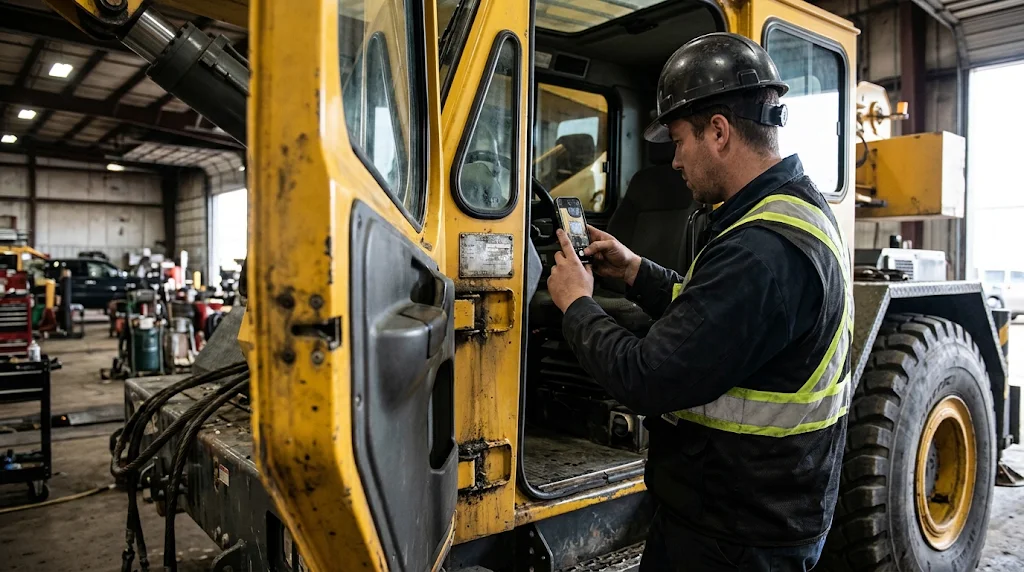
Two machines wearing the same model badge may still diverge at the component level. A mid-run production change or an in-service assembly swap explains most of the difference. When that goes unnoticed, a second freight invoice follows the first. The fix is a consistent identification routine used on every order.
Working through Grove crane parts in a disciplined way means capturing the model designation and serial, finding the assembly in the catalog, reading the version note, and confirming the orderable number. A modified crane adds the installed assembly's tag and the maintenance record to the evidence set. Manitowoc publishes reference manuals by model and directs owners to the serial-specific manuals supplied with their equipment.
Start each enquiry with a written list of what you know and what you still need. The supplier can fill gaps faster than it can correct assumptions.
Establish the source of every number
Three different numbers often appear in one lookup. The crane serial identifies the machine, the catalog number identifies a listing, and the component's own tag identifies the assembly as built. Hydraulic pumps are a common example of that third category. Record the origin of each number before writing it down, so nothing later becomes anonymous.
Supplier communication works better with labelled images than with raw digits. A photo marked "crane data plate" and another marked "pump tag" remove ambiguity immediately. Crews that maintain quality parts records apply the same labelling to every tag they photograph. Unexplained strings of numbers invite assumptions, and assumptions are what create returns.
Where the serial plate sits varies by model. On the GRT8120, Grove's operator manual points to the frame stamping, the plate inside the cab, and the manual's own cover. Used cranes frequently arrive carrying paperwork from several earlier units, so cross-check the number against the machine itself. Take a clear photograph and store it with the unit's records for future reference.
Cast markings on housings are worth capturing, though they identify the casting rather than the assembly as supplied. Two assembly versions may share that casting and differ internally. Include the casting number alongside the tag photo and catalog reference. When transcribing catalog numbers, reproduce leading zeros, letters, suffixes, and punctuation exactly.
Find the serial break before you pick a line
A serial break is the documented point where a part or assembly changes within a production run. Catalogs show both versions and assign each to a group of machines. The model brings you into the right family of Grove crane parts; the serial number picks the exact listing. Skipping that second step is how the wrong variant reaches the workshop.
A typical entry might read "prior to S/N 2500" on one line and "S/N 2500 and up" on the next. Machine 2499 takes the earlier line, machine 2500 the later. The example numbers are placeholders, because only the wording beside the real part defines the actual cutoff. If entries overlap, leave a gap, or use a format that does not match the plate, send the catalog page and full serial to the distributor.
Scope matters as much as the number. A heading note can govern an entire assembly, while a note on a single line governs only that item. Confirm whether the note refers to the crane or to a separately identified component. A break keyed to the crane serial and a revision keyed to a pump serial address different variables.
Callouts and list rows must be read as a pair
In illustrated catalogs, the number beside an arrow is a callout that leads to a parts-list row. That row holds the part number, description, and applicability notes. When a single callout resolves to two rows, both descriptions need reading before either number is copied. The distinction may be a serial range, an option, or the crane side involved.
Check what the row itself describes. A figure may depict a complete cylinder while a separate line offers only a seal kit. For buyers assembling quality parts packages for a rebuild, the figure and item reference belong in the written enquiry. Catalog quantity also needs scrutiny, since one assembly's stated count may not cover the full job.
A callout appearing on two figures usually reflects two drawing angles rather than two parts. Read the figure title before treating the rows as duplicates. Always carry the figure number with the item number into the request.
Quantities mislead when a figure shows only part of an assembly. Confirm whether the count applies to one unit or to the complete set.
Supersession checks run alongside serial-break checks
A catalog number correct in print may be quoted back as something different. Ask whether the new number supersedes the old for this machine's serial and configuration. Distributors fielding requests for Grove crane parts run both comparisons before quoting. Confusing the two ideas is a frequent source of avoidable returns.
A supersession changes the number supplied for a replacement; a serial break describes the production coverage of an entry. Either can change what ships, so verify them independently. Manitowoc provides electronic catalog and ordering tools through Manitowoc Direct and directs customers to local parts dealers for support.
Also clarify the contents of the box. A replacement may ship as a kit with companion items and instructions, and the quote should reflect that. When a supplier offers a cross-referenced alternative, ask for documented compatibility with the specific application. Log the confirmed number on the enquiry so receiving can match it later.
Service history overrides the original build record
Take a seal kit for an outrigger cylinder. The crane serial points to an earlier cylinder, yet the service records show a full replacement five years ago. The identification on the cylinder now fitted controls the lookup. A kit chosen from the original configuration alone can deliver the wrong seals.
Provide the crane serial, a photograph of the installed identification, and the replacement work order when it can be found. That documentation closes the gap for Grove crane parts on machines that have been altered. Swapped winches and hydraulic pumps present the same situation. If the tag is missing or the records conflict, ask the distributor which other identifiers can confirm the assembly before ordering proceeds.
An absent tag narrows the field rather than ending the enquiry. Casting marks, fitting patterns, and hose ends eliminate most candidates quickly. Measurements from the mounting points add further certainty. A dated work order tells you when the change happened, which affects the variant you should expect.
Put the evidence on the purchase order itself
A complete enquiry gives the supplier what it needs to confirm fit. Include the full model and serial number, each part's description and location, and the catalog figure and item reference. Photographs and repair records should travel with the request, especially where quality parts are being ordered across several machines. Tie every requested line to a specific crane, because two units with one badge may fall on opposite sides of a break.
The confirmation should state what will ship: the orderable number, whether the item is a direct replacement or a kit, and the kit's contents where relevant. Keep that confirmation with the purchase order. At delivery, receiving compares the label against the confirmed number and flags any unexplained substitution before the part reaches the workshop. The check is quick, and it prevents a longer delay later.
Once the assembly is fitted, record its number against that crane in the maintenance system, including any replacement identification. The next buyer then begins with the machine's actual history instead of reopening an old catalog to reconstruct which variant was installed.

 English
 Arabic
 French
 Spanish
 Portuguese
 Deutsch
 Turkish
 Dutch
 Italiano
 Russian
 Romaian
 Greek
