


Hair Transplant in Pakistan
Hair loss is a common concern affecting millions of men and women worldwide. Whether it develops gradually with age, results from genetics, hormonal changes, medical conditions, or other factors, hair loss can affect a person's appearance, confidence, and emotional well-being. With advancements in modern aesthetic medicine, hair transplantation has become one of the most effective long-term options for restoring hair in areas affected by thinning or baldness.
A hair transplant is a specialized surgical procedure in which healthy hair follicles are taken from a donor area, usually the back or sides of the scalp, and transplanted into areas where hair is thinning or absent. The transplanted follicles are carefully placed to create a natural-looking hairline and improve overall hair density.
Today, hair transplantation techniques have evolved considerably, allowing qualified surgeons to perform procedures with greater precision, minimal scarring, and natural-looking results. However, successful hair restoration requires proper diagnosis, careful planning, an experienced surgeon, and realistic expectations.
This comprehensive guide explains everything you need to know about hair transplantation, including techniques, candidacy, procedure steps, benefits, recovery, costs, risks, results, and aftercare.
What Is a Hair Transplant?
A hair transplant is a surgical hair restoration treatment that involves transferring hair follicles from a part of the scalp with healthy, stable hair growth to areas experiencing hair loss. These transplanted follicles are generally taken from the donor region, which is commonly located at the back or sides of the head.
The donor hair is selected because it is often less susceptible to the hormonal effects responsible for pattern hair loss. Once transplanted, these follicles can continue to grow hair in their new location, although results vary depending on the individual, underlying hair-loss condition, and surgical technique.
Hair transplantation is commonly used to treat:
-
Male pattern baldness.
-
Female pattern hair loss in carefully selected patients.
-
Receding hairlines.
-
Hair thinning around the crown.
-
Bald patches caused by certain types of hair loss.
-
Hair loss resulting from scars, trauma, or selected surgical procedures.
-
Eyebrow hair loss, in selected cases.
Hair transplantation redistributes existing healthy hair follicles. It does not create new follicles or stop hair loss in untreated areas.
Types of Hair Transplant Techniques
There are several hair transplant techniques available today. The most commonly performed procedures are Follicular Unit Extraction (FUE) and Follicular Unit Transplantation (FUT). Both techniques aim to restore hair growth, but they differ in how donor follicles are harvested.
1. FUE Hair Transplant (Follicular Unit Extraction)
Follicular Unit Extraction (FUE) is one of the most popular hair transplant techniques. In this method, individual follicular units are extracted from the donor area using a small punch instrument and then transplanted into the recipient area.
Unlike traditional strip harvesting, FUE does not involve removing a large strip of scalp tissue. It leaves tiny circular scars that are generally less noticeable, especially when the donor hair is kept at a reasonable length.
How FUE works:
-
The donor and recipient areas are evaluated and prepared.
-
Local anesthesia is administered.
-
Individual follicular units are extracted from the donor region.
-
Recipient sites are created in the thinning or bald area.
-
Extracted follicles are implanted carefully into the recipient sites.
-
Post-procedure care instructions are provided.
Advantages of FUE:
-
No linear scar from strip removal.
-
Generally less invasive donor-area harvesting.
-
Suitable for patients who prefer shorter hairstyles.
-
Typically allows relatively quick donor-area healing.
-
Can produce natural-looking results when performed correctly.
FUE requires considerable skill and precision. Overharvesting follicles from the donor area can cause visible thinning, so careful planning is essential.
2. FUT Hair Transplant (Follicular Unit Transplantation)
Follicular Unit Transplantation (FUT), also known as strip surgery, is another established hair restoration technique. In this procedure, a narrow strip of skin containing hair follicles is removed from the donor area, usually at the back of the scalp.
The strip is then carefully dissected under magnification into individual follicular units, which are subsequently transplanted into the recipient area.
Advantages of FUT:
-
Can provide a large number of grafts in a single session for selected patients.
-
May be useful for patients requiring extensive hair restoration.
-
Preserves some donor hair outside the strip area.
-
Can be appropriate for certain patients with limited donor characteristics.
Disadvantages of FUT:
-
Leaves a linear scar in the donor area.
-
May involve more tension or discomfort during donor-site healing.
-
Can restrict hairstyles that expose the donor scar.
-
Requires sutures or staples and their subsequent removal, depending on the technique.
FUT may still be an appropriate option for certain patients, depending on donor density, hair characteristics, scalp flexibility, goals, and the surgeon's assessment.
3. DHI Hair Transplant (Direct Hair Implantation)
Direct Hair Implantation (DHI) is often described as a variation of FUE. Follicles are generally extracted individually, then implanted using a specialized implanter device, sometimes called an implanter pen.
The implantation device allows the surgeon or trained medical team to control aspects of follicle placement, including angle, direction, and depth, depending on the instrument and technique.
Potential advantages of DHI:
-
Controlled implantation of follicular units.
-
May allow careful placement in certain recipient areas.
-
Can be useful in selected hairline-restoration cases.
-
May reduce the time follicles spend outside the body in some workflows.
DHI is not automatically superior to conventional FUE. The quality of results depends on surgical planning, the skill of the surgeon, graft handling, donor management, and patient suitability rather than the technique's name alone.
Who Is a Good Candidate for Hair Transplantation?
Hair transplantation is not suitable for everyone. A thorough consultation with a qualified hair restoration surgeon is necessary to determine whether the procedure is appropriate.
A good candidate may include someone who:
-
Has stable pattern hair loss.
-
Has sufficient healthy donor hair.
-
Has realistic expectations about hair density and coverage.
-
Is generally healthy enough for elective surgery.
-
Has a hair-loss pattern that can be treated safely.
-
Understands that existing non-transplanted hair may continue to thin.
-
Is willing to follow post-operative instructions.
Who May Not Be Suitable?
Hair transplantation may not be recommended for people with:
-
Active scalp infections or inflammatory scalp conditions.
-
Uncontrolled medical conditions that increase surgical risks.
-
Insufficient donor hair.
-
Certain forms of active or unpredictable hair loss.
-
Unrealistic expectations about density or coverage.
-
Medical conditions that impair healing.
Patients with sudden, diffuse, or unexplained hair loss may require medical investigation before considering surgery. A hair transplant should not be used as a substitute for diagnosing and treating the underlying cause of hair loss.
Common Causes of Hair Loss
Understanding the cause of hair loss is an important part of choosing the right treatment.
Genetic Hair Loss
Androgenetic alopecia, commonly known as male or female pattern hair loss, is one of the most frequent causes of progressive hair thinning. It is influenced by genetic susceptibility and hormonal factors, particularly sensitivity to dihydrotestosterone (DHT) in susceptible follicles.
In men, it often causes a receding hairline and thinning at the crown. In women, it commonly presents as widening of the part and diffuse thinning over the central scalp.
Hormonal Changes
Hormonal fluctuations may contribute to hair loss in some individuals. Changes associated with pregnancy, menopause, thyroid disorders, or other hormonal conditions may affect the hair growth cycle.
Stress and Illness
Severe stress, illness, surgery, nutritional deficiencies, and some medications may trigger temporary hair shedding, including telogen effluvium. In such cases, the underlying cause should be addressed before considering surgical restoration.
Nutritional Deficiencies
Deficiencies in certain nutrients, including iron in some individuals, may contribute to hair loss. A medical evaluation can help determine whether testing or nutritional treatment is appropriate.
Scarring Hair Loss
Certain inflammatory or autoimmune conditions can damage hair follicles and cause permanent hair loss. Hair transplantation may be considered in selected cases only after the condition has been adequately evaluated and stabilized.
How Does a Hair Transplant Procedure Work?
Hair transplantation is generally performed under local anesthesia and may take several hours, depending on the number of grafts, technique, and complexity of the case.
Step 1: Consultation and Hair Assessment
The surgeon examines the scalp, evaluates the hair-loss pattern, assesses donor hair density, and discusses the patient's goals. The hairline design and expected coverage are planned according to facial proportions, donor availability, and long-term hair-loss progression.
Step 2: Preparation and Anesthesia
The donor and recipient areas are prepared. Local anesthesia is administered to minimize pain during the procedure. Patients may feel pressure or mild discomfort during some stages.
Step 3: Follicle Extraction
Depending on the technique, individual follicular units are extracted using FUE or a donor strip is removed using FUT. The follicles are handled carefully to minimize damage.
Step 4: Graft Preparation
The extracted grafts are examined, sorted, and prepared for implantation. Grafts may contain one, two, three, or more hair follicles, depending on their natural composition.
Step 5: Recipient Site Creation
The surgeon creates small recipient sites in the areas requiring hair restoration. The direction, angle, distribution, and spacing of these sites are important for achieving a natural appearance.
Step 6: Follicle Implantation
The prepared follicles are implanted into the recipient area. Single-hair grafts are often used along the hairline to create a softer, natural transition, while larger grafts may be placed behind the hairline to improve coverage.
Step 7: Post-Procedure Care
The patient receives instructions on washing, sleeping, protecting the scalp, medication use, and follow-up appointments.
Benefits of Hair Transplantation
Hair transplantation can provide several benefits when performed on appropriately selected patients.
1. Natural-Looking Hair Growth
Careful hairline design, follicle placement, and consideration of natural hair direction can help achieve results that look natural rather than artificial.
2. Long-Term Hair Restoration
Transplanted follicles often retain characteristics of the donor region and may continue producing hair for many years. However, the longevity of results varies, and continued hair loss in surrounding untreated areas may affect the overall appearance over time.
3. Improved Hairline Appearance
A hair transplant can help restore a receding hairline, fill selected thinning areas, and improve the balance of facial features.
4. Improved Confidence
Some individuals feel more comfortable with their appearance after hair restoration. However, emotional and psychological outcomes vary, and surgery should not be viewed as a guaranteed solution to confidence or self-esteem concerns.
5. Personalized Hair Restoration
The procedure can be tailored to the patient's hair-loss pattern, donor availability, hair texture, scalp characteristics, and restoration goals.
6. Minimal Visible Scarring With FUE
FUE generally leaves small, scattered scars rather than a linear scar. These scars may still be visible, particularly if the scalp is shaved very short or follicles are overharvested.
Hair Transplant Recovery: What to Expect After Surgery
Recovery after a hair transplant is generally manageable, but the healing process takes time. Patients should follow their surgeon's instructions carefully to protect transplanted follicles and reduce the risk of complications.
First 1–3 Days
During the first few days, the scalp may appear red and swollen. Small scabs usually form around transplanted follicles. Mild tenderness, discomfort, or tightness in the donor area may occur.
Patients are generally advised to:
-
Avoid touching, scratching, or rubbing the transplanted area.
-
Follow prescribed medication instructions.
-
Sleep in the recommended position.
-
Avoid strenuous physical activity.
-
Follow the surgeon's washing instructions.
First Week
The scalp begins healing, and small crusts may remain around the grafts. Mild swelling, particularly around the forehead, may occur in some patients and typically resolves over several days.
Avoid activities that increase sweating or place unnecessary pressure on the scalp unless your surgeon advises otherwise.
2–4 Weeks
Many transplanted hair shafts begin shedding during this period. This is commonly referred to as shock loss or shedding of transplanted hairs. It is usually a normal part of the hair growth cycle and does not necessarily mean that the transplanted follicles have failed.
The follicles remain beneath the skin and may begin producing new hair later.
3–4 Months
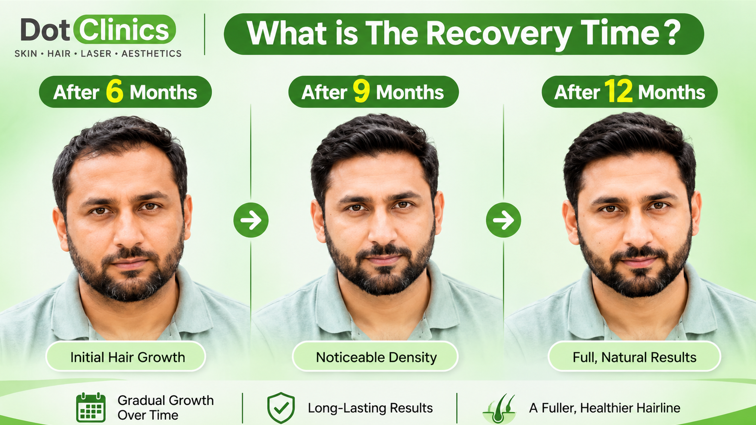
Early new hair growth may begin to appear. Initially, the hair may be fine, uneven, or relatively sparse. Hair growth varies from patient to patient, and some people may see noticeable changes later.
6 Months
Many patients begin noticing more visible improvement in hair density and coverage. The transplanted hair may become thicker and more noticeable, although results are still developing.
9–12 Months
Hair growth and density often become substantially more noticeable during this period. Hairline restoration may show significant improvement, but the crown can take longer to develop.
12–18 Months
Final or near-final results are commonly assessed during this period, particularly for crown restoration. Some patients may continue seeing changes beyond 18 months.
Hair transplant timelines are approximate. Growth, shedding, healing, and final density vary between individuals.
Hair Transplant Before and After Results
Hair transplant before-and-after photographs can help patients understand the potential results of hair restoration. However, results should be evaluated carefully because patients differ in donor density, hair thickness, scalp characteristics, degree of baldness, graft numbers, and hair-loss progression.
When evaluating before-and-after results, consider:
-
Whether photographs show the same lighting and angle.
-
Whether hair length is similar in both photographs.
-
How long after surgery the final photograph was taken.
-
Whether the patient had similar hair characteristics to yours.
-
Whether the restored hairline looks natural.
-
Whether donor-area scarring or thinning is visible.
A realistic assessment is more valuable than promises of extremely high density or guaranteed results.
How Many Grafts Are Needed for a Hair Transplant?
The number of grafts required depends on the size of the affected area, the patient's donor hair availability, hair thickness, hair-loss pattern, and restoration goals.
|
Hair restoration area |
Approximate graft range |
|---|---|
|
Minor hairline correction |
500–1,500 |
|
Receding hairline |
1,500–2,500 |
|
Hairline and frontal region |
2,000–3,500 |
|
Frontal and mid-scalp |
3,000–4,500 |
|
Extensive baldness |
4,000–6,000+ |
These are illustrative ranges, not a recommended graft count. Actual requirements may be lower or higher, and extensive procedures may need multiple sessions.
A graft is a follicular unit, not a single hair. A graft may contain one, two, three, or sometimes more hair follicles. Therefore, graft numbers and individual hair counts are not interchangeable.
Hair Transplant Cost
Hair transplant cost varies significantly depending on the clinic, surgeon's expertise, procedure technique, number of grafts, location, and additional services.
Factors that influence the price include:
-
Number of grafts required.
-
FUE, FUT, or another implantation approach.
-
Surgeon's experience and qualifications.
-
Clinic facilities and medical standards.
-
Complexity of the hair-loss pattern.
-
Whether medications, follow-ups, and aftercare are included.
Hair Transplant Cost in Pakistan
In Pakistan, hair transplant pricing can vary widely between clinics and cities. Some clinics charge based on graft numbers, while others offer package pricing.
Patients should avoid selecting a clinic solely because it offers the lowest price. The experience of the surgeon, quality of graft handling, sterile conditions, donor-area management, and transparent consultation are important considerations.
Before choosing a clinic, ask for a detailed quotation and clarification regarding who performs the extraction, recipient-site creation, and implantation.
Risks and Side Effects of Hair Transplantation
Hair transplantation is generally considered a relatively safe surgical procedure when performed by appropriately qualified professionals, but it still carries risks.
Potential side effects and complications include:
-
Swelling of the scalp or forehead.
-
Mild pain or tenderness.
-
Temporary numbness.
-
Itching during healing.
-
Bleeding.
-
Infection.
-
Folliculitis.
-
Temporary shedding of existing hair.
-
Visible donor scars.
-
Uneven or unnatural hair growth.
-
Poor graft survival.
-
Overharvesting of donor hair.
-
Rarely, more serious complications.
Patients should seek medical advice if they experience worsening pain, spreading redness, significant drainage, fever, or other concerning symptoms.
Hair Transplant Aftercare Tips
Proper aftercare plays an important role in healing and protecting transplanted follicles.
1. Follow Your Surgeon's Washing Instructions
Wash your scalp only as instructed. Gentle cleaning helps remove accumulated oils and debris without damaging healing tissue.
2. Avoid Scratching the Scalp
Itching may occur during healing. Scratching or picking at scabs can irritate the scalp and potentially damage grafts.
3. Avoid Excessive Sun Exposure
Protect your scalp from direct sunlight during the healing period. Follow your surgeon's advice regarding hats and sun protection.
4. Avoid Heavy Exercise Initially
Strenuous exercise, heavy lifting, and activities that increase sweating may need to be restricted temporarily.
5. Sleep Carefully
Your surgeon may recommend sleeping with your head elevated during the first few days to help minimize swelling.
6. Avoid Smoking
Smoking can negatively affect wound healing and circulation. Avoid smoking during the recovery period and follow medical advice regarding longer-term cessation.
7. Attend Follow-Up Appointments
Follow-up appointments allow the medical team to evaluate healing, assess the donor and recipient areas, and address concerns.
8. Take Medications Only as Recommended
Do not start or stop medications, supplements, or topical treatments without discussing them with your surgeon.
Hair Transplant vs. Other Hair Loss Treatments
Hair transplantation is one option for treating hair loss, but non-surgical treatments may also be appropriate depending on the cause.
|
Treatment |
Purpose |
Best suited for |
|---|---|---|
|
Hair transplant |
Relocates healthy follicles |
Selected cases of pattern hair loss and other suitable conditions |
|
Minoxidil |
Supports hair growth or slows thinning in some patients |
Certain types of hair loss |
|
Finasteride |
Reduces DHT-related hair loss in eligible patients |
Certain cases of male pattern hair loss |
|
PRP therapy |
Uses platelet-rich plasma prepared from the patient's blood |
Selected patients with hair thinning |
|
Low-level laser therapy |
May support hair growth in selected patients |
Some forms of hair thinning |
|
Medical treatment for underlying conditions |
Addresses the underlying cause |
Hair loss associated with medical or nutritional factors |
Non-surgical treatments may help preserve existing hair, while a transplant redistributes follicles to areas where coverage is needed. In some cases, a combination of surgical and non-surgical approaches may be recommended.
Medications such as finasteride and minoxidil have potential side effects and contraindications. Their suitability should be discussed with a qualified healthcare professional.
Frequently Asked Questions (FAQs) About Hair Transplant
Is a hair transplant permanent?
Transplanted follicles often provide long-lasting hair growth because they are typically taken from areas less susceptible to pattern hair loss. However, natural hair surrounding the transplanted area may continue thinning, and some patients may need additional treatment in the future.
Is a hair transplant painful?
The procedure is generally performed under local anesthesia, so significant pain during surgery is usually minimized. Patients may experience mild discomfort during anesthesia administration and tenderness, swelling, or soreness during recovery.
How long does a hair transplant take?
A hair transplant commonly takes between 4 and 8 hours, although larger or more complex procedures may take longer or require multiple sessions.
When will I see hair transplant results?
Early growth may begin around 3 to 4 months after surgery. More noticeable results commonly develop between 6 and 12 months, with continued improvement sometimes occurring up to 18 months or longer.
Does transplanted hair fall out?
Transplanted hair shafts commonly shed within the first few weeks after surgery. This is usually temporary, and new hair growth may begin several months later.
Can women undergo hair transplantation?
Yes. Women may be candidates for hair transplantation if they have an appropriate pattern of hair loss, adequate donor hair, and realistic expectations. However, female hair loss often requires careful evaluation because diffuse thinning may affect donor areas as well.
Can a hair transplant be performed on the crown?
Yes. Hair transplantation can be performed on the crown, but crown restoration may require more grafts because of the larger area and the natural circular pattern of hair growth. Crown results may also take longer to become fully visible.
Is FUE better than FUT?
Neither technique is universally better. FUE avoids a linear donor scar, while FUT may be advantageous for certain patients who need a large number of grafts. The appropriate method depends on donor characteristics, goals, surgical considerations, and the surgeon's assessment.
Can I wear a cap after a hair transplant?
Patients may be allowed to wear a loose-fitting cap after a specific period, depending on the surgeon's instructions. Wearing a tight cap too early may create pressure or friction on the healing scalp.
Can a hair transplant fail?
Yes. Poor graft survival, inadequate donor management, infection, underlying medical conditions, and surgical factors can affect results. Although complications are relatively uncommon in appropriately performed procedures, successful outcomes cannot be guaranteed.
Conclusion
Hair transplantation is an advanced hair restoration procedure that can help people experiencing hair loss regain hair coverage in selected areas of the scalp. Modern techniques such as FUE, FUT, and DHI offer different approaches to harvesting and implanting follicles, allowing treatment to be tailored to individual needs.
Successful hair restoration depends on more than the number of grafts transplanted. Proper diagnosis, realistic hairline design, donor-area preservation, surgical expertise, careful graft handling, and post-operative care all contribute to the overall outcome.
Before undergoing a hair transplant, patients should consult a qualified hair restoration surgeon to understand their options, expected results, risks, recovery timeline, and long-term hair management plan. With appropriate patient selection and careful planning, hair transplantation can be a valuable option for restoring hair and improving the appearance of thinning or bald areas.

 Arabic
 French
 Spanish
 Portuguese
 Deutsch
 Turkish
 Dutch
 Italiano
 Russian
 Romaian
 Portuguese (Brazil)
 Greek
