


Do Andrology Room Setup Services Include HVAC Systems?
Introduction
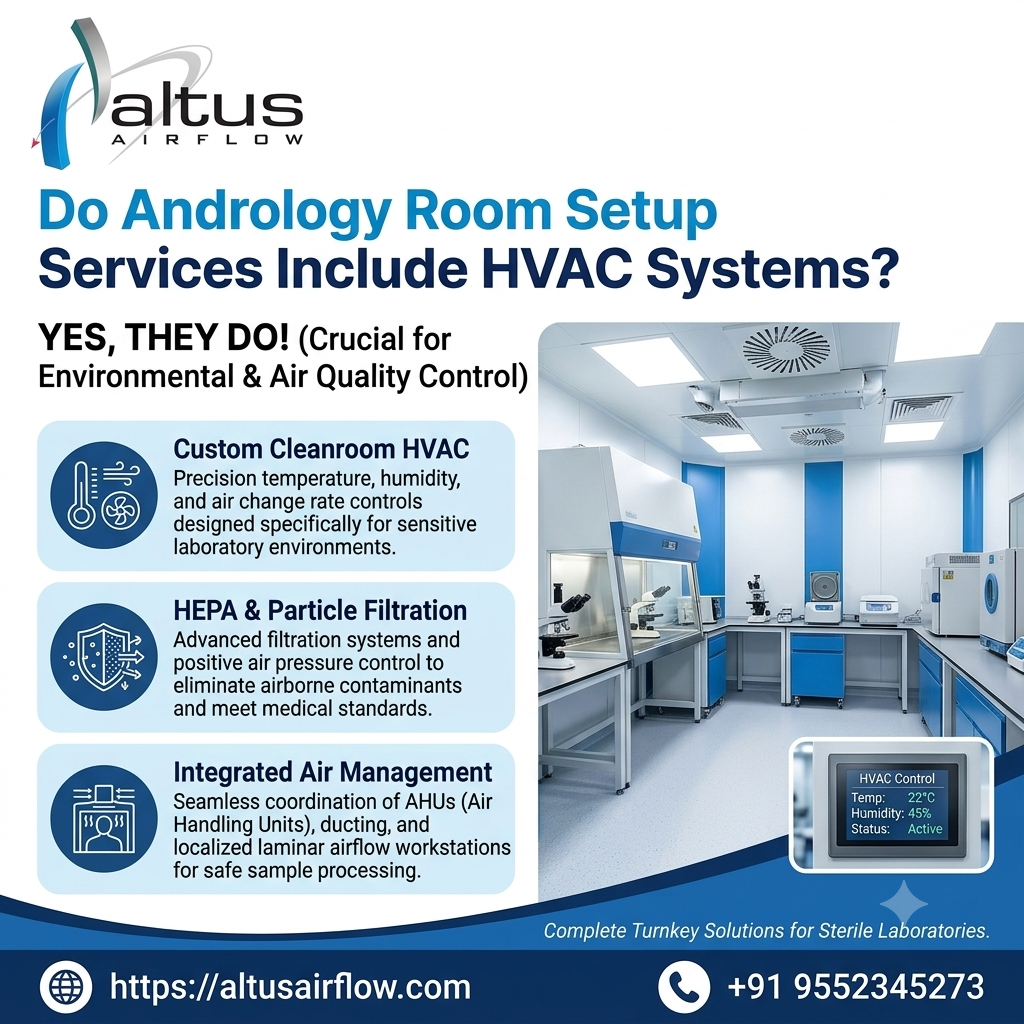
Altus Airflow specialises in developing advanced healthcare and fertility laboratory environments designed to support hygiene, precision, and operational efficiency. Andrology Room Setup Services generally include HVAC system planning and integration because maintaining controlled temperature, humidity, ventilation, and air quality is essential for specialised laboratory activities. A properly designed HVAC system helps create a stable working environment for semen analysis, sperm processing, and other andrology procedures. From ventilation planning and filtration selection to temperature monitoring and airflow management, every component contributes to maintaining suitable laboratory conditions.
An andrology laboratory requires more than basic room construction. Its infrastructure must support sensitive procedures, organised workflows, equipment functionality, and contamination prevention. Therefore, HVAC planning should be considered during the initial design stage rather than added after installation.
1. Understanding the Importance of HVAC Systems in Andrology Rooms
HVAC stands for Heating, Ventilation, and Air Conditioning. It is an essential infrastructure component in specialised healthcare laboratories because it helps regulate indoor environmental conditions.
Andrology laboratories perform procedures that require controlled working environments. These may include semen analysis, sperm preparation, sample evaluation, and other laboratory activities associated with male reproductive health.
An appropriately designed HVAC system helps manage:
-
Indoor temperature.
-
Relative humidity.
-
Fresh air circulation.
-
Air filtration.
-
Air distribution.
-
Pressure relationships between designated areas.
-
Indoor air quality.
Environmental stability is important for laboratory equipment and sample-handling activities. Sudden temperature fluctuations, excessive humidity, and inadequate ventilation can create operational challenges.
Therefore, HVAC planning should be based on the laboratory's intended procedures, equipment requirements, room classification where applicable, and relevant healthcare guidelines.
2. Temperature Control for Andrology Laboratory Operations
Temperature management is one of the most important considerations when designing an andrology laboratory.
Laboratory equipment and reproductive samples may require specific temperature conditions depending on the procedure and validated laboratory protocols.
An HVAC system helps maintain consistent room temperature by regulating heating and cooling according to the design requirements.
Important temperature control considerations include:
Stable indoor conditions: The system should minimise unnecessary temperature fluctuations within the laboratory.
Equipment heat management: Microscopes, incubators, centrifuges, and other equipment may generate heat that affects the indoor environment.
Monitoring arrangements: Suitable sensors and control systems help laboratory personnel monitor environmental conditions.
Zoning: Different laboratory areas may have different temperature requirements depending on their functions.
It is important to distinguish room temperature from sample-specific temperature requirements. HVAC systems regulate the laboratory environment, while specialised laboratory equipment and validated procedures manage specific sample conditions.
3. Humidity Control and Its Importance
Humidity management is another important function of laboratory HVAC systems.
Excessive humidity may encourage condensation, affect certain equipment, and create maintenance challenges. Very low humidity can contribute to static electricity, which may be undesirable around sensitive electronic instruments.
A properly designed HVAC system helps maintain relative humidity within the specified operating range.
Humidity control may involve:
-
Monitoring relative humidity levels.
-
Integrating suitable humidity sensors.
-
Providing appropriate dehumidification.
-
Maintaining balanced ventilation.
-
Monitoring condensation risks.
-
Adjusting environmental controls according to laboratory requirements.
The required humidity range should be established through laboratory design specifications, equipment recommendations, and applicable standards.
Consistent monitoring helps laboratory personnel identify environmental variations and take corrective action when necessary.
4. Air Filtration and Indoor Air Quality
Air filtration is an important part of creating a suitable laboratory environment.
Andrology laboratories may handle biological samples and use specialised equipment. Therefore, controlling airborne particles and maintaining appropriate indoor air quality are important design considerations.
Depending on the laboratory requirements, HVAC systems may incorporate different filtration stages.
Common filtration arrangements include:
Pre-filters: These capture larger airborne particles and help protect downstream filtration components.
Fine filters: These provide additional filtration for smaller airborne particles.
HEPA filters: High-Efficiency Particulate Air filters may be incorporated where the required cleanliness level and risk assessment justify their use.
The selection of filtration equipment depends on the laboratory's intended function and environmental specifications.
Proper filter installation, sealing, maintenance, and periodic performance testing are equally important.
Filtration should also be considered alongside cleaning procedures, appropriate sample handling, and laboratory personnel practices.
5. Fresh Air Supply and Ventilation Planning
Adequate ventilation helps maintain indoor air quality by managing the supply and circulation of air.
During laboratory design, engineers calculate ventilation requirements based on room dimensions, occupancy, equipment heat loads, and applicable technical guidelines.
Important ventilation considerations include:
-
Fresh air intake.
-
Exhaust air arrangements.
-
Supply air distribution.
-
Return air positioning.
-
Air changes per hour.
-
Ventilation equipment capacity.
-
Airflow direction and distribution.
A suitable ventilation design helps prevent stagnant air and supports consistent indoor environmental conditions.
The supply and return air outlets should be positioned carefully to avoid unnecessary airflow disturbances around workstations and sensitive laboratory equipment.
Ventilation requirements should be determined individually for each laboratory rather than applying one standard configuration to every room.
6. Pressure Control Between Laboratory Areas
Pressure management is an important consideration when an andrology laboratory contains multiple functional zones.
Different areas may require specific pressure relationships depending on their activities, contamination risks, and approved design specifications.
For example, a sample preparation area and a general laboratory space may have different ventilation requirements.
The HVAC design team evaluates whether pressure-controlled arrangements are necessary.
The system may incorporate:
-
Differential pressure sensors.
-
Controlled supply air volumes.
-
Exhaust air arrangements.
-
Door sealing provisions.
-
Monitoring displays.
-
Automated HVAC controls.
Pressure relationships should be established through a documented risk assessment and engineering design.
It is important to understand that positive or negative pressure is not universally appropriate for every andrology room. The required configuration depends on the specific laboratory activity and the relationship between adjoining spaces.
7. HVAC Design for Different Andrology Laboratory Zones
An andrology laboratory may contain several functional areas, each with different operational requirements.
HVAC planning should consider these differences to support a practical and organised working environment.
Common areas include:
Semen analysis area: This space requires suitable environmental conditions for microscopy, sample evaluation, and laboratory documentation.
Sample preparation area: Ventilation and environmental conditions should support the designated sample-processing procedures.
Sperm processing area: The environmental design should consider equipment placement, workflow, and sample-handling requirements.
Equipment area: Heat generated by centrifuges, refrigerators, and other devices should be considered when calculating cooling loads.
Storage area: Environmental conditions should be selected according to the storage requirements of the materials and equipment kept there.
An integrated design ensures that ventilation arrangements do not interfere with staff movement, equipment accessibility, or laboratory procedures.
8. Integration of HVAC Systems with Laboratory Equipment
Modern andrology laboratories use specialised equipment that requires careful infrastructure planning.
HVAC systems must be coordinated with equipment placement and electrical arrangements to maintain suitable working conditions.
Common equipment includes:
-
Microscopes.
-
Centrifuges.
-
Laboratory refrigerators.
-
Incubators, where required.
-
Biological safety cabinets, where specified.
-
Sample preparation workstations.
-
Temperature monitoring devices.
Equipment generates different levels of heat, and some devices may require dedicated ventilation or cooling arrangements.
For example, multiple centrifuges operating simultaneously may increase the room's heat load.
Similarly, equipment that requires stable environmental conditions should not be placed directly in areas affected by uncontrolled air currents or temperature fluctuations.
Early coordination between HVAC engineers, laboratory designers, and biomedical equipment suppliers helps prevent installation conflicts.
9. Role of HVAC Automation and Monitoring Systems
Modern laboratory infrastructure increasingly incorporates automated environmental monitoring and control systems.
These systems help laboratory personnel track environmental conditions and identify deviations from specified limits.
Common monitoring features include:
Digital temperature monitoring: Displays current room temperature and helps identify fluctuations.
Humidity monitoring: Tracks relative humidity and provides information about environmental stability.
Pressure monitoring: Measures differential pressure where controlled pressure arrangements are installed.
HVAC automation: Regulates heating, cooling, and ventilation according to configured operating parameters.
Alarm notifications: Alerts designated personnel when monitored conditions move outside established limits.
Data recording: Maintains environmental records to support quality management and internal reviews.
Automation reduces the need for continuous manual adjustments and improves visibility into system performance.
However, automated monitoring must be supported by regular calibration, maintenance, and documented corrective procedures.
10. HVAC Installation Process in Andrology Laboratories
Installing HVAC systems requires detailed planning and coordination with other laboratory construction activities.
The installation process generally follows several stages.
Step 1: Requirement assessment
Engineers understand the laboratory's procedures, equipment, occupancy, room dimensions, and environmental requirements.
Step 2: HVAC load calculation
Cooling and ventilation requirements are calculated by considering equipment heat loads, lighting, occupancy, and other relevant factors.
Step 3: System design
The team prepares ventilation layouts, duct routes, filtration arrangements, and control system specifications.
Step 4: Equipment selection
Suitable air handling units, filters, sensors, and ventilation components are selected according to project requirements.
Step 5: Ducting and installation
Ductwork, air outlets, return air connections, and associated equipment are installed according to approved drawings.
Step 6: Control system integration
Temperature, humidity, and pressure monitoring arrangements are integrated where required.
Step 7: Testing and commissioning
Airflow, filtration, temperature, humidity, and other relevant parameters are checked against the approved specifications.
A systematic installation process helps ensure that the HVAC system functions as intended.
11. Testing and Validation of HVAC Performance
After installation, the HVAC system must undergo appropriate testing and commissioning.
These activities verify whether the installed system meets the design requirements.
Important testing activities may include:
-
Airflow volume measurements.
-
Air changes per hour verification.
-
Temperature mapping.
-
Relative humidity measurements.
-
Differential pressure checks.
-
HEPA filter integrity testing, where applicable.
-
Air distribution assessment.
-
HVAC control system functionality.
The results should be documented and reviewed by the responsible technical team.
If any measured parameter falls outside its specified range, corrective action should be taken before the laboratory begins routine operations.
Periodic performance checks are also important because filter loading, equipment deterioration, and changes in room usage can affect HVAC performance over time.
12. Maintenance Requirements for Andrology Room HVAC Systems
Regular maintenance helps preserve HVAC efficiency and environmental stability.
Even a properly designed system may experience performance problems if filters, ducts, sensors, and mechanical components are not maintained.
A suitable maintenance programme may include:
-
Inspecting and replacing filters according to their condition and manufacturer recommendations.
-
Cleaning air handling equipment and accessible duct components.
-
Checking cooling and heating performance.
-
Calibrating temperature and humidity sensors.
-
Verifying differential pressure readings.
-
Inspecting duct connections and air outlets.
-
Reviewing system alarms and monitoring records.
-
Conducting periodic performance assessments.
Maintenance schedules should be based on equipment recommendations, operating conditions, and laboratory quality procedures.
Proper maintenance supports long-term functionality and helps reduce unexpected equipment failures.
13. How to Choose the Right Andrology Laboratory Setup Provider?
Selecting an experienced laboratory infrastructure provider is important for successful project development.
Hospitals and fertility centres should evaluate whether the provider understands the specialised requirements of andrology laboratory environments.
Consider the following factors:
Technical expertise: Check experience in laboratory HVAC, ventilation, and modular infrastructure.
Design capabilities: Evaluate the ability to prepare layouts that accommodate equipment and laboratory workflows.
Material quality: Review the suitability and durability of modular panels, flooring, and other interior components.
HVAC integration: Understand how filtration, airflow, temperature, and humidity systems are incorporated.
Testing support: Confirm whether installation testing and commissioning are included in the project scope.
After-sales services: Discuss maintenance assistance, warranty arrangements, and technical support.
A provider with an integrated approach can help coordinate laboratory construction and environmental control requirements more effectively.
Conclusion
HVAC systems are an important part of modern andrology laboratory infrastructure. They help regulate temperature, humidity, ventilation, filtration, and airflow according to the laboratory's operational requirements. Proper planning, installation, testing, and maintenance contribute to a stable and well-organised working environment.
Choosing professional Andrology Room Setup Services helps fertility centres plan modular infrastructure and coordinate essential HVAC components with laboratory equipment and workflows. Altus Airflow focuses on developing specialised healthcare and laboratory environments through systematic planning and technical execution. With suitable HVAC integration, laboratories can establish functional spaces that support sample handling, equipment performance, hygiene, and long-term operational efficiency.
Frequently Asked Questions (FAQs)
1. Do Andrology Room Setup Services include HVAC systems?
Yes, Andrology Room Setup Services can include HVAC planning, installation, and integration to maintain suitable temperature, humidity, ventilation, and air quality.
2. Why is HVAC important in an andrology laboratory?
HVAC helps maintain stable environmental conditions and supports suitable air circulation and filtration.
3. Do andrology laboratories require HEPA filters?
HEPA filters may be required depending on the laboratory's cleanliness specifications, activities, and risk assessment.
4. What temperature should an andrology laboratory maintain?
The required temperature depends on laboratory procedures, equipment specifications, and approved environmental requirements.
5. Does HVAC control humidity in andrology rooms?
Yes, appropriately designed HVAC systems can regulate relative humidity through suitable monitoring and control arrangements.
Read Our Previous Blog --------------->How do Turnkey Andrology Room Solutions comply with NABH guidelines?

 English
 Arabic
 French
 Spanish
 Portuguese
 Deutsch
 Turkish
 Dutch
 Russian
 Romaian
 Portuguese (Brazil)
 Greek
