


How to Check Dry Herb Vaporizer Compatibility With Accessories
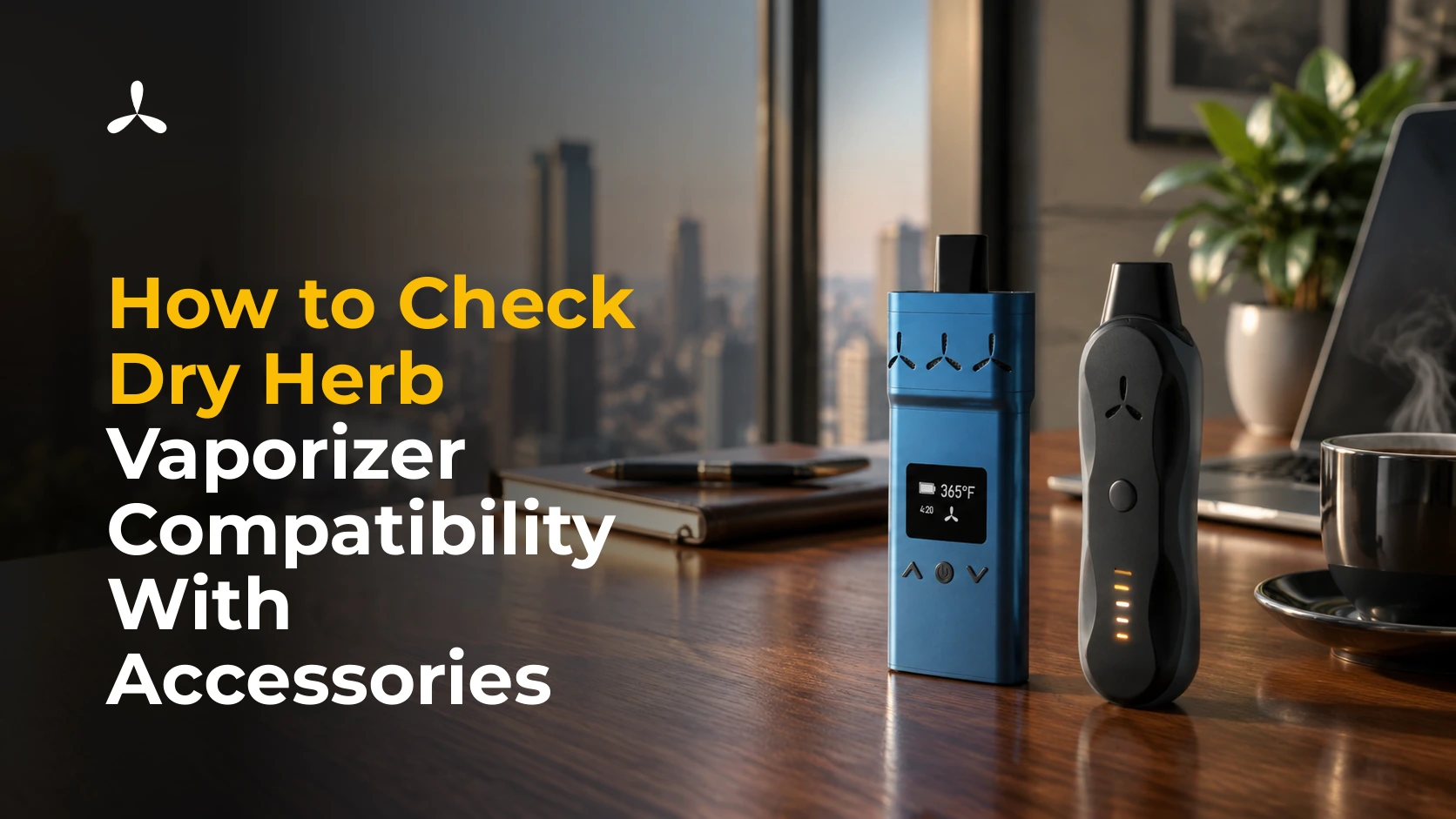
Buying accessories for a dry herb vaporizer can improve convenience, portability, maintenance, and the overall user experience. The annoying part, because apparently even small pieces of glass and metal need compatibility homework, is that not every accessory works with every vaporizer.
Mouthpieces, dosing capsules, water-pipe adapters, replacement screens, batteries, chargers, cases, and other accessories can differ significantly between devices. Even products from the same manufacturer may use different dimensions or connection systems.
Before purchasing an accessory, it is therefore important to confirm that it is designed to work safely and correctly with your specific vaporizer.
This guide explains how to check dry herb vaporizer accessory compatibility, what specifications matter, and which accessories require the most careful checking.
Why Vaporizer Accessory Compatibility Matters
An accessory does not necessarily fit a vaporizer simply because the two products look similar.
Dry herb vaporizers vary in chamber dimensions, mouthpiece connections, electrical requirements, battery formats, airflow designs, and overall construction. Some accessories are specifically engineered for one model, while others are designed to work with several devices.
Using the wrong accessory can result in problems such as:
-
Poor or loose fitting
-
Restricted airflow
-
Difficulty closing the chamber
-
Reduced usability
-
Damage to connectors or seals
-
Incorrect electrical operation
-
Unnecessary wear on the vaporizer
Compatibility checking becomes especially important when dealing with electrical components such as batteries and chargers.
The safest starting point is always the manufacturer's official specifications and compatibility information.
1. Identify the Exact Vaporizer Model
Start with the complete name and version of your dry herb vaporizer.
Do not rely only on the manufacturer or product family.
For example, a company may release several generations of the same vaporizer. They may appear nearly identical externally while using different mouthpieces, screens, chambers, batteries, or internal components.
Check for information such as:
-
Brand: Manufacturer of the vaporizer
-
Model: Exact product name
-
Generation: Original, updated, Pro, Core, 2, etc.
-
Region: US, EU, or another market if applicable
-
Production version: Relevant when manufacturers revise hardware
You can usually find this information on the original packaging, product page, device documentation, or vaporizer itself.
This simple check eliminates a surprising amount of accessory guesswork.
2. Check the Manufacturer's Compatibility List
Once you know your exact device, look at the accessory product page.
Manufacturers will often state something such as:
Compatible with: Model A, Model B
Designed for: Model X
Not compatible with: Previous-generation devices
This information should take priority over assumptions based on appearance.
If the manufacturer specifically lists your vaporizer, compatibility is considerably easier to establish.
Be cautious when a third-party product description uses vague phrases such as "fits most vaporizers" without providing measurements or a list of supported devices.
"Universal" can also mean different things depending on the accessory.
3. Check Physical Dimensions
Dimensions are particularly important for accessories that physically connect to or sit inside a vaporizer.
These may include:
-
Dosing capsules
-
Mouthpieces
-
Glass adapters
-
Screens
-
Chamber inserts
-
Concentrate pads
-
Water-pipe adapters
Suppose a dosing capsule is slightly wider than the vaporizer chamber. It obviously will not fit. Less obviously, even a capsule that technically enters the chamber may not provide enough clearance for proper loading and removal.
Check measurements such as diameter, height, depth, connector size, and thread dimensions where relevant.
Do not force an accessory into a device because the dimensions are "close enough." Precision components are not especially impressed by optimism.
4. Check Dosing Capsule Compatibility Carefully
Dosing capsules allow users to prepare portions of dry herb before loading them into a vaporizer.
However, capsule dimensions vary considerably.
-
Before purchasing capsules, check:
-
Chamber diameter: The capsule must physically fit inside the heating chamber.
-
Capsule height: An excessively tall capsule may prevent the chamber or lid from closing correctly.
-
Loading orientation: Some devices require capsules to sit in a particular direction.
-
Manufacturer support: Certain vaporizers are specifically engineered around proprietary capsules.
It is also worth distinguishing between rigid dosing capsules and more flexible dosing solutions.
Some newer systems use disposable pouches or similar formats intended to accommodate a broader range of vaporizer chambers. Even with broadly compatible products, however, users should follow the accessory manufacturer's loading and compatibility instructions.
5. Check Mouthpiece Connections
Replacement mouthpieces can look deceptively simple, but their mounting mechanisms vary.
A vaporizer mouthpiece might connect through:
-
Friction fitting
-
Magnetic attachment
-
Threaded connection
-
Silicone seal
-
Snap-lock mechanism
-
Proprietary mounting system
The diameter alone therefore does not determine compatibility.
A mouthpiece with the correct width can still be incompatible because its locking mechanism, airflow path, seal, or mounting geometry is different.
For replacement mouthpieces, model-specific accessories are usually the safest option.
6. Check Water-Pipe Adapter Sizes
Water-pipe adapters are one category where standardized measurements are more common.
Typical glass joint sizes include 10 mm, 14 mm, and 18 mm, although the exact options available depend on the accessory and equipment.
You should check both sides of the connection.
First, confirm that the adapter is designed to connect to your vaporizer. Then confirm that the other end matches the intended glass joint.
Also check whether the joint is male or female where relevant.
For example, simply seeing "14 mm adapter" is not enough to establish that the complete setup will fit.
7. Check Screens and Filters
Vaporizer screens are inexpensive, but compatibility still matters.
Screens can differ by:
-
Diameter
-
Thickness
-
Mesh density
-
Material
-
Shape
-
Position within the airflow system
A screen that is too small may move around inside the device. One that is too large may not sit correctly.
Some vaporizers also use specially shaped screens rather than standard circular mesh screens.
When replacing screens, compare the dimensions and material with the original component or use a replacement specifically listed for your device.
8. Be Extra Careful With Batteries
Battery compatibility deserves considerably more attention than something passive like a carrying case.
A removable battery should not be considered compatible merely because it physically fits inside the compartment.
Important factors can include:
-
Battery chemistry
-
Cell format
-
Nominal voltage
-
Maximum continuous discharge capability
-
Capacity
-
Protected versus unprotected design
-
Manufacturer requirements
Many portable vaporizers use lithium-ion batteries, and incorrect cells can present genuine safety risks.
Use the battery type recommended by the vaporizer manufacturer. Avoid damaged cells, torn battery wraps, unknown brands, and batteries with specifications that do not meet the device's requirements.
If a vaporizer uses a built-in battery, do not attempt to replace it unless the manufacturer specifically provides a supported replacement procedure.
9. Check Charger and Power Compatibility
USB-C has made charging more convenient, but matching connectors do not automatically mean identical charging requirements.
Check the manufacturer's specifications for:
-
Input voltage
-
Input current
-
Charging protocol
-
Recommended adapter output
-
Cable requirements
Some modern vaporizers support technologies such as USB-C Power Delivery or faster charging standards, while others use conventional USB charging.
Wireless charging accessories require another compatibility check because the vaporizer must support the relevant charging system or manufacturer-designed wireless accessory.
Never assume a charger is appropriate solely because its connector fits.
10. Check Cases and Protective Accessories
Cases are easier to evaluate because they generally do not affect the vaporizer's electrical or heating systems.
Even so, check internal dimensions carefully.
A protective case should provide enough space for the vaporizer without placing unnecessary pressure on buttons, mouthpieces, or glass components.
If you carry additional accessories, consider whether the case has room for items such as:
-
Charging cable
-
Cleaning tools
-
Dosing accessories
-
Replacement screens
-
Mouthpiece
-
Herb container
A case designed specifically for the device will generally provide a more secure fit than a generic case.
11. Understand What "Universal" Actually Means
The word universal should be interpreted carefully.
It rarely means "works perfectly with every vaporizer ever manufactured."
Instead, it usually means that the accessory is designed to accommodate a wide range of products that meet certain dimensional or technical requirements.
A universal water-pipe adapter, for example, may support several mouthpiece diameters. A universal dosing solution may work with many chamber designs.
Always look beyond the marketing term and find the actual compatibility requirements.
12. Consider Airflow, Not Just Physical Fit
Physical fit is only part of vaporizer accessory compatibility.
Accessories placed in or around the vapor path can influence airflow.
A component that blocks air inlets or leaves insufficient clearance could increase draw resistance.
This is especially relevant for:
-
Dosing capsules
-
Chamber inserts
-
Screens
-
Mouthpieces
-
Water-pipe adapters
An accessory should therefore be evaluated not only by whether it physically fits, but also by whether it allows the device's airflow system to operate as intended.
Manufacturer-approved accessories generally reduce this uncertainty because they have been designed for the device's particular chamber and airflow arrangement.
13. Check Temperature and Material Suitability
Accessories placed near the heating chamber must be made from materials suitable for the temperatures they will experience.
Depending on the accessory, manufacturers may use materials such as stainless steel, glass, ceramic, silicone rated for the intended temperature range, or other heat-resistant materials.
Avoid improvising with components that were not designed for vaporizer use.
A homemade piece may physically fit while still being unsuitable for repeated heating.
14. Read the Accessory Instructions
Product documentation can answer compatibility questions that are not obvious from specifications alone.
Look for instructions covering:
-
Installation
-
Supported models
-
Temperature restrictions
-
Cleaning
-
Loading
-
Replacement intervals
-
Safety warnings
This is particularly important when an accessory changes how material is loaded or how vapor travels through the device.
15. Ask the Manufacturer When Compatibility Is Unclear
If neither the vaporizer manufacturer nor the accessory manufacturer clearly confirms compatibility, contact customer support before buying.
Provide the exact vaporizer model and the accessory you are considering.
A simple question such as:
"Is this accessory compatible with the [exact device model and generation]?"
can prevent buying something that cannot be used.
This is especially worthwhile for batteries, chargers, chamber components, and expensive glass accessories.
Quick Vaporizer Accessory Compatibility Checklist
Before purchasing an accessory, check:
-
Exact vaporizer model and generation
-
Official list of compatible devices
-
Accessory dimensions
-
Connection or mounting mechanism
-
Chamber clearance
-
Airflow requirements
-
Material and temperature suitability
-
Voltage and battery specifications for electrical accessories
-
Manufacturer instructions
-
Warranty implications
If several of these points cannot be verified, buying the accessory becomes more of an experiment than a compatibility decision.
Can Third-Party Vaporizer Accessories Be Used?
Third-party accessories can sometimes work perfectly well, provided they are properly designed for the vaporizer and meet the necessary specifications.
The key distinction is between verified compatibility and assumed compatibility.
Look for clear measurements, supported-device lists, appropriate materials, and reputable manufacturers.
Electrical components deserve greater caution. For batteries, charging equipment, or electronic accessories, following the vaporizer manufacturer's specifications is particularly important.
Does Using Third-Party Accessories Affect the Warranty?
It can depend on the manufacturer and warranty terms.
Simply owning or using a third-party accessory does not automatically mean a warranty becomes invalid in every situation. However, damage caused by an incompatible or improperly used accessory may not be covered.
Read the warranty conditions for your specific vaporizer before using components that modify the chamber, power system, or other critical parts.
Final Thoughts
Checking dry herb vaporizer compatibility with accessories for AirVape USA comes down to more than asking whether something physically fits.
Start by identifying your exact vaporizer model. Then verify manufacturer compatibility, dimensions, connection type, airflow requirements, and material suitability. For batteries and charging accessories, check the electrical specifications especially carefully.
Model-specific accessories generally provide the simplest route because they are designed around the dimensions and operating characteristics of a particular device. Universal accessories can offer greater flexibility, but their actual specifications still need to match your vaporizer.
A few minutes spent checking compatibility before purchasing can prevent poor fit, unnecessary returns, and potential damage while helping you build a vaporizer setup that works the way it was intended to.

 English
 Arabic
 French
 Portuguese
 Deutsch
 Turkish
 Dutch
 Italiano
 Russian
 Romaian
 Portuguese (Brazil)
 Greek
