


What Are Embeddings and How Do They Work in LLMs
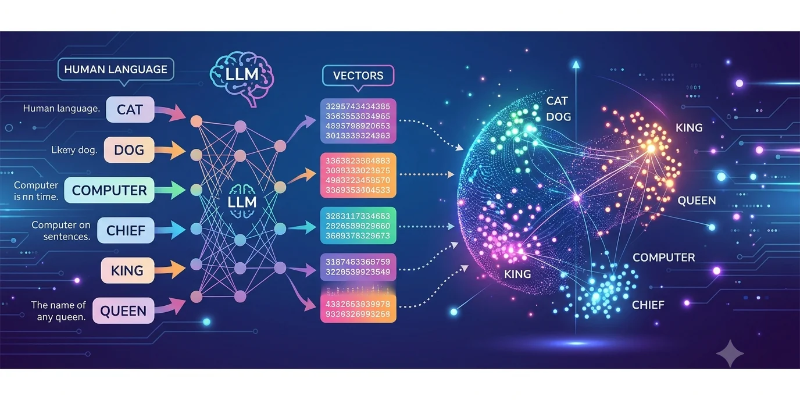
Artificial Intelligence has changed how computers understand and process human language. One of the important technologies behind this progress is embeddings. They help Large Language Models (LLMs) understand the meaning of words, sentences, and other types of information. Instead of treating words as simple text, embeddings convert them into numerical representations that AI models can process. Grasping this idea is valuable if you aim to establish a solid base in Generative AI. If you want to develop practical knowledge of these technologies, consider enrolling in a Generative AI Course in Cochin at FITA Academy to explore the fundamentals of modern AI systems.
What Are Embeddings in Large Language Models
Embeddings are numerical representations of words, phrases, sentences, or other data. They convert information into a format that machine learning models can understand and process.
In simple terms, embeddings help AI models understand relationships between different words and their meanings. For example, the words "king" and "queen" have a closer relationship than "king" and "bicycle". Embeddings represent these relationships through numerical values.
Each piece of information is converted into a list of numbers called a vector. These vectors capture important characteristics and contextual relationships within the data. This allows LLMs to understand language more effectively.
How Do Embeddings Work in LLMs
Embeddings play an important role in helping Large Language Models process human language. When a user submits a sentence, the model initially divides the text into smaller components referred to as tokens.
Every token is subsequently transformed into a numerical format via an embedding process. These numerical vectors contain information that helps the model understand the relationships between different tokens.
The model processes these vectors through its neural network architecture, including transformer layers and attention mechanisms. This helps it identify context, recognize patterns, and understand how different words relate to one another.
For example, the word "bank" can refer to a financial institution or the side of a river. Its surrounding words provide context that helps the model understand the intended meaning.
Why Are Embeddings Important in Generative AI
Embeddings are essential because computers cannot directly understand human language in the same way people do. They need numerical representations to process text and identify meaningful relationships.
Some important benefits of embeddings include:
-
Semantic Understanding: They help AI models identify relationships between words and their meanings.
-
Context Recognition: They support the understanding of words based on surrounding information.
-
Information Retrieval: They assist systems in identifying pertinent information based on understanding rather than precise keyword matches.
-
Text Similarity: They allow AI applications to compare sentences and identify similar content.
-
Better AI Responses: They support language processing tasks that help LLMs generate relevant responses.
These capabilities make embeddings an important part of modern Generative AI applications.
Different Types of Embeddings
There are several types of embeddings used in Artificial Intelligence, depending on the data and application.
1. Word Embeddings
Word embeddings convert individual words into numerical vectors. They help models identify relationships between words and understand similarities in meaning.
2. Sentence Embeddings
Sentence embeddings represent complete sentences as numerical vectors. They help AI systems compare sentences based on their overall meaning.
3. Document Embeddings
Document embeddings represent larger pieces of text, such as articles, reports, and documents. They are useful for searching and retrieving relevant information.
4. Contextual Embeddings
Contextual embeddings represent words based on how they are used in a particular sentence. They help models understand words with multiple meanings.
How Embeddings Support RAG and Semantic Search
Embeddings are widely used in Retrieval-Augmented Generation (RAG) and semantic search systems.
In RAG applications, documents are converted into embeddings and stored in a vector database. When a user asks a question, the system converts the query into an embedding and searches for relevant information using vector similarity.
The retrieved information is then provided to the language model to generate a more relevant response.
Semantic search uses a similar approach. Instead of searching only for exact words, it identifies information based on the meaning and context of a query.
Understanding embeddings, vector databases, and semantic search can help you explore more advanced AI concepts. If you want to strengthen your technical understanding, take an Artificial Intelligence Course in Kochi and establish a strong base in machine learning and contemporary AI technologies.
Real-World Applications of Embeddings
Embeddings are used in several everyday AI applications. Some common examples include:
-
Search Engines: Finding relevant results based on the meaning of search queries.
-
Recommendation Systems: Suggesting products, movies, or content based on user interests.
-
Chatbots: Helping AI assistants understand user questions and retrieve relevant information.
-
Document Search: Finding useful information from large collections of files.
-
Language Translation: Supporting systems that identify relationships between words across languages.
Embeddings are a fundamental technology that helps Large Language Models understand and process human language. By converting words, sentences, and documents into numerical vectors, they make it easier for AI systems to identify meaning, context, and relationships.
They also play an important role in Generative AI, semantic search, RAG applications, and intelligent recommendation systems. Understanding embeddings provides a strong starting point for exploring how modern AI technologies work.

 English
 Arabic
 French
 Spanish
 Portuguese
 Deutsch
 Turkish
 Dutch
 Italiano
 Russian
 Romaian
 Portuguese (Brazil)
