


Gout Therapeutics Market Growth, Analysis Industry Outlook & Region Forecast Analysis By Fact.MR
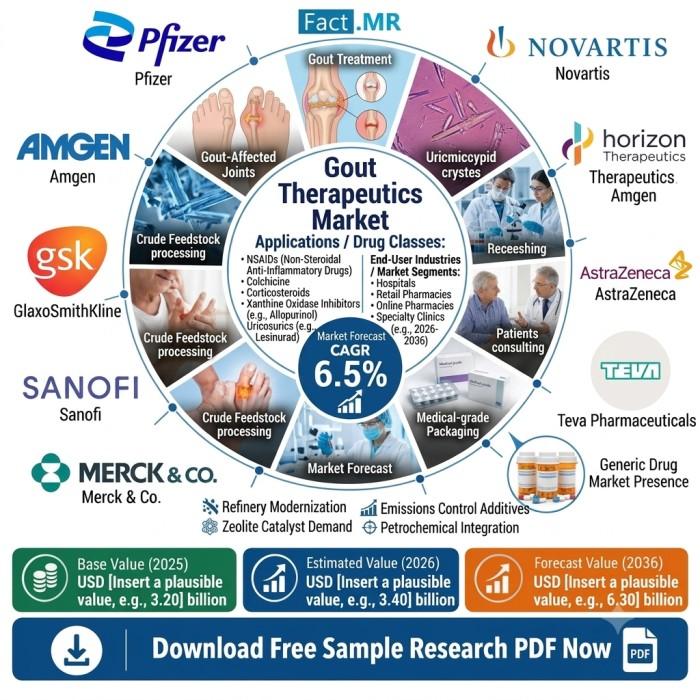
Rockville, Maryland — October 28, 2026 The global gout therapeutics market is projected to increase from USD 3.2 billion in 2026 to USD 6.06 billion by 2036, expanding at a compound annual growth rate (CAGR) of 6.6% over the forecast period, according to Fact.MR. The market was valued at USD 3.0 billion in 2025. Growing demand for sustained urate-lowering treatment, greater awareness of chronic gout management, and the development of targeted therapies are shaping opportunities for pharmaceutical companies.
The Fact.MR analysis identifies Takeda Pharmaceutical Company Ltd., Novartis AG, Regeneron Pharmaceuticals Inc., AstraZeneca, and Arrowhead Pharmaceuticals Inc. among the companies participating in the gout therapeutics market. Merck & Co., Inc., Teijin Pharma Ltd., GSK plc, Zydus Group, and Horizon Therapeutics are also identified in the competitive landscape.
For pharmaceutical manufacturers, the market outlook highlights the importance of building differentiated treatment portfolios, strengthening access to emerging markets, and addressing the long-term needs of patients with recurrent or difficult-to-manage gout.
Get detailed market forecasts, competitive benchmarking, and pricing trends:
Gout Therapeutics Market: Key Takeaways
- Market value in 2026: USD 3.2 billion.
- Forecast market value in 2036: USD 6.06 billion.
- Forecast CAGR: 6.6% from 2026 to 2036.
- Leading drug class: Urate-lowering therapy, accounting for 58% of the drug-class segment in 2026.
- Leading application: Chronic gout management, representing 65% of the application segment in 2026.
- Fastest-growing country markets: India at 8.1% CAGR and China at 7.8% CAGR.
- Competitive priorities: Clinical differentiation, portfolio development, pricing, and distribution access.
What Is Driving Growth in the Gout Therapeutics Market?
Gout develops when urate crystals accumulate in joints and surrounding tissues, causing painful inflammatory episodes. Treatment can involve medicines that control acute flares and therapies that lower uric acid levels over time. This combination of immediate symptom management and long-term disease control supports demand across several pharmaceutical categories.
Increasing Need for Long-Term Disease Management
Rising gout prevalence associated with aging populations, obesity, metabolic disorders, and dietary factors is expanding the need for effective treatment. Patients experiencing recurrent attacks may require ongoing management rather than relying exclusively on medication during acute episodes.
For manufacturers, this creates opportunities to serve both acute-care requirements and chronic treatment pathways. Products that address sustained urate reduction, tolerability, and adherence can support differentiated positioning in a market where long-term management is increasingly important.
Growing Adoption of Urate-Lowering Therapies
Urate-lowering therapy accounts for 58% of the drug-class segment in 2026, according to Fact.MR. These treatments help reduce serum urate levels and are central to preventing recurrent attacks in appropriately selected patients.
The segment's leading position makes it an important area for portfolio planning, market access strategies, and competition among established pharmaceutical companies and specialist developers. Manufacturers must also consider treatment affordability, clinical evidence, and patient adherence when evaluating commercial opportunities.
Development of Targeted Treatments
Biologic therapies targeting interleukin-1 (IL-1) pathways are an emerging area of interest for patients with refractory gout. These treatments can provide additional options for selected patients who cannot adequately manage their condition with conventional approaches.
The commercial opportunity depends on demonstrating clinical value, establishing appropriate patient selection, and navigating regulatory and reimbursement requirements. Targeted therapies may serve specialized treatment needs, although their adoption will depend on clinical outcomes, access, and cost considerations.
Regional Opportunities: India and China Lead Growth
Asia Pacific offers significant growth potential for companies seeking to expand their presence in the gout therapeutics market. Fact.MR projects India to grow at a CAGR of 8.1% and China at 7.8% between 2026 and 2036.
India's growth outlook creates opportunities for pharmaceutical companies to strengthen distribution networks, broaden access to established treatments, and develop market strategies suited to different healthcare settings. Partnerships with distributors and healthcare providers may help manufacturers improve product availability.
China's projected growth presents another opportunity for companies with appropriate regulatory, commercial, and distribution capabilities. Pharmaceutical businesses evaluating expansion should consider local market access requirements, pricing conditions, and competition from domestic and international suppliers.
Established markets also remain relevant. The United States is projected to grow at a 6.9% CAGR, while Germany is forecast to expand at 6.4%. Japan is expected to record a 5.9% CAGR through 2036. These markets offer opportunities for companies to compete through product differentiation, clinical evidence, and established healthcare distribution channels.
Competitive Landscape: Top Companies in the Gout Therapeutics Market
The gout therapeutics market includes established pharmaceutical companies and specialist developers competing across conventional treatments, urate-lowering medicines, and targeted therapies. Fact.MR identifies the following companies in its competitive analysis:
- Takeda Pharmaceutical Company Ltd.
- Novartis AG
- Regeneron Pharmaceuticals Inc.
- AstraZeneca
- Arrowhead Pharmaceuticals Inc.
- Merck & Co., Inc.
- Teijin Pharma Ltd.
- GSK plc
- Zydus Group
- Horizon Therapeutics
This list identifies companies named in the report; it does not represent a verified ranking by revenue or market share.
Competition in the market is influenced by product portfolios, clinical evidence, pricing, distribution capabilities, and access to healthcare systems. Established pharmaceutical companies can draw on existing commercial infrastructure, while specialist developers may focus on differentiated mechanisms or patient groups with unmet treatment needs.
For decision-makers, three priorities warrant attention: expanding treatment options across acute and chronic gout, evaluating targeted therapies for appropriate patient populations, and developing market access strategies that account for regional differences in healthcare spending and reimbursement.
Market Challenges and Business Considerations
Despite the positive forecast, commercial growth will depend on addressing several barriers. Price sensitivity may limit uptake of premium treatments in markets where patients or healthcare systems face budget constraints. Differences in regulatory requirements and reimbursement policies can also complicate expansion across countries.
Limited awareness of long-term gout management may further restrict treatment adoption in some settings. Pharmaceutical companies can respond by supporting appropriate disease education, strengthening engagement with healthcare professionals, and improving the availability of reliable treatment information.
Companies assessing investments should distinguish between the broad opportunity presented by the expanding market and the commercial prospects of individual products. Clinical performance, safety, manufacturing requirements, intellectual property, and market access will remain important factors in product-level decisions.
Outlook for the Gout Therapeutics Market Through 2036
The projected increase to USD 6.06 billion by 2036 points to a growing commercial opportunity for companies serving acute gout treatment and long-term urate management. Demand is expected to be supported by chronic disease management needs, continued adoption of urate-lowering treatments, and interest in targeted options for selected patients.
India and China stand out for their projected growth rates, while the United States and Germany offer opportunities in established pharmaceutical markets. Companies that align product development with clinical requirements and regional access conditions will be better positioned to evaluate the market's long-term potential.
For detailed market forecasts, segmentation, regional analysis, and competitive intelligence, access the full Fact.MR report.
Frequently Asked Questions
What is the projected size of the gout therapeutics market by 2036?
The global gout therapeutics market is projected to reach USD 6.06 billion by 2036, compared with USD 3.2 billion in 2026.
What is the expected CAGR of the gout therapeutics market?
The market is forecast to grow at a CAGR of 6.6% between 2026 and 2036.
Which drug class leads the gout therapeutics market?
Urate-lowering therapy accounts for 58% of the drug-class segment in 2026, according to Fact.MR.
Which countries are expected to grow fastest?
India is projected to grow at a CAGR of 8.1%, followed by China at 7.8%, over the 2026–2036 forecast period.
Who are the top companies in the gout therapeutics market?
Companies identified by Fact.MR include Takeda Pharmaceutical Company Ltd., Novartis AG, Regeneron Pharmaceuticals Inc., AstraZeneca, Arrowhead Pharmaceuticals Inc., Merck & Co., Inc., Teijin Pharma Ltd., GSK plc, Zydus Group, and Horizon Therapeutics.
What factors are supporting market growth?
Key factors include increasing gout prevalence, demand for long-term urate management, adoption of urate-lowering therapies, and the development of targeted treatments for selected patients.
Explore More Related Studies Published by Fact.MR Research
Percutaneous Screw Placement Systems Market
About Fact.MR
Fact.MR is a market research and consulting firm providing syndicated research, customized research, investment research, and market intelligence across a broad range of industries. Its research coverage includes food and beverage, healthcare, pharmaceuticals, biotechnology, consumer products, chemicals and materials, technology, industrial goods, and packaging.
Fact.MR provides market intelligence designed to help organizations understand market dynamics, emerging opportunities, competitive developments, and changing industry requirements.
Media Contact
Fact.MR
Email: sales@factmr.com
Phone: +1 (628) 251-1583
Website: www.factmr.com

 Arabic
 French
 Spanish
 Portuguese
 Deutsch
 Turkish
 Dutch
 Italiano
 Russian
 Romaian
 Portuguese (Brazil)
 Greek
