


Synthetic and Bio-based Polypropylene Market Growth, Predictable to Witness Sustainable Evolution Analysis By Fact.MR
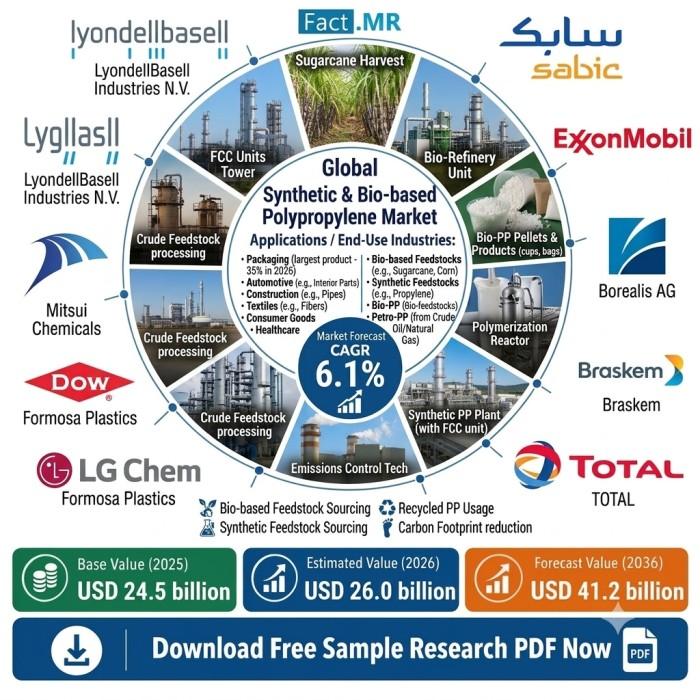
Rockville, Maryland, USA — October 28, 2026 The global synthetic and bio-based polypropylene market is projected to reach USD 162.78 million by 2036, up from USD 112.10 million in 2026, according to Fact.MR. The market is expected to expand at a compound annual growth rate (CAGR) of 3.8% during the 2026–2036 forecast period. Braskem, Dow Inc., Borealis AG, and LyondellBasell Industries Holdings B.V. are among the companies identified in the report’s competitive landscape.
Demand is being shaped by manufacturers’ efforts to incorporate renewable feedstocks into polymer supply chains while maintaining processing compatibility and product performance. Packaging converters, automotive component manufacturers, and textile producers are evaluating bio-based and bio-attributed polypropylene as potential alternatives to conventional fossil-derived resin in applications where material specifications permit substitution.
The Fact.MR report examines market size, application and end-use segments, country-level growth prospects, and competitive positioning through 2036. For resin suppliers and industrial buyers, the analysis highlights the importance of renewable feedstock access, supply reliability, certification requirements, and customer qualification processes.
Get detailed market forecasts, competitive benchmarking, and pricing trends:
Synthetic and Bio-based Polypropylene Market Outlook Through 2036
The market’s projected increase from USD 112.10 million in 2026 to USD 162.78 million in 2036 represents an expansion of USD 50.68 million over the forecast period. The 3.8% CAGR indicates a measured growth trajectory in a market where adoption depends on material economics, feedstock availability, and the ability to meet end-user specifications.
Synthetic and bio-based polypropylene, as covered in the report, includes polypropylene grades produced fully or partially using renewable feedstocks such as bio-naphtha and biomass-derived intermediates. These materials can serve as alternatives to conventional polypropylene in selected manufacturing applications, depending on the production pathway and grade specifications.
The report excludes conventional fossil-only polypropylene, mechanically or chemically recycled polypropylene, bio-based polyethylene, and bio-based polyethylene terephthalate (PET) from its defined market scope.
What Is Driving Demand for Bio-based Polypropylene?
Sustainability commitments are encouraging packaging and automotive companies to evaluate renewable-content materials. For polymer producers, the commercial opportunity depends on supplying grades that satisfy customer requirements for quality, processing performance, traceability, and documented renewable feedstock attribution.
Three factors are particularly relevant to market participants.
Renewable-material sourcing: Packaging manufacturers and consumer goods companies are reviewing material portfolios as they pursue sustainability objectives. Bio-based polypropylene can provide a route to renewable feedstock incorporation in applications compatible with the material.
Automotive material requirements: Vehicle manufacturers and component suppliers are assessing material choices against performance, durability, weight, and sustainability requirements. Qualification processes and traceability documentation can influence which resin suppliers are selected.
Production technology and feedstock availability: Bio-naphtha sourcing, biomass conversion pathways, and bio-refinery capabilities affect production economics and supply scalability. Companies that secure dependable feedstock sources and establish credible certification procedures may be better positioned to respond to customer procurement requirements.
Higher production costs, limited feedstock availability, and the expense of application testing remain important considerations. Manufacturers must assess the total cost and technical suitability of bio-based grades rather than assume that renewable sourcing alone will determine purchasing decisions.
Injection Molding and Packaging Lead Market Segments
According to Fact.MR, injection molding is the leading application segment, accounting for 48.4% of the market in 2026. The segment serves applications including packaging containers, automotive components, and consumer goods. Existing processing infrastructure may support adoption where bio-based grades meet the required specifications.
Textiles represent another application area, with demand linked to fiber-based products and technical textile manufacturing. Film applications also offer opportunities in flexible packaging and related uses where manufacturers can validate material performance.
By end use, packaging accounts for 42.0% of the market in 2026. Brand-owner sustainability objectives and interest in renewable-content materials support demand in this category. Automotive applications provide another important opportunity, particularly where component manufacturers are evaluating bio-attributed polymers against material performance and sourcing requirements.
For converters, a practical priority is to conduct processing trials and verify material specifications before switching resin grades. Procurement teams should also evaluate feedstock traceability, supplier capacity, price premiums, and the availability of long-term supply agreements.
India Leads Country-level Growth Prospects
India is projected to record the fastest growth among the countries highlighted in the report, at a 10.5% CAGR from 2026 to 2036. China follows at 9.8%, while Brazil is expected to expand at 9.1%. The United States is projected to grow at 8.7%, the United Kingdom at 8.2%, Germany at 7.9%, and Japan at 7.5%.
These country forecasts provide a framework for comparing potential demand development across markets. India and China are relevant to companies assessing emerging demand and manufacturing opportunities. Brazil offers a market to evaluate in the context of renewable feedstock resources, while the United States, Germany, the United Kingdom, and Japan provide additional opportunities linked to industrial purchasing requirements and sustainability initiatives.
Businesses considering expansion should validate these market-level forecasts against local resin availability, customer qualification timelines, applicable regulations, and the economics of renewable feedstock procurement.
Top Companies in the Synthetic and Bio-based Polypropylene Market
Fact.MR identifies the following companies in its competitive landscape:
- Braskem
- Dow Inc.
- Borealis AG
- LyondellBasell Industries Holdings B.V.
- Total S.A.
- Trellis Bioplastics
- BioAmber Inc.
- NatureWorks LLC
- Danimer Scientific
- Novamont S.p.A.
This list reflects companies named in the report; it does not represent an independently verified ranking of their current bio-based polypropylene sales or market shares. Their inclusion should not be interpreted as confirmation that every company offers a commercially available bio-based polypropylene grade in every market.
Competition in the sector involves renewable feedstock access, polymer production expertise, certification coverage, distribution capabilities, and the ability to qualify products for industrial applications. Companies pursuing growth should assess the fit between their technology platforms and the needs of packaging converters, automotive suppliers, and other resin purchasers.
Business Priorities for Resin Producers and Buyers
The forecast points to several practical priorities for businesses operating across the polypropylene value chain.
Resin producers should assess long-term bio-naphtha or other renewable feedstock supply arrangements, production costs, and the certification systems required by prospective customers. Packaging converters should validate process compatibility and finished-product performance before committing to material substitution. Automotive suppliers should establish clear documentation requirements and align resin qualification with customer specifications.
Investors and strategic planners can use the report’s application, end-use, and geographic analysis to identify areas for further diligence. The reported growth rates are market forecasts, not guarantees of commercial returns or individual company performance.
About the Synthetic and Bio-based Polypropylene Market Report
Fact.MR’s Synthetic and Bio-based Polypropylene Market report analyzes market sizing and forecasts for 2026–2036, with coverage of applications, end-use industries, regional opportunities, country growth rates, and the competitive landscape. The study examines polypropylene grades produced using renewable feedstocks and the factors affecting their adoption across industrial value chains.
Explore More Related Studies Published by Fact.MR Research
Carton Closing Staplers Market-
Bleached Machine Glazed Papers Market-
About Fact.MR
Fact.MR is a market research and consulting firm providing syndicated research, customized research, investment research, and market intelligence across a broad range of industries. Its research coverage includes food and beverage, healthcare, pharmaceuticals, biotechnology, consumer products, chemicals and materials, technology, industrial goods, and packaging.
Fact.MR provides market intelligence designed to help organizations understand market dynamics, emerging opportunities, competitive developments, and changing industry requirements.
Media Contact
Fact.MR
Email: sales@factmr.com
Phone: +1 (628) 251-1583
Website: www.factmr.com

 Arabic
 French
 Spanish
 Portuguese
 Deutsch
 Turkish
 Dutch
 Italiano
 Russian
 Romaian
 Portuguese (Brazil)
 Greek
