


Stretcher Chairs Market Growth, Revenue Analysis Industry Outlook, Forecast Analysis By Fact.MR
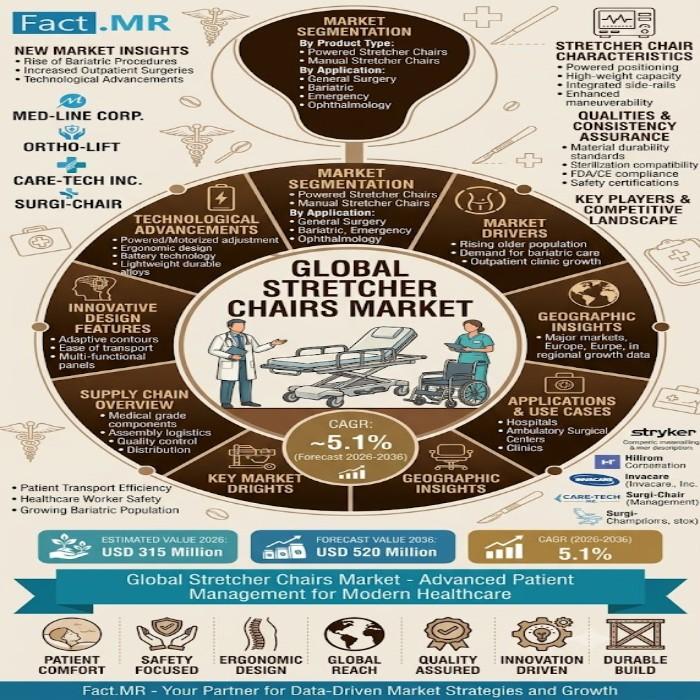
Hospitals are prioritizing patient-transfer efficiency, staff handling requirements and equipment lifecycle costs as convertible stretcher chairs gain relevance in emergency and outpatient care, according to Fact.MR.
NEWARK, Del., October 9, 2026. The global stretcher chairs market is projected to reach USD 493.5 million by 2036, up from USD 265.4 million in 2026, expanding at a compound annual growth rate (CAGR) of 6.4%, according to Fact.MR. The market is expected to generate an incremental opportunity of USD 228.1 million over the forecast period.
Healthcare facilities are reassessing patient transport equipment as emergency departments, diagnostic units and outpatient procedure centres manage movement through increasingly demanding clinical workflows. Stretcher chairs combine seated transport with flat positioning capability, allowing facilities to use a convertible device for selected transfers without switching between separate mobility products.
The commercial opportunity is closely linked to hospital equipment replacement, outpatient procedure growth and demand for equipment that fits within confined clinical spaces. However, longer replacement cycles and pressure on capital budgets continue to influence purchasing decisions.
Get detailed market forecasts, competitive benchmarking, and pricing trends:
Where growth is fastest
Germany leads the six profiled country markets in projected growth, while China and Japan offer opportunities linked to healthcare infrastructure and patient mobility requirements.
- Germany – CAGR 7.2%: Hospital modernization, equipment renewal and attention to patient-handling practices support demand for stretcher chairs.
- China – CAGR 6.9%: Hospital capacity expansion and urban healthcare investment are creating additional demand for patient transport equipment.
- Japan – CAGR 6.6%: An ageing population and compact healthcare facilities support interest in practical patient-transfer equipment.
- United States – CAGR 6.5%: Hospitals and ambulatory surgery centres remain important purchasing channels, with durability and after-sales service influencing selection.
- France – CAGR 6.2%: Public hospital upgrades, private clinic investment and equipment replacement support steady demand.
- Brazil – CAGR 5.8%: Private hospital expansion and emergency care upgrades support demand, although price sensitivity remains a purchasing consideration.
These forecasts suggest that manufacturers should align expansion plans with local procurement conditions. Germany offers the fastest projected growth among the profiled countries, while China presents an opportunity associated with expanding healthcare infrastructure. Suppliers entering price-sensitive markets may need distributor support and affordable product configurations.
What leads the market
Fact.MR identifies five leading segments in its 2026 market assessment.
- Manual stretcher chairs – 43.0% of the product segment: Lower acquisition costs and straightforward use in routine patient transfers support their leading position.
- Patient transport – 39.0% of the application segment: Everyday movement between admission areas, diagnostic rooms, procedure suites and observation spaces remains the largest application.
- Hospitals – 52.0% of the end-user segment: High patient throughput and transport requirements across multiple departments underpin demand.
- Aluminum frames – 46.0% of the material segment: Lightweight handling and corrosion resistance support their use in clinical environments.
- Direct institutional sales – 41.0% of the sales-channel segment: Large healthcare facilities value negotiated purchasing, equipment specifications, warranty arrangements and service support.
These segment shares indicate that basic transport requirements remain commercially important. Advanced electric and bariatric products may serve specialized needs, but suppliers must demonstrate that additional features justify their purchase and maintenance costs.
The hurdle: Slow equipment replacement
The main restraint is the tendency of healthcare facilities to continue using existing mobility equipment until breakdowns or maintenance problems require replacement. Fact.MR also identifies lengthy budget approvals and competition from lower-priced imports as barriers to faster adoption.
Purchasing decisions can involve clinical staff, biomedical engineering teams and finance departments. Each group evaluates different requirements, including handling, cleaning, durability, servicing and acquisition cost. Premium electric and bariatric models face additional scrutiny because their service requirements can be higher.
For manufacturers, demonstrating lifecycle value is therefore as important as offering the right product. Equipment reliability, parts availability and responsive maintenance support can help suppliers distinguish their offerings in price-sensitive tenders.
Industry investment and competitive positioning
The report highlights patient-handling guidance and equipment performance considerations as factors shaping purchasing decisions. The Occupational Safety and Health Administration's Safe Patient Handling guidance, published in 2024, discusses structured patient-handling programmes in healthcare environments. The National Institute for Occupational Safety and Health's About Safe Patient Handling and Mobility, dated May 9, 2024, provides additional context on mobility and patient-handling practices.
The report also references the U.S. Food and Drug Administration's Medical Device Reporting (MDR): How to Report Medical Device Problems, dated March 27, 2025. These sources provide context for the safety, reporting and operational considerations relevant to healthcare equipment. They should not be interpreted as specific mandates requiring the purchase of stretcher chairs.
Fact.MR profiles the following companies in the market:
- GF Health Products, Inc.
- Champion Manufacturing Inc.
- Stryker Corporation
- Winco Mfg., LLC
- TransMotion Medical Inc.
- Novum Medical Products
- Medline Industries, LP
- Merivaara Corp.
- Umano Medical
- Favero Health Projects S.p.A.
Competition spans large medical equipment suppliers and specialist manufacturers. Product durability, ergonomic design, cleaning compatibility and dependable service are important factors in institutional purchasing. The report does not identify dated company acquisitions, partnerships or product launches as key developments for this market; none are added here.
Analyst perspective
Shambhu Nath Jha, Senior Analyst at Fact.MR, said:
“Healthcare equipment purchasers are no longer viewing stretcher chairs as basic mobility products. The stronger opportunity lies in devices that reduce transfers, work within crowded clinical areas, and support staff handling safety. Vendors that can prove durability, easy cleaning, and service reliability will have an advantage over suppliers selling only on price.”
What this means for hospital procurement teams and equipment manufacturers
The market outlook points to three practical priorities for buyers and suppliers.
1. Assess total ownership costs. Procurement teams should compare acquisition prices with maintenance, spare parts, cleaning requirements and expected equipment life. This is particularly relevant when choosing between manual and more complex electric models.
2. Match equipment to clinical workflows. Hospitals should assess how often stretcher chairs will be used across emergency, diagnostic, procedure and recovery areas. Manufacturers can strengthen proposals by demonstrating suitability for the intended workflow rather than relying on broad product claims.
3. Build regional service capability. Suppliers targeting Germany, China and Japan should evaluate distribution, maintenance and parts availability alongside market growth. In Brazil and other price-sensitive markets, rental and refurbished supply channels may provide additional routes to customers with limited capital budgets.
The report's projections suggest that growth will depend not only on healthcare investment but also on whether suppliers can meet practical institutional requirements at an acceptable lifecycle cost.
Unlock 360° insights for strategic decision making and investment planning:
Report details
Fact.MR's Stretcher Chairs Market report examines market size and forecasts for 2026–2036, product types, applications, end users, materials, sales channels, country-level growth and the competitive environment.
Explore More Related Studies Published by Fact.MR Research
General Surgical Devices Market
Rhizoma Gastrodiae Tablets Market
Critical Care Diagnostics Market
Radiation Proctitis Treatment Market
About Fact.MR
Fact.MR is a market research and consulting firm providing syndicated research, customized research, investment research, and market intelligence across a broad range of industries. Its research coverage includes food and beverage, healthcare, pharmaceuticals, biotechnology, consumer products, chemicals and materials, technology, industrial goods, and packaging.
Fact.MR provides market intelligence designed to help organizations understand market dynamics, emerging opportunities, competitive developments, and changing industry requirements.
Media Contact
Fact.MR
Email: sales@factmr.com
Phone: +1 (628) 251-1583
Website: www.factmr.com

 English
 Arabic
 French
 Spanish
 Portuguese
 Deutsch
 Turkish
 Dutch
Dutch
 Italiano
 Romaian
 Portuguese (Brazil)
 Greek
Greek
