


Bone Cement & Glue Market Growth, Company Revenue Share, Key Drivers & Trend Analysis By Fact.MR
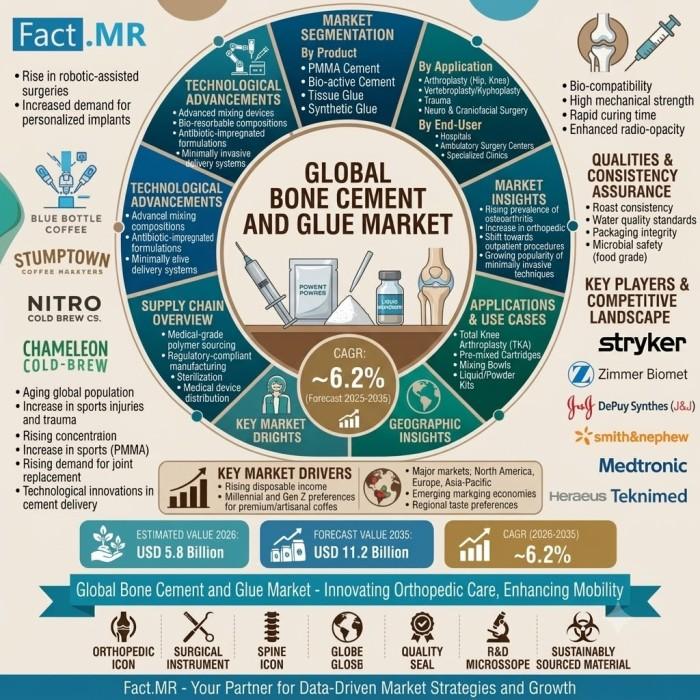
Rising joint replacement volumes, spinal repair requirements and closer scrutiny of fixation reliability are shaping purchasing decisions for orthopedic materials, according to Fact.MR.
NEWARK, Del., October 9, 2026. The global bone cement and glue market is projected to reach USD 3.0 billion by 2036, up from USD 1.7 billion in 2026, expanding at a compound annual growth rate (CAGR) of 6.1%, according to Fact.MR. The market is expected to generate an incremental opportunity of USD 1.3 billion during the forecast period, supported by demand across joint replacement, spinal stabilization, trauma repair and dental bone procedures.
Purchasing decisions increasingly depend on material handling, curing behavior, fixation performance and infection-risk management. Hospitals and orthopedic specialists are assessing these characteristics alongside product documentation, supplier support and availability. The shift creates opportunities for manufacturers that can demonstrate consistent material performance while meeting the cost and procurement requirements of healthcare facilities.
Get detailed market forecasts, competitive benchmarking, and pricing trends:
Where growth is fastest
China and India lead the country-level outlook, while Germany represents a measured European growth opportunity.
- China – CAGR 9.2%: Hospital expansion and wider access to orthopedic procedures support demand for materials used in joint replacement and spinal repair.
- India – CAGR 8.4%: Rising trauma-care demand and expanding private orthopedic capacity support market growth. Price sensitivity remains a key purchasing consideration.
- United States – CAGR 6.4%: Joint replacement, spinal care and trauma procedures provide an established demand base. Clinical documentation and dependable inventory support influence supplier selection.
- Germany – CAGR 5.8%: Established orthopedic infrastructure, structured hospital purchasing and demand for documented material performance underpin growth.
- Brazil – CAGR 5.6%: Private hospital investment, joint replacement and trauma repair support demand, although affordability remains important.
- Japan – CAGR 3.4%: Aging-related orthopedic procedures and continued demand for joint and spinal care support a more moderate growth trajectory.
China's projected growth rate exceeds the global market CAGR by 3.1 percentage points. For suppliers planning geographic expansion, the difference highlights the importance of evaluating local procedure access, purchasing capacity, regulatory requirements and distribution support.
What leads the market
Bone cement and polymethyl methacrylate remain central to demand, reflecting their established use in orthopedic procedures. Fact.MR identifies five leading segments for 2026.
- Bone cement – 60.0% share: Implant fixation and vertebral repair support its position as the leading product type.
- Polymethyl methacrylate (PMMA) cement – 48.0% share: Longstanding clinical use and surgeon familiarity support its leading position by material.
- Arthroplasty – 46.0% share: Hip and knee replacement procedures make joint reconstruction the largest application segment.
- Hospitals – 58.0% share: Complex orthopedic, spinal and trauma procedures sustain hospitals' leading position among end users.
- Direct institutional sales – 43.0% share: Supplier contracts, product documentation and clinical support favor direct relationships with healthcare institutions.
These segment shares show why procurement reliability matters. Hospitals require consistent product availability for scheduled procedures, while surgical teams need materials with predictable working and curing characteristics. Manufacturers must balance these requirements with pricing and documentation obligations.
The hurdle: Cost, clinical risk and adoption barriers
High procedure costs and concerns about material performance can slow adoption. New formulations require appropriate safety evidence, biocompatibility evaluation and surgeon confidence before broader clinical use. Reimbursement gaps in some markets can also limit demand for premium products.
Material selection is particularly important where implant fixation, revision concerns or infection management influence clinical decisions. Hospitals may hesitate to change suppliers when surgical teams are familiar with an established product. Manufacturers entering new accounts therefore need to demonstrate product consistency, provide relevant documentation and support clinical teams with appropriate training.
Industry investment and regulatory considerations
Regulatory documentation and postmarket monitoring are important considerations for suppliers serving hospitals and surgical centers. The Fact.MR report references the following frameworks and publications:
- U.S. Food and Drug Administration (FDA), Medical Device Reporting (MDR): How to Report Medical Device Problems, March 27, 2025. The report cites this guidance in the context of postmarket monitoring and supplier traceability.
- European Commission, Medical Devices Sector, 2024. The report references the European medical-device framework in discussing patient safety, device performance and product evaluation.
- ISO 10993, Biological Evaluation of Medical Devices, 2024 reference. The report identifies biological evaluation as an important consideration for materials that come into contact with bone and tissue.
- ISO 13485 quality management systems: The report also discusses quality systems in the context of medical-device manufacturing and supplier qualification.
These references provide regulatory and quality context rather than evidence of a specific new regulatory deadline for bone cement or glue.
Competitive landscape
Fact.MR profiles the following companies in its analysis:
Exactech, Inc.; Teknimed; Arthrex, Inc.; CryoLife, Inc.; Stryker Corporation; DJO Global, Inc.; Heraeus Medical LLC; Cardinal Health, Inc.; Smith & Nephew PLC; DePuy Synthes; Trimph Pty Ltd; and Zimmer Biomet Holdings, Inc.
Competition reflects differences in formulation consistency, curing behavior, antibiotic-loading capabilities, surgeon familiarity and access to hospital purchasing contracts. Established suppliers benefit from clinical familiarity and existing institutional relationships, while smaller suppliers may compete through pricing, specialty applications and regional distribution.
The report page does not identify specific, dated company product launches, partnerships or acquisitions for this market. No such developments are attributed to the profiled companies in this release.
Analyst perspective
Shambhu Nath Jha, Senior Analyst at Fact.MR, notes:
“Bone cement and glue demand is no longer tied only to more orthopedic procedures. The stronger shift is toward fixation reliability, controlled handling, and infection-risk management. Suppliers that can prove clinical consistency, surgeon support, and material safety will hold a better position than companies competing only on availability.”
What this means for hospital procurement teams and medical-device manufacturers
1. Assess total purchasing requirements. Hospitals should compare product pricing with documentation, training, traceability and inventory support. A reliable supply arrangement is particularly important when cement availability affects scheduled orthopedic procedures.
2. Align formulations with intended applications. Procurement teams should evaluate material characteristics against clinical requirements and the intended procedure. Manufacturers should communicate relevant product documentation and handling requirements without making unsupported performance claims.
3. Prioritize markets using both growth and access indicators. China and India offer the highest projected country growth rates in the report. Suppliers considering expansion should also assess local purchasing budgets, distribution capabilities, regulatory requirements and the availability of clinical support.
Unlock 360° insights for strategic decision making and investment planning:
Report details
Fact.MR's Bone Cement & Glue Market report examines market size and forecasts from 2026 to 2036, with analysis by type, material, application, end user, sales channel, region and country. The study also evaluates competitive positioning, demand drivers, adoption barriers and market opportunities.
Explore More Related Studies Published by Fact.MR Research
General Surgical Devices Market
Rhizoma Gastrodiae Tablets Market
Critical Care Diagnostics Market
Radiation Proctitis Treatment Market
About Fact.MR
Fact.MR is a market research and consulting firm providing syndicated research, customized research, investment research, and market intelligence across a broad range of industries. Its research coverage includes food and beverage, healthcare, pharmaceuticals, biotechnology, consumer products, chemicals and materials, technology, industrial goods, and packaging.
Fact.MR provides market intelligence designed to help organizations understand market dynamics, emerging opportunities, competitive developments, and changing industry requirements.
Media Contact
Fact.MR
Email: sales@factmr.com
Phone: +1 (628) 251-1583
Website: www.factmr.com

 Arabic
 French
 Spanish
 Portuguese
 Deutsch
 Turkish
 Dutch
Dutch
 Italiano
 Russian
 Romaian
 Portuguese (Brazil)
 Greek
Greek
